How Charities Can Use AI Effectively
Without Compromising Trust, Ethics, or Social Impact.
Introduction: Why AI Matters for Charities Now
Artificial intelligence (AI) is rapidly becoming part of everyday operations in the charity sector. Charities face intense cost pressures, higher donor expectations for personalised communication, and ongoing staff shortages. In this landscape, AI offers a way to do more with less – automating routine tasks, uncovering insights in data, and engaging supporters at scale.
Crucially, AI is an enabler for charity teams, not a replacement for the human empathy and compassion that drive charitable work. When used thoughtfully, AI can free up staff time and stretch budgets further, without sacrificing the personal touch that donors and beneficiaries value. Importantly, as charities embrace AI, they must also address trust, ethics, and transparency from the start. Donors need to know that new tech is being used responsibly. Whether it’s an AI suggesting a donation amount or a chatbot answering questions, transparency and ethical guardrails are key.
By taking a responsible approach – being open about AI use, protecting data privacy, and keeping humans in control – charities can adopt AI confidently and maintain the trust that underpins all fundraising and service delivery. In short, AI matters for charities now because it can amplify impact during challenging times, but it must be implemented in a strategic, reassuring, and ethical way.
What “Using AI” Actually Means for Charities
When we talk about “using AI,” it isn’t about robots taking over or computers magically solving problems. For charities, AI usually refers to software and algorithms that learn from data or mimic human decision-making in specific tasks. It’s helpful to break it down:
- Automation vs. AI: Automation often means using rules or software to handle repetitive tasks (like scheduling emails or sorting data). AI, on the other hand, involves machines “learning” patterns or making predictions. For example, an AI tool might analyse donor data and predict who is likely to donate again. The key difference is that AI can improve and adapt its outputs based on data, rather than just following preset rules.
- Generative AI: This is a subset of AI that creates new content. Tools like ChatGPT can generate text (for instance, drafting a thank-you letter), and image AIs can create pictures or designs from prompts. Generative AI has grabbed headlines because it can produce human-like content, but it’s just one part of the AI spectrum.
In reality, most charities are already using AI without realising it. If your organisation uses spam filters in email, recommendation features in your donor database, or social media platforms to target posts, you’re using AI. Common examples in the charity sector include:
- Chatbots on websites or Facebook Messenger that answer supporter FAQs (using natural language AI to understand questions).
- Email marketing tools that personalise subject lines or send times based on past open rates (using machine learning to improve engagement).
- Donation forms that auto-suggest giving amounts or timings for recurring gifts (using predictive analytics to optimise donations).
- Analytical dashboards that highlight trends in donations or program data (often powered by AI under the hood).
In other words, “using AI” can be as simple as leveraging features in software you already have. It doesn’t require a robot or a data scientist in the office. It means taking advantage of advanced tools, often built into everyday platforms, that can help your charity work smarter and more efficiently. Understanding this helps demystify AI: it’s not magic or sci-fi, but a natural extension of the digital tools charities have been gradually adopting for years.
Practical Ways Charities Can Use AI Today
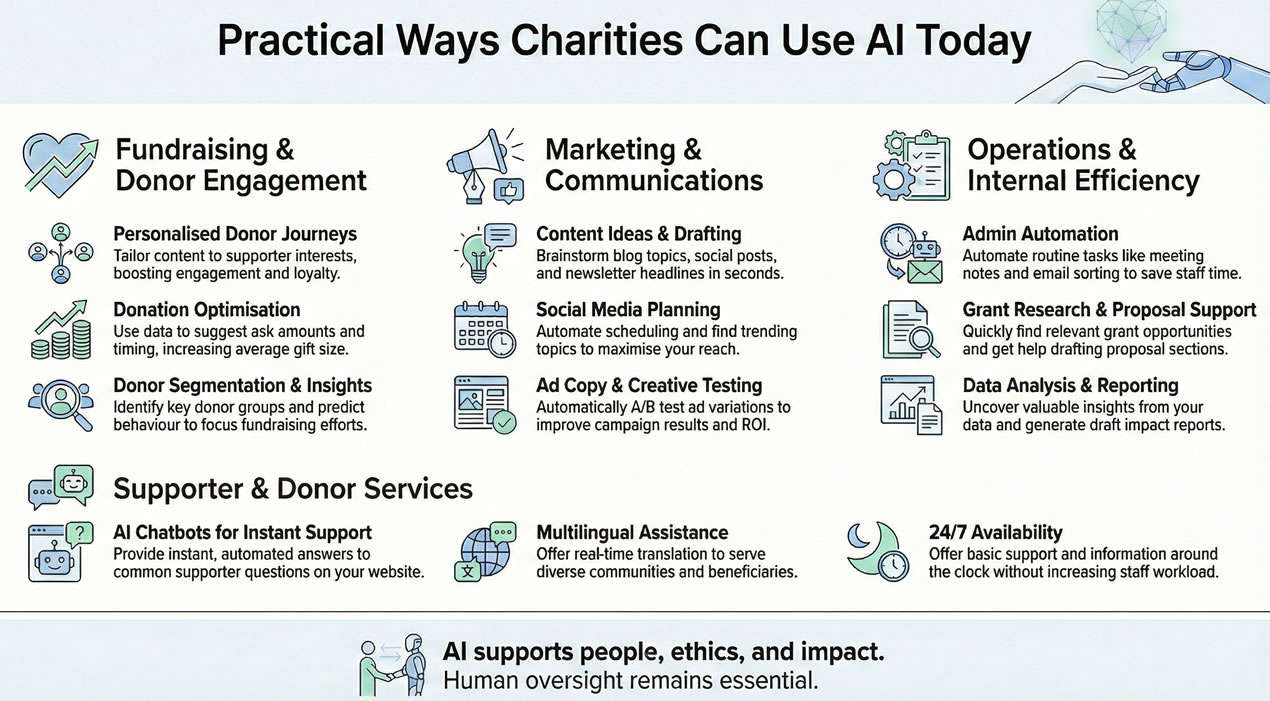
AI isn’t a distant future technology; there are many practical applications that charities of all sizes can implement right now. Below, we break down how AI can support key areas of charitable work, with concrete examples:
A – Fundraising & Donor Engagement
- Personalised Donor Journeys: AI can help customise the experience each donor has with your charity. For instance, algorithms can segment donors by their interests and behaviours, then automatically send each group content that resonates with them. A donor who often supports healthcare projects might get stories and updates about medical programs, whereas an events-driven donor might receive invitations to local fundraisers. This tailored approach makes supporters feel seen and valued, increasing their engagement and loyalty.
- Donation Optimisation: Ever wonder what the best time or amount is to ask for a donation? AI can crunch historical donation data to find patterns, answering questions like “What time of month are donors most likely to give?” or “Which donors might upgrade to a monthly gift?” Some fundraising platforms use AI to suggest the optimal ask amount for each donor on a web form. For example, if a donor usually gives £20, the form might highlight a £25 option as a gentle upsell. Charities have found these AI-driven prompts can boost conversion rates and average gift size, all while keeping donors comfortable. Importantly, AI can also identify when not to ask – preventing donor fatigue by avoiding poorly timed appeals.
- Donor Segmentation and Insights: AI is excellent at finding patterns that humans might miss. Non-profits can use AI analytics to segment donors into meaningful groups (e.g. “long-term supporters who have decreased giving recently” or “social media followers likely to become first-time donors”). These insights allow fundraisers to target outreach better, such as sending a re-engagement campaign to lapsed donors identified by the AI. Predictive models can even score which donors are most likely to respond to a campaign or which major donors might be interested in a particular project, helping fundraising teams prioritise their efforts. By augmenting human intuition with data-driven predictions, charities can focus their relationship-building where it will have the most impact.
B – Marketing & Communications
- Content Ideation and Drafting: Staring at a blank page is always a challenge. AI writing assistants (like ChatGPT or other copywriting tools) can serve as a creative partner for busy charity communicators. You can ask these tools to suggest social media post ideas for an upcoming awareness day, draft a first version of a blog article about your cause, or even come up with newsletter headlines. This can jump-start the creative process and save time. For example, an AI might generate five different angles for a story about your beneficiaries – giving your team a head start. Always remember to edit and fact-check AI-generated text (to add the authentic human touch and ensure accuracy), but as a brainstorming and drafting aid, these tools are incredibly useful for small teams.
- Social Media Planning: AI tools can analyse engagement data to help you plan more effective social media schedules and content. They might determine the best times to post on different platforms for maximum visibility, or even recommend trending topics and hashtags related to your cause. Some tools can automatically repurpose a piece of content across multiple channels – for instance, turning a blog post into a series of tweets or a script for a short video – optimising each format using learned best practices. By leveraging AI in planning, charities can maintain a consistent, active social presence without investing huge amounts of staff time in manual analytics and scheduling.
- Ad Copy and Creative Testing: Charities that use digital advertising (like Google Ads, Facebook Ads, etc.) can harness AI to improve their campaign performance. AI can rapidly generate and test multiple versions of ad copy or visuals to see what works best. For example, an AI might create a few variations of a Facebook ad headline for your fundraising campaign, and then automatically A/B test them to find which one gets the most clicks or donations. AI-driven image tools can also help create engaging visuals or edit photos (for example, automatically enhancing images or even generating simple graphics). All this means your marketing becomes more data-driven and efficient – the AI helps identify the most effective messages, so you can get better results from modest ad budgets. It’s like having a built-in optimisation expert tweaking your campaigns 24/7.
C – Operations & Internal Efficiency
- Administrative Automation: A lot of charity staff time goes into routine admin – scheduling meetings, compiling reports, sifting through emails. AI can step in here to lighten the load. For instance, meeting assistant AI tools can automatically transcribe meetings, pick out action items, and draft summary notes. Instead of someone spending an hour writing up minutes, the AI provides a first draft that a staff member can quickly polish. Similarly, AI can prioritise your emails or even draft responses to common inquiries (ready for a human to review). In finance or HR, AI might help by flagging anomalies in budgets or timesheets that need attention. These automations add up to significant time saved, letting your team focus on high-value work like strategy, donor relationships, and service delivery.
- Grant Research and Writing Support: Finding and winning grants is vital but laborious. AI tools can streamline parts of this process. For research, AI engines can scan huge databases of grant opportunities and filter them based on your charity’s profile – highlighting, say, the top 10 funding opportunities that best match your education program’s goals. This can replace hours of manual Googling. When it comes to writing proposals, AI won’t replace your expert knowledge, but it can help draft sections of a grant application or format answers for different funder portals. For example, if each grant application asks slightly different questions, an AI tool can adapt your base proposal to each format, saving copy-paste time. It can also check that your language aligns with the funder’s priorities (by analysing the funder’s own materials). Humans still need to craft the narrative and ensure the heart of the proposal is there, but AI can handle the menial parts of grant writing – allowing your fundraising staff to focus on strategy and storytelling.
- Data Analysis & Reporting: Charities collect a lot of data (from programme outcomes, surveys, donor databases, etc.), but making sense of it can be challenging. AI-powered analysis tools can quickly highlight trends and insights without needing a full-time data analyst. For example, an AI system might sift through years of beneficiary feedback forms and reveal that a particular region’s needs have shifted, or that one type of intervention consistently reports higher satisfaction. In terms of reporting, AI can auto-generate draft reports by pulling together key stats and even writing narrative explanations. Imagine getting a draft of your quarterly impact report or an infographic of your annual outcomes with minimal human effort – then your team just fine-tunes it. Moreover, AI can help forecast outcomes, like predicting how a small change in strategy might improve service delivery, giving charities a sort of decision support tool. All of this makes operations more evidence-based and proactive.
D – Supporter & Donor Services
- AI Chatbots for Instant Support: Providing timely responses to supporters and beneficiaries is critical, but charities often can’t staff phones or chat 24/7. AI chatbots can fill this gap. Deployed on your website or messaging apps, a well-designed chatbot can handle frequently asked questions at any hour. For example, a donor might ask, “How do I get a donation receipt?” or “Where does my money go in this project?” – the chatbot can instantly provide the answer. Modern AI chatbots understand natural language and can cover a wide range of queries if trained on your organisation’s information. This improves the supporter experience by not making them wait for an email reply, and it frees staff from answering the same basic questions repeatedly. Importantly, a good AI chatbot will seamlessly hand over to a human if the question is complex or sensitive (ensuring that personal, human service is there when it really matters).
- Multilingual Support: Charities working with diverse communities or in international contexts face language barriers – and AI can help bridge them. AI translation tools can be integrated into chatbots or customer service workflows, allowing supporters to receive information in their preferred language. For instance, a charity helpline could use AI to instantly translate a Spanish message from a beneficiary into English for a staff member, and then translate the reply back to Spanish. This kind of real-time translation opens access for non-English speakers without needing an in-house translator for every language. It’s particularly valuable for refugee services, global campaigns, or even local charities in multicultural cities. By using AI in this way, charities demonstrate inclusivity and respect for supporters’ and service users’ language needs.
24/7 Availability Without Extra Staff Costs: Unlike humans, AI systems don’t sleep. Once set up, they can provide basic services continuously. This means a donor can get help with their online donation at midnight via a chatbot, or a beneficiary can access resources on a weekend through an AI-powered FAQ search. Small charities especially benefit, because it levels the playing field – you might not have a call centre, but a decent AI service can make it feel to a user like you’re always “open”. This round-the-clock availability can increase donations (no lost donors due to frustration after office hours) and ensure those in need get information when they need it. The key is to use AI for what it’s good at (simple queries, guidance, form-filling assistance) and have clear pathways to manage expectations for what requires waiting for a human (like detailed case support or complex problems). When balanced right, supporters get convenience and responsiveness, while staff aren’t stretched to burnout trying to be available all the time.
AI Tools Available to Charities (Realistic & Useful)
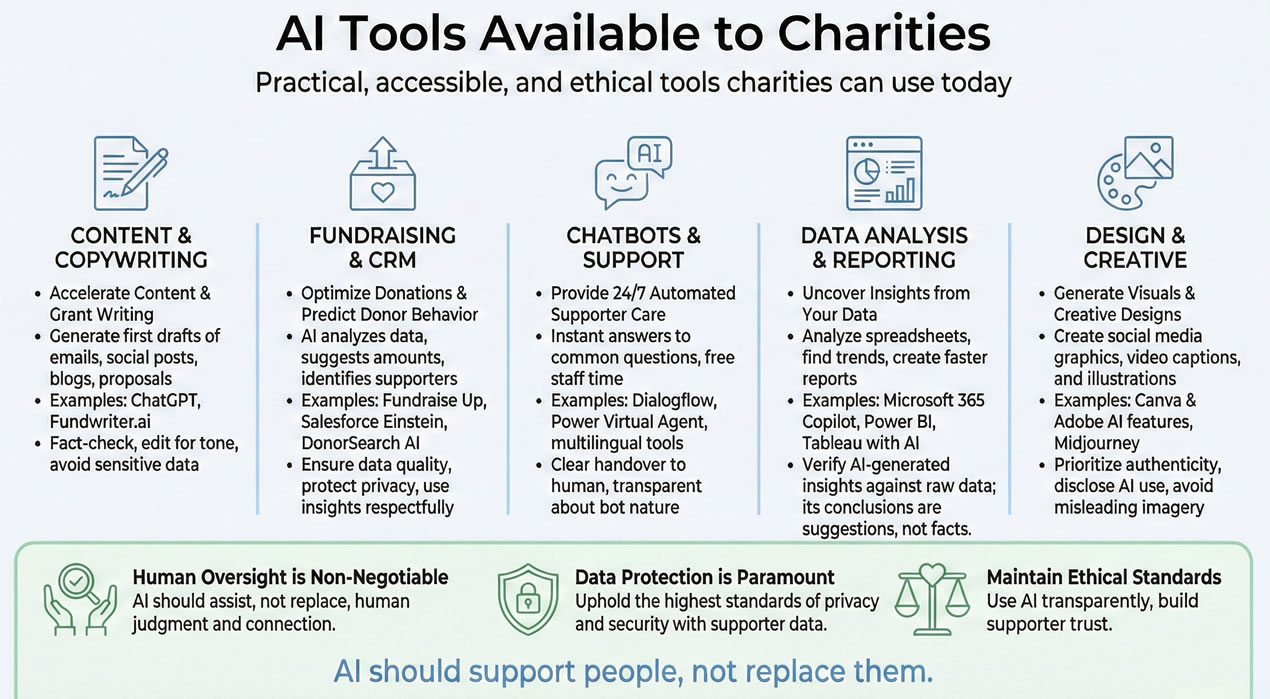
There’s a dizzying array of AI tools out there, but which ones are actually practical for charities? Below is a curated selection of tools and platforms, grouped by their purpose. These are tools that charities (even with limited tech expertise) can realistically adopt to boost their work. We’ll also note why each is useful and any ethical or data considerations to keep in mind:
A – Content & Copywriting Tools
1 – ChatGPT (OpenAI): A general-purpose AI chatbot that can generate text, answer questions, and brainstorm ideas. Charities can use ChatGPT to draft newsletter articles, social media posts, thank-you letters, or blog content. It’s extremely user-friendly – you just type a question or request, and it produces a written response.
Why useful: It’s like having a virtual copywriting assistant available at any time, which is great for small communications teams.
Considerations: ChatGPT’s answers aren’t guaranteed to be factually correct or perfectly aligned with your tone, so you must fact-check and edit the outputs. Also, avoid sharing sensitive or personally identifiable data in your prompts, since the tool is cloud-based.
2 – Fundwriter.ai: An AI writing tool designed specifically for non-profits and fundraisers. It has templates and training around storytelling, grant proposals, fundraising emails, and campaign messages.
Why useful: It can save time by generating first drafts of grant applications or donation appeal letters, complete with persuasive language and calls-to-action geared for charity audiences. This can help even novice writers produce solid drafts.
Considerations: It’s there to assist with speed and structure, but the heart of the message should still come from your team. Human refinement is needed to add genuine emotion and ensure the content truly reflects your charity’s voice and values.
B – Fundraising & CRM Intelligence
1 – Fundraise Up: A donation platform that uses AI to increase online giving. It offers smart features like suggesting optimal donation amounts (based on what similar donors have given) and timing prompts for recurring donations.
Why useful: Fundraise Up has shown it can lift conversion rates – for example, many donors will choose a suggested gift amount if it’s presented compellingly, and charities have seen higher average donations as a result. It’s fairly easy to integrate into your website and works for charities of all sizes.
Considerations: While AI suggestions can boost revenue, ensure the suggested amounts remain respectful (not pushing people beyond their means) and that donors always have easy opt-outs. Transparency is key; some charities using such tools explain that suggestions are based on data insights aimed at helping the cause, which can reassure donors.
2 – CRM AI Features (Salesforce Einstein, Blackbaud Intelligence, etc.): If your organisation uses a donor CRM or database, check if it has built-in AI analytics. Many modern CRM systems offer AI modules that can predict donor behaviour or automate tasks. For example, Salesforce Nonprofit Cloud has “Einstein” AI that can forecast which supporters are likely to become major donors or which volunteers might be good fundraiser candidates.
Why useful: These features can surface valuable insights from your existing data with minimal effort – essentially pointing your team in the right direction.
Considerations: The accuracy of predictions depends on the quality of your data. If your data is patchy, the AI insights might not be reliable. Also, be mindful of privacy – use these predictions internally and ethically, not to “judge” donors but to better support and engage them.
3 – Predictive Analytics Services (e.g. DonorSearch AI, Gravyty): There are specialised services and software that analyse donor data (wealth indicators, past giving, engagement metrics) to help identify high-potential donors or recommend who a fundraiser should call today.
Why useful: They can dramatically improve major gift fundraising efficiency by ensuring no important supporter “falls through the cracks”. These tools might, for instance, flag that Jane Doe has a high capacity and just interacted with your newsletter, suggesting a personal follow-up.
Considerations: These services often rely on combining your donor data with external data (like wealth screenings). Charities should ensure they are compliant with data protection laws and ethical in how they use such insights – donors shouldn’t feel “spied on”. It’s wise to use these tools to enhance personal outreach, not as a substitute for building genuine relationships.
C – Chatbots & Supporter Support
1 – AI Chatbot Platforms (e.g. Microsoft Power Virtual Agent, Google Dialogflow, IBM Watson Assistant): These are services that let you build a custom chatbot for your website or social media without heavy coding. You provide the common questions and answers (like an FAQ), and the AI handles understanding the user’s phrasing and pulling the right answer.
Why useful: A well-implemented chatbot can handle a large volume of routine inquiries – “How do I update my address?”, “What does this charity do?” “When is the next event?” – saving staff time and providing instant responses. This is especially useful for supporter care and event participant queries.
Considerations: Always program the chatbot to recognise when it can’t help and hand off to a human or give contact info. Also, clearly indicate that it’s a virtual assistant (e.g. “Hi, I’m an automated assistant, here to help”) so users aren’t misled. Keep the content updated, and monitor chatbot logs to see if it’s failing to answer certain questions – AI chatbots learn over time, but only if you feed them the right info.
2 – Salesforce Agentforce (Einstein Bots): If your charity uses Salesforce for CRM, Agentforce is an AI chatbot that integrates with your data. It can help both internally (staff asking the bot for CRM help) and externally (answering supporter questions by pulling knowledge from your records).
Why useful: Because it ties directly into your existing systems, it can provide personalised answers – for example, a donor could query the chatbot for their donation history or the status of a donation receipt, and the bot can retrieve that securely. It’s also convenient as it doesn’t require adding a separate platform if you’re already on Salesforce.
Considerations: Integration needs to be set up carefully, with attention to data permissions (you wouldn’t want a general user to get someone else’s data). Also, ensure you have an AI usage policy in place, since connecting AI to live donor data means you must be extra cautious about privacy and accuracy.
3 – Multilingual Chat and Translation Tools: Platforms like Google’s Cloud Translation API or the features in Intercom/Zendesk can automatically translate chat conversations on the fly.
Why useful: They enable your support team to communicate with supporters and service users in dozens of languages without needing multilingual staff for each language. This can significantly widen your reach and make non-English-speaking stakeholders feel valued and heard.
Considerations: Machine translation has improved, but it’s not perfect. For critical or sensitive conversations, have a native speaker review or double-check important messages. Also, be transparent if an important message (like terms and conditions, consent forms, etc.) is translated by AI – you may need professional translation for legally or culturally sensitive content to ensure nothing gets lost.
D – Data Analysis & Reporting
1 – Microsoft 365 Copilot (and similar AI assistants): Microsoft’s AI “Copilot” integrates with tools like Excel, Word, and PowerPoint. It can analyse data in a spreadsheet and answer natural language questions about it, or draft a summary of a Word document, or create a starter slide deck from notes.
Why useful: For charities already using Microsoft 365, this adds a powerful layer to everyday tools. You could, for example, ask Excel, “Which fundraising event raised the most net income in 2025?” and get an answer without manual formulas. Or have Word generate a first draft of your annual report narrative based on key points you list. It’s a big productivity booster for reporting and analysis tasks that normally eat up staff time.
Considerations: These AI features work with your internal data, so they should respect your privacy by design (Microsoft has pledged enterprise-level privacy for Copilot). However, ensure any cloud AI features you use are covered in your data agreements and that staff are trained to verify AI-generated insights. If Copilot creates a chart or a statement, double-check it against the raw data – think of it as an eager assistant that might occasionally misinterpret things.
2 – Business Intelligence (BI) Tools with AI (Power BI, Tableau): Many BI dashboard tools now have AI-driven insight generation. For instance, Power BI can run algorithms on your data to detect outliers or suggest reasons “why” a number changed. Tableau has an “Explain Data” feature using AI.
Why useful: These help non-analysts get advanced insights. Instead of just seeing that donations were 20% lower in June, the AI might point out, “Donations dropped because a major campaign from last year didn’t recur this June”. It can highlight correlations or segments automatically. This guides your team to ask the right questions and make data-backed decisions faster.
Considerations:AI insights are suggestions to explore, not absolute truths. They can sometimes find spurious correlations (e.g. linking unrelated data oddly), so use them as a starting point for investigation. Also, maintain strong data governance – the AI is only as good as the data quality, so keep your databases clean and updated.
3 – AI for Monitoring and Evaluation: Special mention for tools that help with programme data analysis – for instance, AI platforms that aggregate field reports, social media sentiment, or beneficiary feedback. They can quickly categorise text feedback (using natural language processing to tag comments as positive/negative or by topic) and even detect emerging trends or urgent issues.
Why useful: For charities that need to report on impact or adjust programming on the fly, this kind of AI digest can be invaluable. You get a pulse of what’s happening without reading hundreds of reports manually.
Considerations: Ensure that any AI doing this analysis is unbiased – if the training data isn’t diverse, it might misinterpret colloquial or culturally specific feedback. And of course, keep personal data anonymous in such analyses to respect privacy.
E – Design & Creative Tools
1 – Canva and Adobe Creative AI Features: Design platforms like Canva (widely used by charities for its simplicity) have introduced AI-powered features. Canva’s “Magic Design” can generate design layouts automatically – for example, you input a few images and text, and it will produce a selection of polished poster designs to choose from. Adobe’s tools (Photoshop, Premiere, etc.) have Adobe Sensei AI that can do tasks like smart image retouching, auto-generating image backgrounds, or transcribing and captioning videos.
Why useful:These features let a non-expert create high-quality visuals and multimedia in a fraction of the time. Need a quick social media graphic? Canva’s AI can suggest a great starting design. Have hours of interview footage? An AI video tool can identify the best clips and even create subtitles automatically. This lowers the cost and skill barrier for producing professional-looking content to support your campaigns.
Considerations: Design AI can save time, but be wary of using any imagery whose origin you don’t fully understand the origin of. If an AI suggests a stock photo or generates an illustration, ensure it aligns with your authenticity and consent standards. For instance, avoid using AI-created images of “people in poverty” that aren’t real – they may carry stereotypes (more on that later). And as always, review everything; an AI might format something oddly or miss a local nuance that a human designer would catch.
2 – Midjourney (AI Image Generator): Midjourney is an AI tool that creates images from text prompts – you describe what you want, and it produces a unique image. Some charities have experimented with tools like this to generate illustrations for blog posts or conceptual art for campaigns.
Why useful: It can be inspiring and cost-effective. If you don’t have a budget for a graphic designer or photographer, AI can produce a pretty illustration or abstract art related to your cause (for example, “a hopeful painting of a tree growing from a book” for an education campaign). It’s also useful for rapid prototyping of ideas – you can visualise concepts to share with your team or supporters.
Considerations:Using AI-generated images in external communications is tricky. First, disclosure and honesty – if you present an AI image as if it were a real photo, that could be misleading and erode trust. Also, AI models have been known to produce culturally insensitive or stereotypical outputs if asked for images of certain situations (e.g. disaster scenes or poverty contexts). Always vet the images carefully and consider the ethical implications. They should supplement, not replace, genuine photos of your work. A safe use might be decorative graphics or illustrations, rather than anything purporting to show real beneficiaries.
In summary, plenty of AI tools are ready and available to help charities in content creation, fundraising, support, data analysis, and design. The best approach is to start with one or two tools in areas where your organisation has a clear need, and gradually build confidence. Remember the ethical considerations with each tool: fact-check content, protect donor data, be transparent, and don’t compromise on your values or message just because a tool makes something easy. With those safeguards in place, these tools can be game-changers for productivity and impact.
How NOT to Use AI in Charities
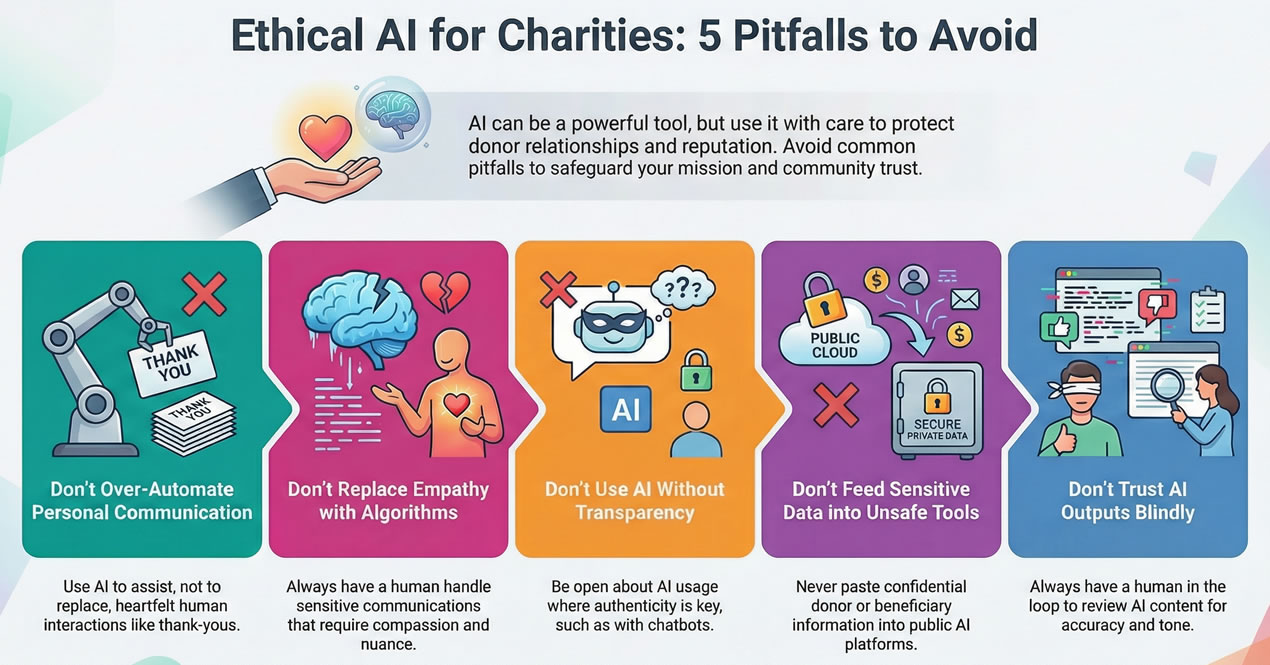
As powerful as AI can be, there are pitfalls to avoid. Implementing AI without care can backfire and harm your relationships or reputation. To ensure AI remains a positive force, charities should avoid these common mistakes:
1 – Over-automating donor communication
It’s a mistake to let AI send communications that really call for a human touch. For example, automatically generating and sending generic thank-you emails or responses to sensitive supporter messages can come off as tone-deaf. Donors notice when a message lacks personal warmth. Avoid using AI to replace heartfelt one-to-one interactions – use it to assist, not fully automate, your donor thank-yous and condolences. The goal is to enhance what your team can do, not to make every interaction robotic. If a loyal donor gets a birthday message that reads as if it came from a machine, you risk alienating the very people who sustain your mission.
2 – Replacing empathy with generic AI responses
Charities deal with human stories and often with people in vulnerable situations. An AI lacks real empathy or ethical judgment. If someone shares an emotional story on your Facebook page, a canned AI reply might come across as uncaring or inappropriate. Don’t let AI respond to complex emotional or crises on its own. Always have human oversight for communications that require compassion, nuance, or moral decision-making. In practice, this means setting clear limits on your chatbot – e.g. if a conversation mentions grief, trauma, or anger, it should flag a human to step in. Mission-driven work runs on empathy; no algorithm can substitute for that.
3 – Using AI without transparency
Trust is the currency of the nonprofit world. If your community finds out you’ve been using AI in a way that wasn’t clear to them, they might feel deceived. For instance, if you publish an article or report heavily written by AI and it contains mistakes, stakeholders could question your transparency and authenticity. Always be open when appropriate – you don’t need a banner saying “This email was written with AI help”, but do disclose AI usage in contexts where authenticity is paramount. If you use AI-generated images, consider captioning them as illustrations. If an AI chatbot is chatting with donors, make sure it introduces itself as a virtual assistant. Honesty about AI use prevents any sense of secrecy. Most people will understand the use of productivity tools if you explain how it benefits the cause, but they will not forgive feeling misled.
4 – Feeding sensitive data into unsafe tools
One of the biggest risks is accidentally compromising privacy or security when using AI. Free or public AI tools (like the free version of ChatGPT) may store the data you input, which is problematic if that includes donor information or personal details. Never paste confidential data (donor names, emails, case details) into an AI tool unless you are sure of its privacy policy and data handling. Even then, anonymise data if possible. For example, instead of asking ChatGPT, “Write a profile for our donor Jane Doe who lives in Manchester and has cancer”, you could ask it generally about “a supporter who benefited from our cancer program in a big city”. Be especially cautious with cloud-based AI services – ensure they comply with GDPR or relevant regulations, and ideally use enterprise versions that offer data privacy guarantees. The bottom line: protect your donors’ and beneficiaries’ data as zealously when using AI as you do in any other context.
5 – Blindly trusting AI outputs without human review
AI can and will make errors or odd recommendations – it might fabricate a statistic, misinterpret a question, or produce wording that doesn’t fit your audience. A critical mistake is to assume the AI is always right. For example, letting an AI auto-post content on your website or social media without a human check is asking for trouble. There have been cases of AI chatbots giving factually wrong or insensitive answers. Always have a human in the loop to review and approve AI-generated content or decisions. Treat AI’s work as a first draft or a suggestion. If an AI flags a donor as high-value, have a person verify that with context. If it drafts a blog post, have a person edit every paragraph for accuracy and tone. By keeping human oversight, you catch mistakes and avoid embarrassing or harmful situations before they go public.
In summary, misuse of AI can damage donor trust, cause PR issues, or even harm the people you serve. Charities should use AI as a supporting tool, not an unchecked actor. By staying vigilant about these “don’ts” – not over-automating, preserving empathy, being transparent, safeguarding data, and maintaining human oversight – you can steer clear of the major pitfalls and ensure AI serves your mission ethically.
Best Examples of AI Used Well in Charities
Many charities are already harnessing AI in innovative, responsible ways. Here are some real (and inspiring) examples of AI being used to enhance impact without losing the human touch:
1 – AI-Powered Donor Segmentation at Charity Water
The nonprofit Charity: Water uses machine learning to analyse its donor database and find patterns. By segmenting donors based on their giving history and interests, they tailor communications to each group. This targeted approach – for example, sending different project updates to major donors vs. one-time donors – has improved engagement. Donors receive stories and asks that genuinely match what they care about. The result is higher response rates and more funding for clean water projects, all achieved with AI doing the heavy data lifting so staff can focus on crafting the right message.
2 – UNICEF’s U-Report Chatbot for Youth Engagement
UNICEF tapped into AI through a chatbot called U-Report, which engages young people around the world via SMS and social platforms. U-Report uses simple AI rules to collect opinions on social issues (education, health, etc.) by chatting in multiple languages. Millions of youths have participated, giving UNICEF real-time insights into their needs and viewpoints. In return, the youngsters feel heard and involved in UNICEF’s mission. This two-way engagement has led to better-designed youth programs and also increased UNICEF’s support base as U-Reporters often become campaign advocates. AI enabled UNICEF to scale this outreach to global levels, something that would be impossible to do manually with the same speed.
3 – American Red Cross “ARC Bot” for Blood Donations
The American Red Cross implemented an AI-driven chatbot (nicknamed “Hero”) on its blood donation website. The chatbot answers common questions about blood donations and eligibility criteria, and helps people find nearby blood drives. Since launching, it has significantly eased the process for potential donors – for instance, someone can quickly ask, “Can I donate if I travelled recently?” and get an instant answer any time of day. By lowering the information barrier and anxiety around donating, the Red Cross saw an uptick in donor turnout. The chatbot also frees up staff and volunteers from fielding thousands of repetitive calls, allowing them to focus on running donation events and personal follow-ups for critical cases. This is AI improving service efficiency and user experience hand-in-hand.
4 – Movember Foundation’s Campaign Optimisation
Movember (the charity behind the men’s health moustache campaign each year) uses AI to analyse past fundraising campaign data. They trained algorithms on years of fundraising results to find what factors led to the most successful peer-to-peer fundraising efforts (for example, looking at email wording, event timing, social media tactics). With these insights, Movember provides personalised advice to each of their volunteer fundraisers, like “fundraisers who send a second follow-up message raise 20% more” or suggesting optimal times to post updates. This AI-guided coaching helped thousands of participants raise more funds for men’s health than they otherwise might have. It’s a great example of AI augmenting human fundraisers’ effectiveness behind the scenes, leading to a big boost in proceeds for the cause.
5 – Al-Wedad Foundation’s AI-Boosted Ramadan Campaign
A charity in Saudi Arabia (Al-Wedad Foundation, supporting orphans) partnered with Google to use AI in their online advertising and raised over double the funds compared to the previous year. They used Google’s AI tools to auto-optimise their search ads and target both existing supporters and new donors during Ramadan. The AI automatically adjusted bids and suggested ad improvements in real time, ensuring the charity’s limited budget went as far as possible. The result: a 110% year-on-year increase in donations and a 25% growth in donor numbers, which helped Al-Wedad provide homes for more orphaned children. This success was achieved without adding staff – AI handled the complex optimisation, the team provided the strategy and heartwarming content. By trusting AI for the technical heavy lifting and focusing on storytelling (they shared videos of children meeting new families), they maintained donor trust and saw phenomenal growth. It shows AI can be a force multiplier when aligned correctly with a charity’s campaign goals.
6 – Accessibility Improvements with AI at a Disability Charity
A UK disability support charity leveraged AI to make its communications more accessible. They used AI speech-to-text to automatically caption their campaign videos and livestreams, allowing deaf and hard-of-hearing supporters to follow along without delay. They also experimented with an AI tool that provides image descriptions for the visually impaired (auto-generating alt-text for images on their website and social media). This meant that all supporters, regardless of disability, could engage with the content simultaneously. The charity received appreciative feedback from supporters who previously struggled to access updates. Not only did this broaden their reach, but it also underscored their commitment to inclusion – achieved with minimal additional cost, since the AI handled what would have been many hours of manual transcription and tagging.
Each of these examples focuses on outcomes – more engaged donors, better service, increased funds, or greater inclusion – rather than the technology for its own sake. They illustrate that when AI is used well in charities, it’s invisible to the end user (except for being faster or more responsive) and it complements the charity’s mission.
Human staff and volunteers are still very much in control and present, but they are supported by AI in achieving superior results. These cases also share another trait: the organisations clearly considered ethics and user experience. They deployed AI to help people, made sure it worked properly, and remained transparent and empathetic. That’s the gold standard for using AI effectively in the non-profit world.
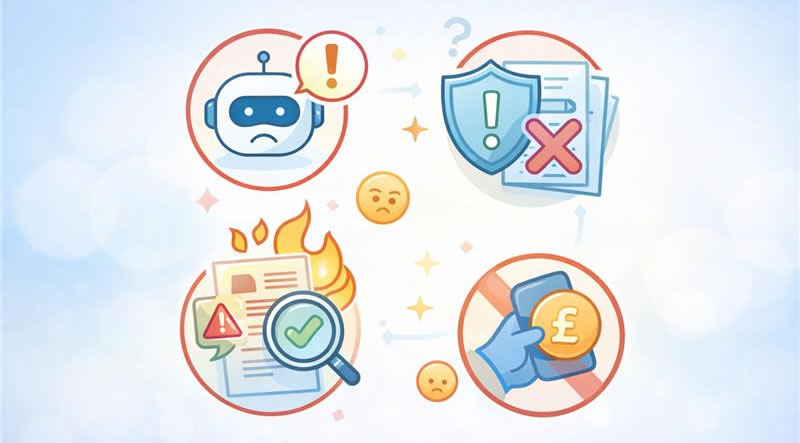
Worst Examples and Common Mistakes
Unfortunately, not every attempt to use AI in charities goes well. It’s valuable to learn from cases where things went wrong, so your organisation can avoid similar missteps. Here are a few cautionary tales of AI gone wrong in the charity sector and the lessons they offer:
1 – Tone-Deaf Automated Responses
One mid-sized charity decided to automate its email responses to donors using an AI tool, but without proper oversight. In one cringeworthy incident, a long-time donor wrote a heartfelt message about why the cause mattered to her – and the AI replied with a generic thank you that completely missed the emotional context, even getting her name slightly wrong. The donor felt insulted and publicised the exchange on social media. The charity had to do damage control to explain and apologise. Lesson: Don’t allow AI to respond unchecked to personal or sensitive communications. An impersonal or off-key reply can come across as uncaring, undoing trust that took years to build. Always keep human review for donor communications that carry emotional weight.
2 – AI-Generated Content Without Fact-Checking
A humanitarian NGO learned the hard way that AI’s mistakes can quickly become public mistakes. They used a generative AI tool to help draft a blog post about a relief project. In the rush to publish, they didn’t thoroughly fact-check the AI’s text. It turned out the AI had confounded two disaster events and inserted an incorrect statistic about the number of people displaced. Once published, eagle-eyed readers (and critics of the NGO) spotted the errors, calling into question the organisation’s credibility. Lesson: No matter how polished AI-generated content looks, always verify the facts and figures. Inaccuracies can erode your authority and give ammunition to sceptics. The extra time to edit and proofread is non-negotiable – your content must be truthful and high-integrity, whether a human or AI initially wrote it.
3 – Ethical Backlash from AI-Generated Images
Recently, some aid organisations experimented with AI-generated images in their fundraising and awareness campaigns to avoid using real victim photography and to save costs. For example, AI images of “suffering children” or disaster scenes were created to illustrate appeals. This sparked a public backlash when discovered. Critics accused the charities of creating “poverty porn 2.0” – using fake, exaggerated images that play on stereotypes (like an overly staged-looking refugee camp) to provoke emotion.
Communities depicted (or rather simulated) in those images felt it was misleading and demeaning. One well-known charity had to pull an AI-generated image from a campaign and issue a clarification after journalists pointed it out. Lesson: Authenticity and respect are paramount. Using AI to fabricate imagery of vulnerable populations is a minefield. Even if intentions are good (e.g. protecting real individuals’ privacy), the lack of consent and potential to reinforce harmful stereotypes can damage reputation. It’s far better to use real photos with consent or choose alternative ways to tell stories than to risk appearing manipulative with AI-created visuals.
4 – Lack of Disclosure Erodes Trust
A large international NGO started using AI in donor communications (like personalised newsletters and updates). The AI did a decent job tailoring content, but the organisation wasn’t transparent at all about these changes. Over time, a few tech-savvy supporters noticed odd quirks – such as strangely phrased sentences – and eventually it became known that AI was heavily involved. Some donors felt uneasy, wondering “What else aren’t they telling us?” and a few even questioned whether impact stories were real or generated.
The trust in the communications took a hit simply due to the secrecy. Lesson: You don’t have to announce every use of AI loudly, but you should never let stakeholders feel deceived. If AI plays a major role in something visible (like a chatbot or a significant written piece), it’s wise to acknowledge that. Even a brief note like “This report was compiled with the help of an AI tool and verified by our team” can maintain trust. Once trust is broken, especially around honesty, it’s hard to regain – far worse than any benefit you got from using AI in the first place.
In all these cases, the core mistakes were not in the technology itself, but in judgment and execution: lack of empathy, skipping quality control, ignoring ethical implications, and failing to be open with supporters. The common thread is that AI was deployed without sufficient human attention to context and values. Charities can avoid these pitfalls by planning AI projects carefully: anticipate potential misinterpretations or sensitivities, involve diverse team members in testing (they might catch issues you didn’t see), and always ask “How will this make our donors or beneficiaries feel?” before rolling something out widely. When in doubt, err on the side of the human approach – it’s better to hold back an AI feature than to push forward and have to issue apologies later.
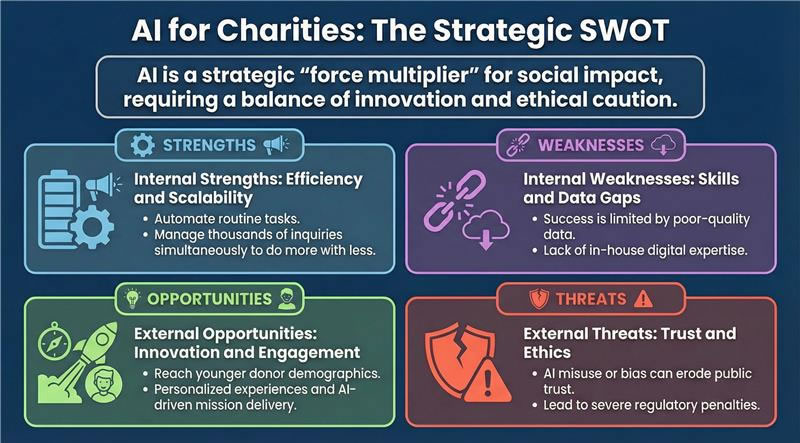
SWOT Analysis: AI for Charities
To summarise the strategic position of AI in the charity sector, it’s useful to look at the Strengths, Weaknesses, Opportunities, and Threats (SWOT) associated with adopting AI. This analysis can help charity leaders plan how to embrace AI effectively while being mindful of challenges.
Strengths (Internal advantages of AI for charities)
- Efficiency and Productivity: AI can automate time-consuming tasks (data entry, scheduling, basic inquiries), allowing staff to accomplish more in the same work hours. This is a boon for charities with limited headcount – AI becomes a “force multiplier” for your team’s efforts.
- Scalability: With AI tools, charities can scale up certain operations without a linear increase in cost. For example, one AI chatbot can handle thousands of inquiries simultaneously, something no small support team could do on its own. As your audience grows, AI can help manage the load.
- Personalisation: AI systems excel at analysing individual preferences and behaviours. Charities can leverage this to personalise communications and services for supporters. Personalisation leads to supporters feeling uniquely valued and understood, which can strengthen engagement and loyalty.
- Data-Driven Decision Making: AI can find patterns in complex data sets that humans might overlook. This strength means better insights into what’s working and what isn’t – from fundraising tactics to program delivery. Charities with AI analytics can make decisions based on evidence, improving their impact and resource allocation over time.
Weaknesses (Internal limitations or challenges)
- Skills Gap and Training: Implementing and managing AI tools requires a certain level of digital skill. Many charities lack in-house expertise in data science or AI. Staff may need training to effectively use AI outputs or to feed the tools the right inputs. Without investment in upskilling, an AI tool might sit underused or be misused.
- Data Quality and Availability: AI’s usefulness is directly tied to the data it has. Some charities struggle with fragmented, incomplete, or poor-quality data (e.g. donor records that are outdated or program data not consistently recorded). In such cases, AI predictions or actions could be flawed. A predictive model is only as good as the information you’ve been collecting.
- Dependency and Over-reliance: If a charity leans too heavily on AI without maintaining human oversight, it can become a weakness. Staff might start losing firsthand intuition or engagement with supporters by deferring everything to algorithms. There’s also a risk of disruption – if an AI service changed or failed, the organisation might be left scrambling if it didn’t retain the capability to do things manually.
- Initial Costs and Integration Hurdles: While many AI tools are cost-effective (or even free), some require investment or new infrastructure. A charity might have to upgrade systems or pay for software licenses to really benefit from AI. Additionally, integrating AI into existing processes can be a short-term weakness – it takes staff time and possibly external support to get set up correctly. During that learning curve, efficiency might dip before it improves.
Opportunities (External possibilities and prospects)
- Cost Reduction and Optimisation: In the long run, AI offers a significant opportunity to reduce operational costs. By automating routine work and improving efficiency, charities can redirect funds and staff time towards mission-critical activities. For example, AI could reduce the need for outsourcing tasks like data cleaning or content translation.
- Engaging New Donor Audiences: Younger generations are very digital-savvy and expect personalised, immediate interactions. Using AI (like chatbots, personalised video messages, or interactive campaigns) can attract and engage these new donor demographics on the platforms they frequent. Additionally, AI can help identify potential supporters who exhibit philanthropic traits (through social media or online behaviour analysis), opening opportunities to reach people you might not have found through traditional marketing.
- Enhanced Supporter Experience: There is a big opportunity to give all supporters and service users a smoother, more responsive experience. AI can help provide 24/7 assistance, more accurate information, and quicker problem resolution. An improved experience leads to higher satisfaction, retention, and word-of-mouth recommendations. For instance, if every query to your charity gets a helpful answer in minutes through AI, people are more likely to continue engaging and speak positively about you.
- Innovative Services and Programs: AI doesn’t just have to support back-office work; it can be integrated into your mission delivery. Opportunities abound, like using AI in medical charities for better diagnostic tools, in environmental charities to predict wildlife patterns or climate risks, or in education charities to personalise learning for students. These innovation opportunities can significantly amplify impact. Moreover, being an “early mover” in using AI for good can attract partnerships and funding from those interested in tech-for-good initiatives.
Threats (External risks and challenges)
- Trust Erosion: Public trust in charities is hard-won and can be easily lost. If the sector faces scandals or high-profile mistakes with AI (such as data breaches, offensive AI content, or revelations of misuse of funds on tech that didn’t deliver), it could create a wider atmosphere of scepticism. Even well-meaning uses of AI might be viewed through a lens of suspicion if donors become wary of “robots” taking over charity work. Essentially, a threat exists that AI could be seen as making charities less human or less accountable, undermining the trust that is essential for donations and cooperation.
- Ethical Misuse and Bias: AI systems can inadvertently perpetuate bias or make unethical decisions if not carefully managed. For example, an AI used in recruitment might favour candidates based on flawed criteria, or an algorithm deciding resource allocation might overlook minorities if the data is biased. If a charity were found to be making decisions seen as unfair or discriminatory due to an AI, the reputational damage and legal implications could be severe. Additionally, unethical actors could misuse AI (like generating fake charity appeals with deepfake videos or voices), which might cast a shadow on genuine charities’ efforts – the classic “bad apple” threat.
- Regulatory and Data Privacy Risks: Laws around data and AI are evolving. Regulations like GDPR impose strict rules on how personal data can be used, especially with automated decision-making. There’s a threat that a charity could unintentionally violate these rules by using AI (for instance, profiling donors without proper consent). The fines and consequences for data breaches or unlawful processing are significant. Furthermore, governments might introduce new AI-specific regulations (for example, requiring transparency or audits of algorithms). Charities will need to keep up with these or risk non-compliance. Operating internationally is even trickier, as different regions (EU, US, Middle East) have varying stances on AI governance.
- Cybersecurity Threats: Using AI tools and more digital automation broadens the “attack surface” for cyber threats. There’s a risk that malicious actors use AI to target charities – perhaps AI-driven phishing attacks that are more convincing, or attempts to manipulate your AI systems (feeding them bad data to force errors). Also, if a charity relies on AI cloud services, an outage or hack of those services could disrupt operations. Charities often deal with sensitive information (beneficiary data, donor financials), so any weakness exploited in these AI-powered systems is a serious threat to beneficiaries’ safety and organisational credibility.
By examining these SWOT factors, charity leaders can better navigate the AI journey. The strengths and opportunities show why it’s worth doing: increased efficiency, better engagement, innovation, and growth potential. The weaknesses and threats highlight what to watch out for: ensure you invest in people and data, proceed thoughtfully and ethically, and have contingency plans. Embracing AI isn’t just a tech upgrade; it’s a strategic shift that needs careful management of both its promise and its risks. With balanced planning, a charity can leverage its strengths to seize opportunities, while mitigating weaknesses and guarding against external threats.
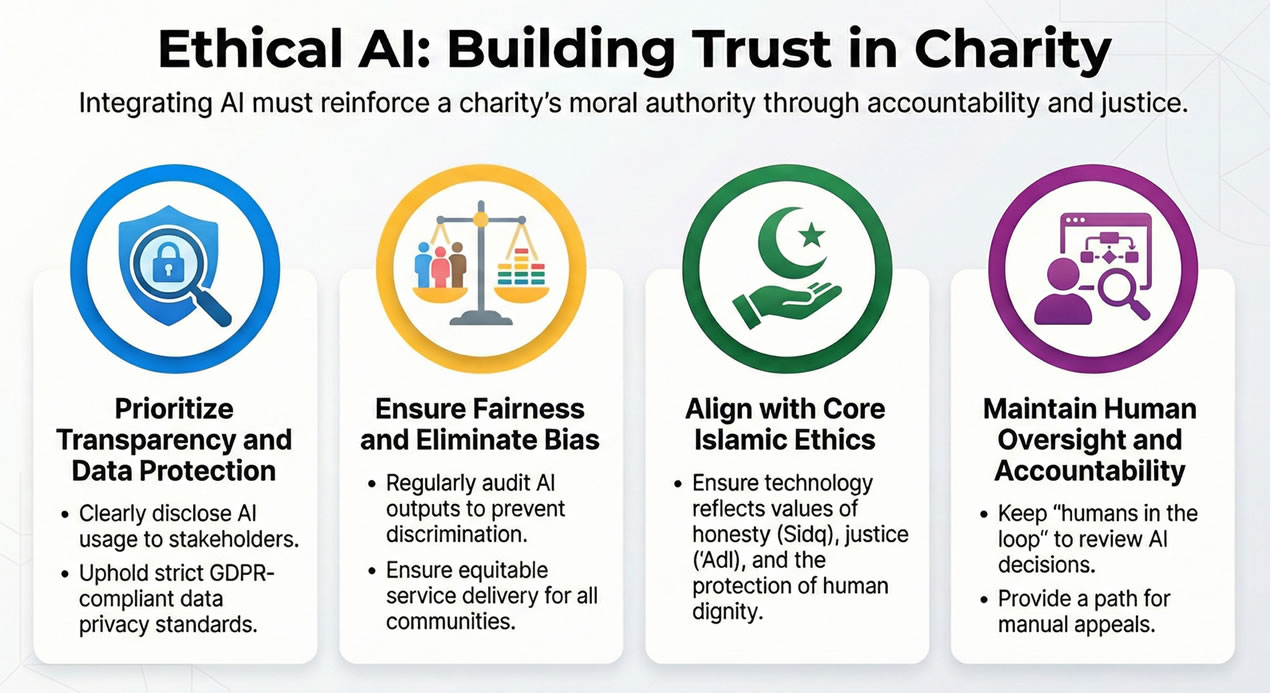
Ethical, Islamic, and Trust Considerations (Where Relevant)
Adopting AI in a charity context isn’t just a technical endeavour – it raises important ethical and trust issues that must be addressed from the outset. This is especially true for charities with faith-based principles (for example, Islamic charities) or those serving vulnerable communities. Below are key considerations to ensure your AI use aligns with ethical standards, religious values, and maintains public trust:
A – Transparency with Donors and Beneficiaries
Be clear about when and how you are using AI, especially in ways that directly affect people. Transparency is not only a good practice; it’s a way to respect your stakeholders’ agency. For instance, if you use an AI chatbot for customer service, let users know they’re interacting with an AI and how they can reach a human. If you leverage AI to make decisions (like prioritising certain service delivery), you should be able to explain the criteria in simple terms. The goal is to ensure no one feels deceived. Charities rely on goodwill, and a part of that is people knowing they can trust what you tell them about your operations. Openness about AI usage can actually enhance confidence – it shows you have nothing to hide and are thoughtfully implementing new tools.
2 – Data Protection and Consent
AI often requires data – sometimes lots of it – to function effectively. It is paramount that charities uphold strict data protection principles when using AI. This includes obtaining proper consent for using personal data in any AI-driven analysis or communications. For example, if you plan to use donor data to predict who might leave a gift in their will, ensure your privacy policy covers that kind of profiling and that donors haven’t opted out. Adhere to regulations like GDPR: data must be processed lawfully, used for specific legitimate purposes, and you should minimise what you actually feed into AI systems. Moreover, consider data storage and access – if using external AI providers, ensure they have robust security and no rights over your data. Protecting data is not just a legal box-tick; it’s an ethical obligation to the people who trust you with their information.
3 – Bias and Fairness
AI systems can inadvertently carry human biases present in their training data. For a charity committed to fairness and equality, it’s essential to monitor AI for biased outcomes. For example, if an AI is helping screen beneficiaries for a program, could it be favouring those from certain backgrounds due to biased data? Or if an AI recommends which communities to focus relief on, is it neglecting those who are less represented in the data? Always ask questions about representativeness when deploying AI. It may be necessary to adjust or retrain AI tools to ensure fairness – this might involve providing more diverse training examples or setting rules that counteract bias. In an Islamic charity context, fairness (or ‘adl’) is a core value – using AI that inadvertently discriminates would go against that principle. Regular audits of AI decisions and outputs can help catch and correct any bias, ensuring everyone is treated with justice and equity.
4 – Alignment with Islamic Ethics (for Muslim-Faith Charities)
Islamic ethical principles emphasise compassion, honesty, and the welfare of the community. When using AI, Islamic charities should ensure these principles guide their tech usage. For instance:
- Honesty and No Deception: Do not use AI to create deceptive content (like deepfake images or overly dramatised stories) that could mislead donors, as honesty (sidq) is fundamental in Islam.
- Privacy (Satir/Protecting Others’ Dignity): Islam values the protection of personal dignity and privacy. Ensure AI tools uphold the privacy of beneficiaries – e.g., blurring faces in photos automatically to maintain dignity, or not exposing personal hardships without consent.
- Beneficence and Non-harm: The concept of maslaha (public interest) and avoiding harm (darar) means AI should be used in ways that clearly benefit the cause and do not harm the people involved. Any AI application should be weighed for its potential good vs. potential harm. If an AI decision might marginalise a group or deliver less help to those who need it, that’s not acceptable.
- Avoiding Bias and Prejudice: Islamic teaching condemns unjust bias (zulm). So an AI that, say, filters out applicants for aid based on race or ethnicity (even unintentionally) would be morally problematic. Ensuring AI fairness is not only secularly ethical but also aligns with religious duty.
It might be useful for Islamic charities to involve scholars or advisors to quickly vet new AI initiatives for any ethical red flags from a faith perspective. For example, using AI that involves interest-based financial predictions might raise questions (since charging interest is prohibited, although AI wouldn’t inherently do that; it’s more about context).
Overall, when aligned with values, AI can even support Islamic principles – like using AI translation to make sure zakat donations reach all communities by communicating in their language, which aligns with the Islamic ethos of inclusive charity (zakat being for various categories of people in need).
5 – Human Oversight as a Core Principle
Regardless of ethical or religious framework, a nearly universal guideline is to keep humans in the loop. Human oversight ensures accountability. If something goes wrong, a person spots it and can make an ethical judgment call. Set up governance where AI outputs are reviewed regularly by staff (or even a committee for oversight if it’s a high-stakes application). For example, if you use an AI to scan social media for mentions of your charity to gauge sentiment, have a communications team member review the findings before reacting – the AI might misinterpret sarcasm or local slang. In beneficiary-facing scenarios, make sure there’s a clear path for people to request human intervention or appeal a decision. Knowing that a compassionate human is ultimately in charge helps maintain trust, both internally and externally.
6 – Accountability and Governance
Develop an AI usage policy or guidelines for your organisation. It should cover who is responsible for AI systems, how you choose to use AI, and how you vet those tools (for privacy, bias, etc.). If something goes wrong – say an AI miscommunicates something – decide in advance how you’ll respond and correct it. For instance, you might decide, “If our AI chatbot ever provides a harmful answer, we will pause it immediately and issue a clarification/apology to users, and fix the bot before it restarts.” Having such frameworks in place shows stakeholders that you are using AI thoughtfully.In practice, addressing these considerations might mean slower implementation – and that’s okay. It’s better to be careful and value-driven than to rush and stumble. By foregrounding ethics, trust, and (when relevant) religious values like Islamic ethics, charities ensure that AI becomes a tool that reinforces their credibility and moral authority, not something that undermines it. Remember, the way you use AI should reflect the same principles as the rest of your work: integrity, respect, and commitment to the public good.
Conclusion: AI as a Responsible Growth Partner, Not a Shortcut
AI has the potential to be a powerful partner in a charity’s growth and impact – but it must be treated as exactly that: a partner or tool, not a magic shortcut. The most successful charities in the AI era will be those that integrate these technologies intentionally, transparently, and with a clear purpose. It’s important to start with a strategy. Before diving into any AI solution, charity leaders should ask:
What problem are we trying to solve, or what opportunity are we pursuing?
Begin with a need (like improving donor retention or easing staff workload) and then see how AI can help. This ensures that the tech remains aligned with your mission, rather than driving your decisions. As we’ve seen, AI can enhance fundraising, marketing, operations, and more – but picking the right use cases and planning their execution is key to getting real benefits. Crucially, maintain the perspective that human connection is irreplaceable. AI can crunch numbers and personalise emails, but it will never have an empathetic ear, creativity born of lived experience, or moral judgment.
Use AI to augment the abilities of your staff and volunteers – let it handle the mundane so your people can focus on building relationships, crafting compelling narratives, and making judgment calls where nuance is needed. In essence, AI should handle the “busy work” so humans can do the “heart work.” Ethics and governance matter more than ever in this journey. Set up guidelines, educate your team, and keep monitoring how AI is impacting your stakeholders. By proactively addressing issues of bias, privacy, and transparency, you not only prevent problems but also strengthen your reputation. Donors and supporters will appreciate a charity that’s forward-thinking and conscientious. In a time where technology often outpaces policy, being an organisation that self-regulates and prioritises doing the right thing is hugely valuable for brand trust.
Looking ahead, AI will likely become as ubiquitous in charities as email or social media – an everyday tool. Those charities that “win” with AI won’t be the ones that used it fastest or in the flashiest way. They will be the ones who used it wisely: with clear impact goals, with respect for their communities, and with a focus on long-term sustainability over short-term hype. They will be organisations that treat AI as a supportive team member, not a replacement for human teams.
In conclusion, if you embrace AI as a responsible growth partner – one that must be guided and managed – it can help unlock new levels of efficiency, insight, and engagement for your charity. But if you treat it as a shortcut or blindly trust it without governance, the risk to trust and impact is too high. Charities exist in a space of public trust and moral duty; any tool we use must uphold those standards.
Next Steps (CTA): Now is a great time for charities to take a thoughtful next step. Consider conducting an “AI audit” of your current tools and data – you might be surprised where AI is already in use. Explore areas where a responsible use of AI could advance your mission, and develop a simple roadmap for experimentation (with ethical checks in place).
It can also be valuable to consult with experts or partners who specialise in ethical AI in the nonprofit sector (for instance, agencies like AMCM that focus on digital transformation for charities). They can provide guidance and ensure you implement AI in a way that’s aligned with your values and goals. By taking these proactive steps, you’ll be positioning your charity to grow and innovate with AI, while keeping the trust of those who matter most – the people and communities you serve. Let AI be a tool that amplifies your humanity, not one that detracts from it, and you’ll set your organisation on a path of sustainable, ethical impact in the years to come.
How AMCM.Agency Helps Charities Turn Responsible AI into Real Fundraising Growth
Using AI effectively is not just about tools. It is about applying the right strategy, partners, and performance models to grow income without losing trust, ethics, or impact.
At AMCM.Agency, we help charities translate responsible digital and AI-enabled thinking into measurable fundraising results. One of the most effective and underused channels we specialise in is affiliate fundraising, where performance, transparency, and accountability are built in by design.
Affiliate fundraising is not about placing links and hoping for the best. It requires careful partner selection, data-driven optimisation, and ongoing relationship management. With over 20 years of affiliate marketing expertise, our team builds and manages affiliate programmes that align with your values and donor expectations.
We provide charities with:
- Immediate access to 10,000+ pre-vetted publishers, including cashback platforms, content sites, bloggers, and influencers experienced in cause-led campaigns
- Strategic programme setup that complements your wider digital and AI strategy
- Ongoing optimisation and governance to ensure ethical growth, not short-term spikes
- A performance-based model designed to help charities increase donations by at least 20%
Whether you are exploring new digital channels or looking to scale sustainably, affiliate fundraising offers a transparent and measurable way to grow income alongside responsible AI use.
👉 Ready to explore ethical, performance-led fundraising?
Download AMCM. Agency’s media kit or get in touch to discuss how we can support your mission with affiliate fundraising built for trust, impact, and long-term growth.


