Corporate Social Responsibility (CSR) in Islamic Charities
A Practical Guide to Faith-Aligned Corporate Partnerships and Social Impact
Introduction
Corporate Social Responsibility (CSR) refers to a company’s commitment to operate in ways that positively impact society and the environment. In practical terms, CSR means businesses voluntarily go beyond just making profits – they also give back to communities, uphold ethical practices, and reduce any negative footprint on the world. Over the past decade, CSR has evolved from a niche concept into a mainstream business priority in places like the UK, USA, and across the Middle East.
Many large companies now have dedicated CSR programs or departments. For Islamic charities, understanding CSR is crucial: it opens doors to partnerships with these socially-conscious businesses and aligns strongly with the charitable values at the heart of Islamic tradition. In this blog, we’ll explore what CSR is, why it matters, how it aligns with Islamic principles, and how an Islamic charity can leverage CSR – including working across departments like fundraising and programmes – to amplify its impact.
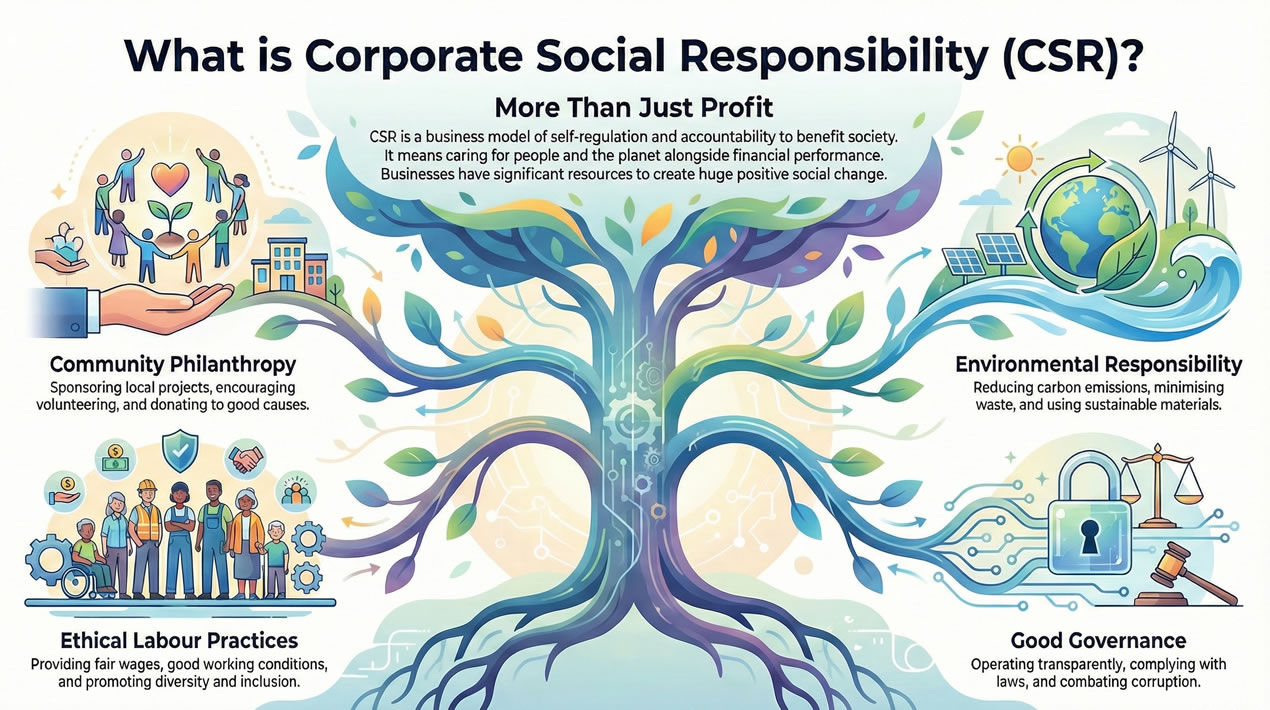
What is CSR and Why Does It Matter?
Definition and Scope: CSR is essentially about self-regulation and accountability. It means a business ensures its operations benefit society and minimise harm. This can cover a broad range of activities, typically grouped into a few key areas:
- Community Philanthropy: Companies donating to charities, sponsoring community projects, or encouraging staff to volunteer for good causes.
- Environmental Responsibility: Efforts to protect the planet – for example, reducing waste and carbon emissions, using sustainable materials, or supporting conservation projects.
- Ethical Labour Practices: Treating employees and suppliers fairly. This includes fair wages, good working conditions, diversity and inclusion policies, and not exploiting labour anywhere in the supply chain.
- Good Governance: Operating transparently and ethically, complying with laws, and combating corruption. (Sometimes this is rolled into a broader “ethical responsibility” category alongside labour practices.)
In short, CSR asks companies to be good corporate citizens. A socially responsible business cares about more than just its bottom line – it also cares about people and the planet. This concept matters because businesses often have significant resources and influence. When even a fraction of those resources is channelled into positive initiatives, the benefits can be huge. For example, a large retail company might fund schools or hospitals in underserved areas, or a tech firm might run a mentorship program for young entrepreneurs. Such initiatives improve lives and help address social or environmental challenges.
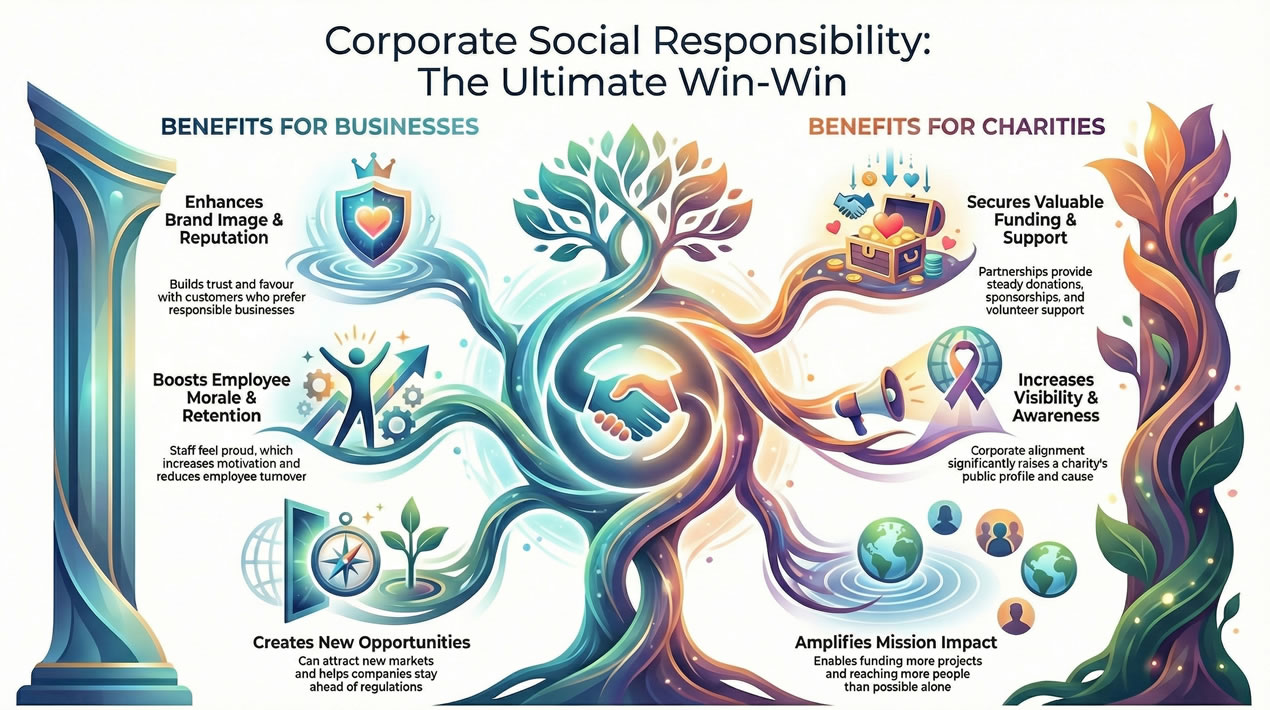
Benefits of CSR (for Companies and Charities)
CSR is not only altruistic; it’s often a win-win for both the company and the community. For companies, engaging in CSR can enhance their brand image and reputation – consumers and clients tend to trust and favour businesses that show compassion and responsibility. It also boosts employee morale: staff feel proud working for a company that cares, which can increase motivation and reduce turnover. In a practical sense, CSR can even open new business opportunities or markets (for instance, developing eco-friendly products can attract environmentally conscious customers). On the legal side, some jurisdictions are starting to require large companies to report on their social and environmental impact, so proactive CSR helps companies stay ahead of regulations.
For charities – especially Islamic charities relying on donations – CSR presents a valuable partnership opportunity. Businesses that embrace CSR often look for credible charity partners to support. When a company chooses your charity for a partnership, it can mean steady funding, volunteer support, and increased visibility for your cause. Corporate donations and sponsorships have become a significant part of the non-profit funding mix in the UK and USA. In the UK alone, corporate philanthropy contributions amount to billions of pounds each year, and in the US many companies run employee giving programs that collectively raise huge sums for charities annually. By tapping into these, an Islamic charity can fund more projects and reach more beneficiaries than would be possible through public donations alone.
CSR in an Islamic Context
Islamic values have long emphasised social responsibility, so there is a natural harmony between CSR principles and Islamic charitable ethos. Key Islamic concepts like Zakat (obligatory almsgiving), Sadaqah (voluntary charity), and Waqf (endowments for public benefit) all encourage helping those in need and improving society. In essence, Islam has ingrained the idea that wealth comes with a responsibility to do good – which is precisely what CSR asks of businesses.
Faith and Giving
In Muslim-majority regions (for example, the Middle East), many companies historically viewed their charitable activities through the lens of religious duty. It’s common for businesses there to donate money or goods during Ramadan or for Eid, or to contribute a portion of annual profits as zakat. This is CSR in a basic form: fulfilling religious charitable obligations and community expectations. For instance, a company in the Middle East might sponsor large iftar meals for the poor during Ramadan or fund the construction of a community water well – actions driven both by faith and a sense of corporate duty. These traditions mean that the culture of corporate giving is not new in Islamic contexts; however, it was often informal or purely philanthropic in nature.
Moving from Charity to Strategy
In recent years, there’s a trend (in the Middle East especially) of moving beyond treating CSR as just ad-hoc charity (donating money or planting a few trees) towards a more strategic approach. Governments and business leaders in countries like the UAE, Saudi Arabia, and Qatar have started encouraging comprehensive CSR strategies – setting up CSR departments, planning sustainable development initiatives, and publishing annual sustainability reports.
For example, some banks and corporations in the Gulf now integrate environmental sustainability programs (like reducing plastic use or investing in renewable energy) alongside their zakat contributions. The idea is to align with global CSR standards while still honouring local values. That said, the level of maturity in CSR varies across the region: some companies still focus only on donations (sometimes mainly as a public relations exercise), whereas others are truly embedding social responsibility into how they operate.
Environmental Stewardship in Islam
One aspect to highlight is how caring for the environment is both a CSR pillar and an Islamic duty. Islam teaches that humans are stewards (khalifa) of the Earth, entrusted to take care of nature. This resonates strongly with modern environmental CSR initiatives. Many Islamic charities and Muslim-led projects emphasise clean water, conservation, and sustainability. From planting trees to promoting recycling and green energy, there’s a growing recognition that protecting the environment is part of serving humanity. Companies in the Middle East and beyond have begun sponsoring environmental campaigns – for instance, organising volunteer clean-up drives or investing in climate-resilient agriculture – which align with Islamic principles of conservation.
Volunteers participate in a forest cleanup as part of a company’s CSR environmental initiative, reflecting the Islamic principle of stewardship of the Earth.
It’s worth noting that while terms like “CSR” or “sustainability” might be modern, the underlying ideals are deeply compatible with Islamic values. An Islamic charity can confidently frame CSR partnerships in terms of shared values: both the charity and a Muslim-owned business, for example, have a mutual interest in fulfilling the duty to help others, be just, and care for creation. Even with non-Muslim businesses, an Islamic charity’s focus on humanitarianism and integrity will resonate, since those are universal ethics.
Examples of CSR in Action (UK, USA, Middle East)
To make CSR more concrete, let’s look at how companies often engage with charities through CSR, with examples that could apply in different regions:
United Kingdom & USA
Employee Engagement and Corporate Donations: In the UK and the US, many companies, large and smal,l have active programs to support charities. A common model is choosing a “Charity of the Year” or running matching gift schemes. For example, a British company might select an Islamic charity like Islamic Relief as its Charity of the Year, raising funds through various staff activities for that charity over 12 months. Employees might organise bake sales, charity runs, or donate a day’s salary, with the company matching what they raise pound for pound. Big firms often have payroll giving, where employees can donate straight from their salary to a charity (tax-free), and the company may top it up by a certain percentage.
In the USA, it’s popular for corporations to offer matching gifts – if an employee donates $100 to a nonprofit, the company also gives $100. Tech giants and banks have used this to encourage their workforce to support causes they care about. For Islamic charities operating in the West, tapping into these employee-driven CSR programs can be very fruitful. A real example: Islamic Relief USA has partnered with private companies for initiatives like meal-packing events – corporate volunteers come together to pack food parcels for communities in need, fulfilling a humanitarian goal while also giving those employees a hands-on volunteering experience. Such collaborations strengthen the charity’s capacity and give the company a tangible way to show community support.
Middle East
Zakat and Community Programs: In Middle Eastern countries, CSR often takes on a flavour influenced by local traditions. Many businesses there allocate a portion of their annual profits to charity in line with zakat. Rather than simply handing money to authorities, some companies directly partner with trusted charities to implement projects. For instance, a large corporation in the UAE or Qatar might collaborate with an Islamic charity to deliver food aid to war-affected refugees or to build schools in impoverished regions. These are high-profile projects that allow the company to fulfil its religious giving duty and public CSR commitments at once. During religious occasions, you’ll see companies sponsoring iftar tents, distributing Ramadan ration boxes, or funding medical camps – all examples of CSR rooted in cultural practice.
However, beyond donations, Middle Eastern companies are gradually also embracing broader CSR roles: education and employment initiatives (like funding vocational training programs for youth, or supporting entrepreneurship incubators) are on the rise. An example could be a Saudi tech company running a coding bootcamp for free, aimed at underprivileged students, in partnership with a charity – this helps the community develop skills and aligns with the company’s industry as well. It’s also increasingly common to see environmental CSR in the Middle East: e.g. Qatar’s national airline adopting green fuel initiatives or organising wildlife conservation drives, often in collaboration with NGOs. These efforts show that CSR in the region is evolving beyond simple charity to more varied forms of social contribution.
Global Corporate Partnerships with Islamic Charities
Many international corporations recognise the importance of reaching Muslim communities or supporting causes in Muslim-majority countries. This has led to some innovative partnerships. For instance, Islamic charities have teamed up with halal food brands and events – one UK-based Islamic charity partnered with a Halal Food Festival to fundraise and promote charitable giving among attendees.
In another case, a Muslim-owned beverages company (Labbaik Cola, for example) pledged a portion of every sale to charity projects, turning consumer purchases into donations – a practice known as cause-related marketing. Sports and lifestyle brands have also sponsored charity events in the Muslim community (like fun runs during Ramadan or supporting orphan sponsorship programs), integrating CSR with marketing to a faith-based demographic.
These examples demonstrate that CSR activities can be very creative: from charity dinners sponsored by banks to travel agencies donating a percentage of ticket sales to relief efforts. For Islamic charities, being open to such partnerships and ready to collaborate in various ways is key. It not only brings in funds, but often also helps raise awareness of the charity’s work to new audiences (for example, the customers of that halal food brand or the attendees of that festival learn about the charity and its mission).Tip: If you’re discussing CSR in your Islamic charity, it helps to illustrate it with stories. Talk about how a partnership made a difference – e.g. “Last year, Company X’s support enabled us to build 50 new wells in rural Somalia” or “With funding from Company Y’s Ramadan campaign, we delivered food packs to 5,000 families in Gaza.” These real-life impacts show staff and stakeholders what CSR means in action and can inspire more engagement.
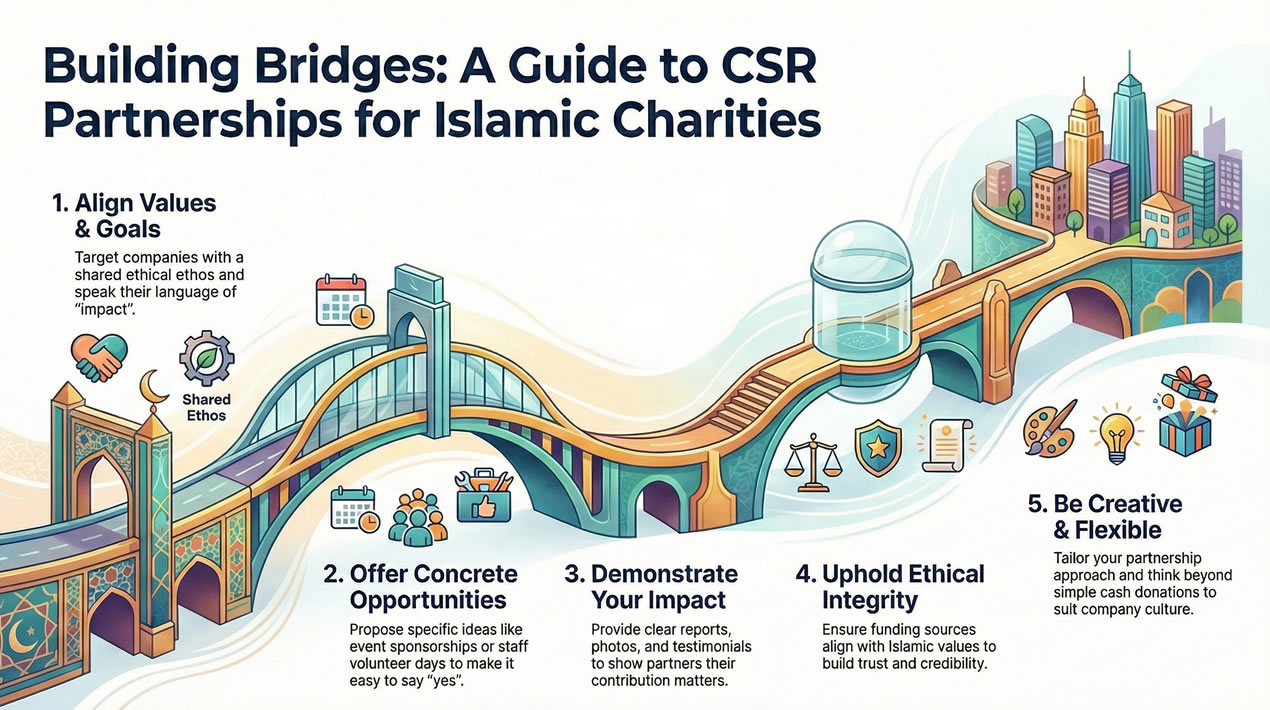
How Islamic Charities Can Leverage CSR Partnerships
So how can an Islamic charity make the most of the CSR trend? Here are some practical ways to engage with corporations and build fruitful partnerships:
1. Identify Shared Values and Goals
Begin by finding companies whose values align with your charity’s mission. This could be a halal food company, an Islamic bank, or even a mainstream business with a strong ethical ethos. Emphasise the common ground. For example, if your charity focuses on education in poor communities, you might approach a company that champions education or skills training as part of its CSR. When you pitch a partnership, frame it as helping the company achieve their social responsibility goals while furthering the charitable objectives – a mutual benefit.
It’s very effective to use language a business understands: talk about “impact”, “sustainability”, and “community investment” alongside the moral imperatives. Remember, many firms (even non-Muslim-run ones) see the value in supporting diversity and inclusion, which can include working with faith-based charities to reach minority communities. An Islamic charity can position itself as an expert in delivering aid in Muslim regions or engaging Muslim donors, which can be attractive to companies looking to broaden their CSR reach.
2. Offer Specific Engagement Opportunities
Companies often respond better to concrete ideas rather than vague requests for support. Come prepared with a menu of ways they can help. For instance: “Would you consider sponsoring our annual orphan support dinner? It draws 500 community members, and we could feature your brand as a key supporter.” Or, “How about your staff join our volunteers on a weekend to pack winter kits for refugees? It would make a great team-building and CSR volunteering day.” By providing ready-made opportunities – whether it’s event sponsorship, employee volunteer days, fundraising challenges, or cause-marketing promotions – you make it easy for the company to say yes. Many businesses actually have CSR budgets or quotas (like a certain number of volunteer hours to fulfil, or funds earmarked for charity each quarter).
If you can present an opportunity that fits into those, you’re helping their CSR manager solve a problem (how to utilise their CSR resources effectively). For example, if a company in the USA gives employees 2 paid days for volunteering per year, you can invite them to use one of those days with your charity’s project (like a neighbourhood clean-up or assembling food parcels). This benefits your charity with labour and spreads goodwill among the volunteers.
3. Ensure Transparency and Impact Reporting
Corporate partners will want to know the result of their contributions. An Islamic charity needs to have good monitoring, evaluation, and reporting practices in place. If a company donates £20,000 to build wells, they’ll greatly appreciate (and likely continue the partnership) if you later send them a concise impact report: how many wells were built, how many people now have clean water, maybe even a few photos or testimonials from beneficiaries.
This isn’t just about accountability; it also gives the company material to share in their own CSR communications (like their annual CSR report or internal newsletter, where they highlight partnerships – it makes them look good to have a successful story). Many charities create customised thank-you certificates or even videos for corporate sponsors, which can go a long way in relationship-building. In Islamic tradition, we’re encouraged to show gratitude – “Thank the people, and you thank God” – so thanking a corporate donor with sincerity and detail is both polite and strategic. It sets the stage for a long-term relationship rather than a one-off donation.
4. Mind the Ethics (Halal Funding and Practices
One unique consideration for Islamic charities is ensuring that partnerships meet Islamic ethical standards. This means being cautious about accepting money from industries that conflict with Islamic values (for example, gambling, alcohol, or interest-based financial services, depending on your charity’s policies). While most CSR funds will be benign, it’s wise to have guidelines. If a potential corporate donor operates in a grey area, an Islamic charity might offer alternative arrangements – such as channelling only their permissible funds, or advising them on zakat purification if needed.
On the flip side, Islamic charities can also serve as advisors to companies on how to structure donations in a Sharia-compliant way. For example, a bank might consult an Islamic charity on how to best disburse its zakat in a manner that is religiously sound and impactful. By upholding integrity in funding sources and project implementation, the charity preserves its reputation and provides added value to the partnership (the company knows its support is used in an ethical, faith-conscious manner). This builds trust all around.
5. Be Creative and Flexible: CSR is a dynamic field
There’s room for creativity. Islamic charities should think beyond just “donation = money for project.” Consider campaigns that create a buzz: maybe a challenge where a corporate CEO promises to shave his head or climb a mountain if employees meet a fundraising target for the charity (fun and press-worthy), or a collaborative Ramadan campaign where a supermarket asks customers to add a £1 charity donation at checkout (with proceeds going to your charity’s Ramadan food program).
In the Middle East, one might partner with popular influencers or local businesses during charitable seasons to amplify reach. In the West, partnering with mosques or Muslim-owned small businesses for cause campaigns can also fall under CSR if framed as a community partnership. By being open to different types of collaboration, you enable more companies to slot you into their CSR plans. Every company has its own culture – some prefer volunteer work, others like writing checks, others want public recognition like logo placement. Tailor your approach to what suits the partner while keeping the focus on the humanitarian outcome.
Integrating CSR with Other Departments in Your Charity
One critical aspect of successfully working with CSR initiatives is ensuring that all relevant departments of your charity collaborate and understand their role. CSR partnerships are multifaceted – they’re not just the domain of the fundraising team. Here’s how CSR links with various departments in an Islamic charity:
Strong CSR partnerships are built on collaboration – much like a handshake agreement – requiring coordination between a charity’s departments and the supporting company.
Fundraising/Partnerships Department
This team usually takes the lead in CSR engagements. They research potential corporate partners, make the approach, and manage the relationship. In an Islamic charity, the fundraising department might have a specialist for corporate partnerships or a “CSR liaison” who speaks the language of business. They will coordinate proposals, ensure agreements are in place (e.g. what the company will fund or how they’ll be acknowledged), and maintain regular communication. Fundraisers must communicate clearly with other departments about the promises made – for example, if a company is promised that their donation will fund 100 cataract surgeries, the programmes team needs to know this and deliver it!
Programmes/Projects Department
The programmes team is responsible for implementing the charitable projects on the ground. When a CSR partner funds or sponsors a project, the programme managers must integrate this into their plans. In practical terms, that means designing the project to meet both the community’s needs and any reasonable objectives the corporate donor has. For instance, if a company funds a new water well project in Pakistan, the programmes team will carry it out as usual, but may also host a field visit for the company’s representatives or provide extra documentation of the process. There’s often a need for close dialogue: the fundraising team might ask programmes, “Can we brand these aid distributions with the company’s logo? They’d like that for their CSR report.” Or, “The donor is particularly interested in education – do we have a school project to direct their funds to?” By collaborating, programmes can slightly tailor or highlight relevant aspects of projects to fit a partner’s focus, without compromising the charity’s mission. This synergy ensures the partner stays happy and the projects remain effective.
Communications/Marketing Department
Storytelling and publicity are big parts of CSR partnerships. The comms team can help amplify the collaboration by giving it coverage on the charity’s media channels and facilitating joint publicity with the company. For example, they might issue a press release about the partnership: “Islamic Charity X and Company Y join hands to provide winter relief in Syria.” They can arrange for photographers to capture the donation in action (taking care not to exploit beneficiaries, but to show impact).
They’ll also handle social media shout-outs, ensure the company is thanked publicly (if the company is open to that), and maybe create case studies for newsletters or the annual report. From the company’s side, their PR or CSR communications staff might want quotes or stories from the field – the charity’s comms department would provide these. Essentially, good communication ensures that both the charity’s supporters and the wider public see the positive results of the CSR partnership. This recognition is often very important to corporate partners, just as it is to individual donors, so the comms team plays a key role in delivering that value.
Finance and Compliance Department
When corporate funds come in, finance needs to track them properly, sometimes separately for reporting back. They may need to provide the company with receipts or even an audited breakdown of expenditure if it’s a large grant. Compliance-wise, if there are any restrictions (like the company requiring funds to be used in a certain country or within a certain timeframe), finance must ensure they are adhered to.
For Islamic charities, finance also has to consider zakat-specific accounting if the corporate donation is Zakat (to ensure it’s spent in Islamically permissible ways and not mixed with non-zakat funds improperly). This department’s diligence gives confidence to the corporate donor that their money is handled responsibly. Often, corporate donors will perform a bit of due diligence on a charity before giving – having strong financial controls and the ability to report on use of funds will tick their boxes and make a partnership more likely.
Volunteer Management/HR (if applicable)
If the CSR collaboration involves employee volunteering (which is common), whoever manages volunteers in the charity will be involved. They might need to coordinate schedules, provide training or a briefing to incoming corporate volunteers, and ensure there are meaningful tasks for them. For example, if a company’s team is coming to help pack food parcels at your warehouse for a day, the volunteer coordinator would set up the activity, supervise on the day, and maybe arrange some interaction where your charity’s beneficiaries or staff share stories to enrich the volunteers’ experience.
HR might also coordinate on things like volunteering, MoUs (Memorandums of Understanding), or insurance for volunteers on-site. In some cases, HR of the charity could be involved in internal CSR too – for instance, making sure the charity itself is practising what it preaches (like eco-friendly policies in the office, staff well-being programs, etc.), which can in turn become a talking point with corporate partners (showing that the charity also upholds social responsibility internally).
In summary, a successful CSR partnership in a charity is a team effort. Regular internal meetings can help – for instance, having a monthly cross-departmental check-in on corporate partnerships to update each other: fundraising can share new leads, programmes can give status updates on ongoing corporate-funded projects, comms can outline upcoming publicity opportunities, etc. This prevents silo mentality and ensures the company involved experiences a smooth, professional collaboration with the charity. When each department knows its role and works together, the charity can deliver on promises made to the corporate partner, which increases the likelihood of continued support and even expansion of the partnership over time.
Conclusion
Corporate Social Responsibility offers a powerful avenue for Islamic charities to further their humanitarian mission. By understanding CSR – its principles, its appeal to businesses, and its alignment with Islamic values – charity professionals can engage in more meaningful conversations with corporate donors and create partnerships that benefit everyone involved. Whether it’s a tech firm in the USA matching employee donations during Ramadan, a British company sending staff to volunteer at a refugee fundraiser, or a Gulf-based corporation funding a livelihood program as part of its zakat, the opportunities are vast.
The key takeaway is that CSR is about building bridges: between the private sector and charitable causes, between profit motives and altruistic service. Islamic charities, grounded in a faith that champions charity, social justice, and caring for creation, are naturally well-positioned to be at the forefront of these collaborations. By approaching businesses with professionalism and a clear value proposition – and by coordinating internally to meet partnership needs – a charity can unlock new resources and ideas that propel its work to new heights.
After all, at the heart of CSR is a simple idea: doing good is a shared responsibility. Companies have resources and reach; charities have expertise and passion for helping people. When these come together, real change happens. As someone involved in an Islamic charity, if you can speak the language of CSR and champion its importance, you’ll add tremendous value to discussions on strategy and growth. You’ll be able to suggest innovative ways to involve corporate partners in your campaigns, ensure that your charity’s projects are attractive to potential sponsors, and help shape a culture where businesses see your organisation as a trusted ally in making the world a better place.
Empowered with a solid understanding of CSR and its connection to various aspects of your charity’s operations, you can go into your next meeting or community event and articulate how “doing good is everyone’s business” – inspiring colleagues and donors alike. By integrating corporate social responsibility in your approach, you will not only secure more support for your causes but also drive forward the prophetic values of compassion and generosity in the modern world of business. And that truly is a partnership for good.
Fundraise 20% more with AMCM.Agency
Building an affiliate fundraising campaign isn’t just about setting up tracking and waiting for partners to join. Success comes from knowing where to look, who to contact, and how to build lasting relationships with affiliates and influencers that align with your cause. That’s where AMCM.Agency comes in.
We are specialists in affiliate fundraising for charities. With over 20 years of experience in affiliate marketing, our team has the knowledge and tools to cut through the noise and find the partners who really matter. Unlike most charities starting from scratch, we already maintain a bank of over 10,000 publishers – bloggers, cashback platforms, coupon sites, and content creators – who can give your campaign the kickstart it needs.
By partnering with AMCM.Agency, your charity benefits from:
- Immediate access to pre-vetted affiliates and influencers who understand cause-driven fundraising.
- Professional campaign setup and management on the right networks and platforms.
- Hands-on recruitment and outreach to align you with publishers who genuinely connect with your mission.
- Ongoing optimisation so your campaign isn’t just launched, but continues to grow and deliver year after year.
Our goal is simple: to help your organisation raise at least 20% more in donations by building a sustainable, performance-based affiliate fundraising program. We know the sector, we know the tools, and we know the partners who can make it happen.
If you’re ready to turn your affiliate fundraising ambitions into real results, let AMCM. Agency launches and manages your campaign. We’ll connect you with the right affiliates, negotiate the right deals, and ensure your program is set up for long-term success.
👉 If your charity is ready to increase online donations through affiliate fundraising, download AMCM Agency’s media kit here or contact AMCM Agency today to discuss how we can help.