The Power of Partnerships: Driving Sustainable Growth for Charities
From fintech to faith communities, explore how alliances reshape charity growth – Part 1 of 7.
Introduction
This article is the first in a seven-part blog series designed to help charities explore the key drivers of growth. This seven-part blog series is designed for growth experts, CTOs, fundraising managers, and marketing directors in the charity sector, with each post exploring one key topic in depth.
- Strategic Partnerships – Fintech, corporate, and institutional collaborations.
- Product & Platform Innovation – Seamless donation experiences through digital wallets, recurring giving, white-label portals, and API widgets.
- AI & Automation – Advanced personalisation, predictive analytics, fraud detection, and operational efficiency to scale securely.
- Donor Engagement & Community – Loyalty rewards, gamification, match funding, and ambassador programs that build trust and drive repeat giving.
- Revenue Diversification & New Ventures – New income streams via cashback programs, affiliate portals, Islamic finance comparison tools, and e-commerce initiatives.
- Market Expansion & Outreach – Localised platforms, multi-language support, and regional partnerships to capture new donor bases globally.
- Digital Marketing & Outreach – Paid ads, SEO, content marketing, and data-driven campaigns to accelerate user acquisition and retention.
In this post, we focus on Strategic Partnerships, a powerful way to expand reach, build trust, and unlock new revenue streams for your charity.
In today’s evolving non-profit landscape, growth isn’t just about asking for more donations – it’s about forging the right partnerships. Charities that collaborate strategically with external partners are seeing transformative results. In fact, research indicates that when institutions team up effectively, they can improve program performance by up to 50%, dramatically amplifying their impact. From tech integrations that embed giving into everyday apps to alliances with corporations, faith communities, and influencers, these partnerships open new frontiers for outreach and revenue.
This post explores what strategic partnerships look like for charities, the key benefits (from expanded reach to increased trust and donations), how to pursue and pitch them, and real-world examples – including faith-based success stories – that prove collaboration is a catalyst for growth. By the end, you’ll see why thinking beyond fundraising and embracing partnerships can unlock unparalleled opportunities for your organisation’s mission.
What Are Strategic Partnerships for charities?
Strategic partnerships in a charity context are mutually beneficial collaborations between a charity and outside entities (businesses, platforms, community organisations, or individuals) to further a shared goal. Unlike one-off donations or sponsorships, these are deeper alliances where each party contributes and gains value beyond just financial support. In practical terms, this can take many forms.
Strategic Partnerships: Unlocking Growth Through Collaboration
Partnerships are no longer “nice-to-have” extras for charities; they’re catalysts for scale. By teaming up with fintechs, corporations, influencers, communities, and even brands, charities can embed giving into everyday life, reach new donors, and strengthen trust. Below are five practical partnership models you can explore for your charity.
1 – Fintech & Technology Integrations
Tech partnerships can transform charitable giving by embedding it directly into the financial tools people already use. Imagine a donor rounding up their spare change through a banking app, fintech apps, Islamic apps or selecting “donate” at checkout in a fintech wallet. These micro-moments of generosity add up fast. One crowdfunding platform, for instance, raised over $60 million through a single healthcare integration. For charities, this approach means your cause travels with your supporters every day, everywhere, through platforms they already trust.
Potential Impact
High – Embedding giving into widely used apps and banking platforms could expose your charity to millions of potential donors instantly.
Effort Required
High – Success requires strong business development, API integrations, and compliance checks with financial institutions.
Teams Involved
- Partnerships: to secure fintech/bank deals
- Tech/Product: to build and integrate donation flows
- Legal/Compliance: to handle banking and data regulations
- Marketing: to launch co-branded promotions and campaigns

2 – Corporate & CSR Partnerships (Donation Matching & Employee Giving)
CSR-driven partnerships align charities with companies that want to make a measurable social impact. Through donation-matching programs and employee giving, charities not only double the funds raised but also tap into entirely new donor bases, company employees. Studies show matching gifts can boost donations by 50% or more, while workplace giving increases employee morale and brand loyalty.
Potential Impact
High – Corporate matching can significantly boost both volume and visibility of donations.
Effort Required
Medium – Requires outreach, relationship-building, and sometimes bespoke enterprise features.
Teams Involved
- Partnerships: to negotiate CSR collaborations
- Marketing: for co-branded campaigns and PR
- Tech/Product: to support enterprise portals if needed
- Compliance: to vet campaigns for corporate standards

3 – Mosque, Community & Charity Partnerships
Faith communities and local charities remain some of the most trusted institutions. By collaborating with mosques, churches, and community organisations, charities can access built-in, loyal donor bases. For example, onboarding a large mosque community to your Ramadan appeal can yield thousands of donations while strengthening credibility.
Potential Impact
Medium – Aggregates existing charitable efforts under your umbrella, boosting both reach and trust.
Effort Required
Medium – Requires outreach, training, and sometimes tailored support for partners.
Teams Involved
- Partnerships: for outreach to communities and mosques
- Customer Success: for onboarding and support
- Tech/Product: for campaign page customisation
- Compliance: for regulatory alignment

4 – Brand Ambassador & Media Collaborations
Today’s donors are often discovered, not searched for. Ambassador partnerships allow charities to tap into the trusted voices of community leaders, scholars, influencers, bloggers, writers, content creators, or celebrities. A single campaign led by a high-profile figure can bring in thousands of new donors almost overnight. Think charity livestreams, challenge campaigns, or co-created content that mobilises followers to act. Most of the charity brand ambassadors also act as leading social media influencers with specific followings from their niche.
Potential Impact
Medium–High – Ambassadors can create viral spikes in donations and dramatically expand awareness.
Effort Required
Medium – Involves careful recruitment, relationship management, and campaign support.
Teams Involved
- Partnerships: to recruit and manage talent
- Marketing/PR: to amplify ambassador-led campaigns
- Customer Success: to provide support for high-profile campaigners

5. Brand-Sponsored Charity Surveys & Polls
Not all partnerships are about direct donations. Brands often seek consumer insights while demonstrating social responsibility. Imagine a halal food company funding a charity survey where each response generates a $1 donation to your cause. Supporters feel they’re donating “for free,” the brand gains market research, and your charity secures new funding and engagement.
Potential Impact:
Medium – Engages users in a novel way, generates sponsor-funded donations, and creates brand goodwill.
Effort Required:
Low–Medium – Needs a survey tool integration and outreach to ethical brand sponsors.
Teams Involved:
- Marketing: to design surveys and user experience
- Partnerships/Sales: to secure sponsoring brands
- Product: to integrate survey/poll features
- Finance/Compliance: to handle funds and ensure data privacy
Each of these partnership types shares a common theme: mutual benefit. The fintech or platform gains a social-good feature that users appreciate; the company fulfils its social responsibility while motivating employees and customers; the community group furthers its service mission; the ambassador gets to champion a cause and build a positive image. Meanwhile, your charity doesn’t just get funds – it gains new channels to grow, whether through technology, corporate networks, community trust, or influencer fan bases. In essence, strategic partnerships allow charities to do more than they ever could alone.

How Partnerships Drive Growth: Key Benefits
Why go through the effort of building partnerships? Simply put, a well-chosen partnership can catapult a charity’s growth far beyond what traditional fundraising alone can achieve. Here are the major benefits and value that strategic collaborations offer:
1 – Expanded Reach to New Audiences
Partnerships allow you to tap into audiences that you normally wouldn’t reach. By teaming up with a business or platform, you gain exposure to their customer base or users; by partnering with a mosque or community group, you reach their congregation or membership; through an influencer, you access their followers.
For example, integrating donations into a popular banking app could put your cause in front of millions of potential givers who use that app every day. Likewise, an influencer-driven campaign can introduce your mission to an entirely new demographic overnight. This broader reach not only brings in more donors – it raises awareness of your work on a grand scale, planting seeds for long-term support.
2 – Enhanced Trust and Credibility
When you partner with respected organisations or figures, some of their credibility shines on your charity. Donors are more likely to give when they see a brand or community leader they trust vouching for you. A corporate logo or a well-known community institution on your campaign sends a powerful signal that “we’ve done our due diligence on this charity.” This halo effect reassures potential supporters that your nonprofit is reputable. In fact, collaborating with established organisations can lend significant credibility and social proof to your initiatives. Trust is currency in the nonprofit world – and partnerships help you earn more of it.
3 – Access to New Donor Pools and Funding Streams
Strategic partnerships often unlock completely new pools of donors and income. A CSR partnership might open the door to the company’s employees and customers as donors (often with the company matching their gifts). Community partnerships can turn an entire congregation or club into a fundraising source for your cause. Tech integrations can generate thousands of micro-donations through everyday transactions.
All of this means increased revenue. For instance, adding a donation-matching program with a company doesn’t just double certain gifts – it also motivates more people to give because their impact is multiplied. Additionally, many corporate partners provide direct sponsorships or grants as part of the collaboration. Over time, these diversified funding streams make your charity less reliant on any single source and more financially resilient.
4 – Improved Capabilities and Resources
A partner can bring strengths that complement your own, making your operations more efficient and effective. This might include technology, expertise, or manpower. For example, a fintech company might offer a customised donation platform or data analytics that you don’t have in-house. A corporation could send teams of skilled employee volunteers (for IT support, marketing, etc.) or offer pro bono services.
An influencer partnership might come with content creation skills and creative campaign ideas that enliven your fundraising. By pooling resources, you can execute projects that would be hard to do alone. One study noted that nonprofits benefit from leveraging each other’s strengths to operate more diverse and efficient programs – the same applies when partnering with companies or experts. Essentially, you’re borrowing the muscles of your partners to achieve bigger goals.
5 – Greater Visibility and Brand Boost
Many partnerships come with marketing exposure that money can’t easily buy. Companies often promote their nonprofit partnerships in press releases, advertisements, or on product pages. Influencers naturally broadcast your cause to their followers. Community organisations will mention your charity in their newsletters or events.
All this publicity elevates your brand in the public eye. Media coverage tends to follow innovative collaborations, providing free PR. Over time, being associated with high-profile partners positions your charity as a leader in your sector. You become the nonprofit that tech firms want to integrate with, or the charity that companies want to sponsor, creating a virtuous cycle of opportunity.
In short, strategic partnerships provide a “force multiplier” effect on your growth. They expand your reach, bolster your reputation, unlock fresh sources of support, and supplement your capabilities. Instead of pushing the boulder uphill alone, you have others pushing with you – often into new territory. For a nonprofit looking to scale its impact, these benefits make pursuing partnerships one of the most high-leverage strategies available.

Implementing Strategic Partnerships: A How-To Guide
Great partnerships don’t happen by chance; they’re carefully built. For charities, that means being proactive: spotting opportunities, pitching effectively, and managing collaborations with professionalism. Here’s a practical step-by-step guide to help charity leaders put strategic partnerships into action.
1. Identify the Right Partners
The first step is to focus on organisations or individuals whose values and audiences align with your mission. The closer the overlap, the smoother the collaboration.
- Look for businesses, fintech platforms, or community groups serving a similar audience.
- Prioritise partners with a clear overlap of interest and a significant reach.
- Use your existing network—board members, donors, or volunteers may already have useful connections.
- For faith-based charities, consider mosques, churches, or faith-led businesses with shared community goals.
2. Craft a Compelling Partnership Pitch
Your pitch should frame the partnership as a win-win. Partners need to see what’s in it for them as well as the cause.
- Highlight mutual value: community impact for you, brand or CSR benefits for them.
- Use data and case studies to prove your track record (e.g., impact numbers, success rates).
- Tailor the pitch to the partner’s priorities: CSR goals for businesses, community service for faith groups, or user experience for fintech.
- Keep the message clear, concise, and focused on their benefit as much as your own.
3. Propose Concrete Initiatives
Avoid vague asks. Offering ready-to-go ideas makes it easier for partners to say “yes.”
- Suggest employee giving campaigns with donation matching.
- Pitch fintech integrations like “donate your spare change” features.
- Propose community events such as charity days co-hosted with local groups.
- Invite partner input to co-design initiatives, strengthening buy-in.
4. Secure Internal Buy-In and Resources
Partnerships require commitment from your own team. Before you sign anything, make sure you’re equipped to deliver.
- Assign a dedicated point person (e.g., a partnerships manager).
- Ensure leadership support from your CEO and board.
- Prepare internal teams (IT, marketing, PR, fundraising) for their roles.
- Set aside time, budget, and tools to manage the partnership effectively.
5. Formalise the Agreement
Clear expectations prevent misunderstandings later. A written agreement helps keep both sides accountable.
- Draft a Memorandum of Understanding (MOU) or partnership contract.
- Outline roles, responsibilities, and timelines.
- Clarify financial arrangements, branding usage, and success metrics.
- Include contingencies or exit clauses for flexibility.
6. Launch with Enthusiasm and Communicate Often
The launch is your chance to generate momentum and goodwill. Keep the energy high and maintain regular contact.
- Plan joint announcements via press releases, social media, or events.
- Schedule regular updates (monthly calls, progress reports).
- Share impact stories and donor feedback to keep partners engaged.
- Publicly recognise their contribution through reports or social channels.
7. Measure Impact and Adapt
Ongoing success depends on tracking results and staying flexible as circumstances change.
- Define metrics early: funds raised, new donors, volunteer hours, or program outcomes.
- Share results regularly with your partner to reinforce the value of the collaboration.
- Ask for feedback and be open to tweaking the approach.
- Use successful initiatives as springboards for long-term alliances.
By following these steps, you’ll turn partnerships into a core growth strategy rather than one-off opportunities. Treat them with the same focus and rigour as your fundraising campaigns, and they can become one of the most powerful drivers of long-term success.
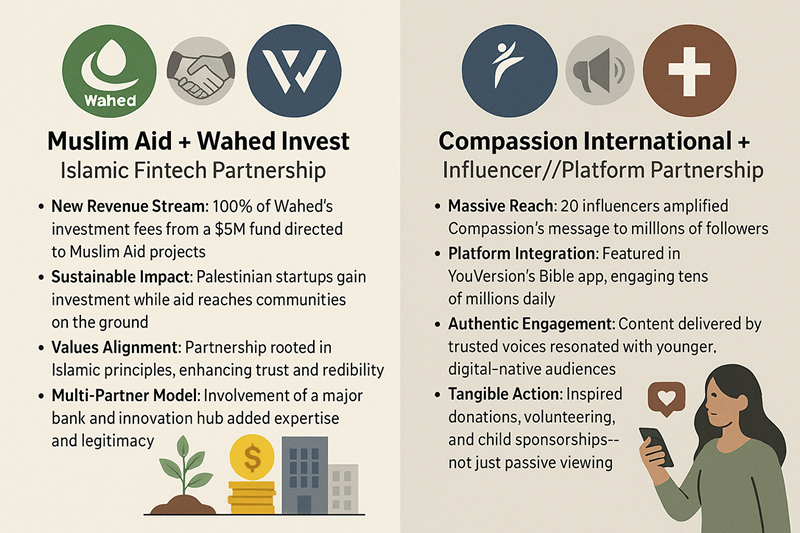
Partnerships in Action: Real-World Examples
Nothing illustrates the power of strategic partnerships better than real success stories. Here are two examples of charities – both faith-based – that accelerated their growth and impact through smart collaborations:
Muslim Aid + Wahed Invest (Islamic Fintech Partnership)
A pioneering partnership blending charitable giving with Islamic finance to support Palestinian communities.
- New Revenue Stream: 100% of Wahed’s investment fees from a $5M fund directed to Muslim Aid projects.
- Sustainable Impact: Palestinian startups gain investment while aid reaches communities on the ground.
- Values Alignment: Partnership rooted in Islamic principles, enhancing trust and credibility.
Multi-Partner Model: Involvement of a major bank and an innovation hub added expertise and legitimacy.
Compassion International + Influencers & YouVersion (Influencer/Platform Partnership)
A digital-first campaign that mobilised influencers and faith-based platforms to inspire action.
- Massive Reach: 20 influencers amplified Compassion’s message to millions of followers.
- Platform Integration: Featured in YouVersion’s Bible app, engaging tens of millions daily.
- Authentic Engagement: Content delivered by trusted voices resonated with younger, digital-native audiences.
- Tangible Action: Inspired donations, volunteering, and child sponsorships—not just passive viewing.
- Brand Strengthening: Boosted Compassion’s presence and credibility in faith-based digital spaces.
These examples underscore a crucial point: whether it’s a tech-driven financial partnership or a creative content-driven campaign, strategic collaborations can dramatically amplify a charity’s reach and results. They also show that faith-based organisations in particular can leverage values-aligned partners – Islamic fintech in one case, Christian content creators in another – to unlock new pathways for generosity.

Conclusion: Getting Started with Strategic Partnerships
Every charity, no matter its size or focus, can start reaping the benefits of strategic partnerships. The beauty of collaboration is that it’s scalable – you can begin with one small pilot and grow from there. Here are a few immediate steps to kick off your partnership journey:
Brainstorm Potential Allies
Gather your team and list 5–10 organisations or individuals that would make dream partners. Think of local businesses, community groups, larger companies with local offices, or influential personalities in your cause area. Use the categories in this post (tech, corporate, community, influencer) as inspiration. You might be surprised how many viable connections are already within your network or just a phone call away.
Reach Out and Explore
Pick one high-potential partner from your list and make the first move. It could be as simple as requesting a meeting to discuss “how we might work together to further [common goal].” You don’t need a perfect proposal from day one – sometimes a conversation will spark ideas and interest. The key is to start building relationships. Even if Partner A isn’t ready, you’ll learn and improve your approach for Partner B.
Empower a Partnership Champion
Identify someone on your staff (or even a board member or skilled volunteer) who can dedicate time to partnership development. This “partnership champion” will keep the momentum going – researching opportunities, making introductions, and following up. If your organisation is larger, consider forming a small cross-department team to evaluate and pursue strategic collaborations as an ongoing growth strategy.
Leverage Existing Success
Do you already have any partnerships in place, even informal ones? For example, maybe a local business sponsored your last event, or a community group helped promote one of your programs. Look at ways to deepen or formalise those relationships first. It’s often easier to expand an existing collaboration than to start a brand new one. Use early wins as case studies to approach bigger partners later.
The most important thing is to embrace a partnership mindset. Instead of asking “How can we raise more money?” start asking “Who could we work with to achieve our mission faster and better?”. By opening up to collaboration, you’ll find opportunities for growth in places you might never have looked before.
What’s Next
At AMCM Agency, we firmly believe that strategic partnerships are a game-changer for charitable growth. Our team has seen firsthand how the right alliance – whether with a fintech platform, a major company, or a community institution – can rapidly expand a charity’s reach and revenue. We regularly advise nonprofits on identifying and structuring these kinds of collaborations. If you’re feeling inspired to explore partnership opportunities but unsure where to begin, we’re here to help. Whether it’s providing guidance on a partnership pitch, connecting you with potential allies, or sharing best practices from across the sector, AMCM Agency can support you in turning collaborative ideas into reality.
Ultimately, beyond fundraising means you no longer have to go it alone. By teaming up with others who share your vision, your charity can achieve more than you ever thought possible – and faster. So go ahead: take that first step toward a strategic partnership. The relationships you build today could become the driving force that transforms your organisation’s tomorrow, accelerating your mission to new heights.
👉 Download AMCM Agency media pack for Charities or contact us below.


