The Charity Leader’s Guide to AI
How artificial intelligence is reshaping fundraising, operations and impact in the charity sector.
Introduction
Artificial Intelligence (AI) is rapidly becoming a transformative tool across all sectors – and charities are no exception. Recent surveys show that around 61% of UK charities are already using some form of AI in their day-to-day work (up from just 35% a year prior). However, most of this use is informal or experimental rather than fully integrated into organisational strategy. Charity leaders in the UK, Ukraine, MENA and beyond are asking: Where does AI fit into our mission, and how can we adopt it responsibly?
In this advisory, we’ll demystify what AI is in plain English and explore its role in a charity setting. We will break down different types of AI and their uses, highlight the benefits and limitations for charities, and discuss crucial issues of authenticity, ethics, and trust. We will examine, department by department, where AI can help – from Fundraising and Marketing to Finance, Operations, and programme delivery – and share real-world examples of charities successfully using AI to further their causes.
Practical guidance will be given on the costs of AI implementation and how to get started (covering teams, tools, policies, pilot projects, and upskilling). We’ll also outline categories of affordable or free AI tools available today, present a SWOT analysis comparing charities that embrace AI versus those that don’t, and look ahead to the future of AI in the charitable sector (including donor AI agents, automation, voice technology, and regulation).
Throughout, the focus remains on practical, responsible adoption. This means using AI to augment staff capabilities and advance your mission, without overhyping the technology or losing the human touch that is so vital for trust in the third sector. By the end of this guide, charity executives should have a clearer understanding of how AI can fit into their organisation – and why thoughtful adoption of AI can offer competitive and mission-driven advantages.
What is AI (and How It Works in Plain English)
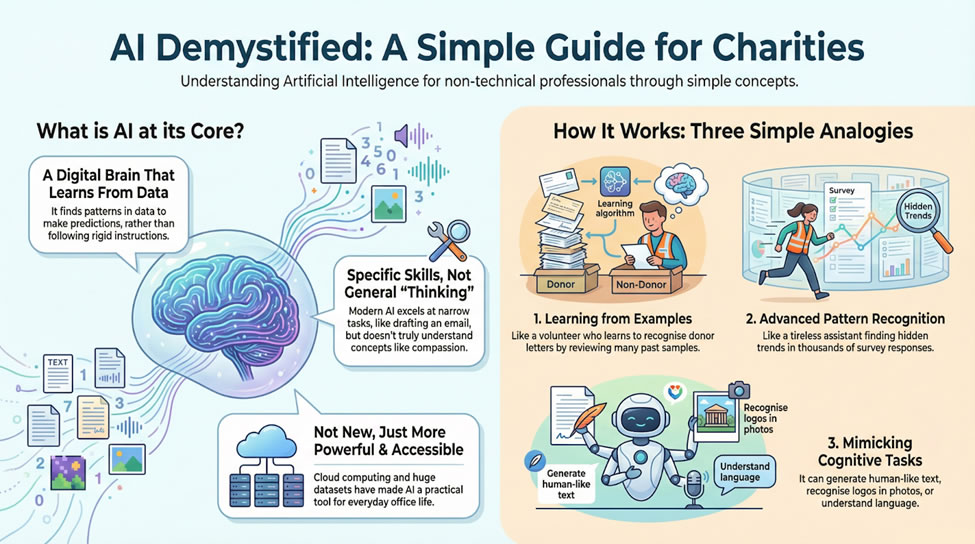
At its core, Artificial Intelligence refers to a machine’s ability to perform tasks that would normally require human intelligence or decision-making. In plain English, AI is like a digital brain that can learn from data and experience. Instead of being explicitly programmed with step-by-step instructions for every scenario, an AI system figures out patterns or rules by analysing large amounts of examples. For instance, you might show an AI thousands of past donor records, and it can learn which supporters are likely to donate again, much as a human might intuit patterns but on a far larger scale.
There are a few simple analogies that can help demystify AI for non-technical audiences:
- Learning from Examples: Imagine teaching a volunteer to recognise donor thank-you letters by showing them many samples – eventually they get a “feel” for it. Similarly, AI algorithms (especially machine learning) develop a model from training data, enabling them to make predictions or decisions when given new input.
- Pattern Recognition: AI excels at detecting patterns that humans might miss. It’s like having a tireless assistant comb through thousands of survey responses to find trends, or scanning social media posts to identify which issues people care about most.
- Mimicking Cognitive Tasks: Some AI can understand and generate human-like language (you’ve probably heard of ChatGPT – an AI that can draft emails or answer questions in a very human-sounding way). Other AI systems can recognise images (for example, flagging a logo in a photo) or even drive cars. These systems use complex statistical models (often neural networks inspired by the human brain’s structure) to approximate cognitive functions.
Crucially, modern AI is usually narrow – it’s very good at specific tasks (like translating text or predicting donor behaviour), but it doesn’t truly “think” or have a general understanding like a person. For example, an AI might generate a convincing fundraising appeal letter, but it doesn’t truly understand compassion or the mission behind your charity. It simply knows what such letters typically look like based on patterns in data.
It’s worth noting that AI is not entirely new. Even in the 1970s, machine learning was being used in fields like healthcare. What’s changed is that today’s AI is far more powerful and accessible: cloud computing and vast datasets have supercharged AI capabilities, and user-friendly tools have brought AI from research labs into everyday office life. In fact, many people already use AI without realising it – from email spam filters and streaming service recommendations to voice assistants on phones. In the charity context, this means AI isn’t some magical science-fiction entity, but often just an extension of software we can use to work smarter.
By understanding AI in these simple terms, charity leaders can cut through the hype. AI is essentially about automation and augmentation: automating routine tasks and augmenting human decision-making with data-driven insights. In the next sections, we will explore how exactly this plays out in a charity setting.
The Role of AI in a Charity Setting
How can AI further the mission of a charity? At a high level, AI should be seen as a tool that supports and amplifies your organisation’s work – always aligned to your charitable objectives. Charities operate with limited resources and big ambitions, whether it’s serving beneficiaries, campaigning for change, or raising vital funds. AI can help bridge the gap by freeing up valuable time and providing insights, so staff and volunteers can focus more on high-impact activities.
1 – Efficiency and Productivity
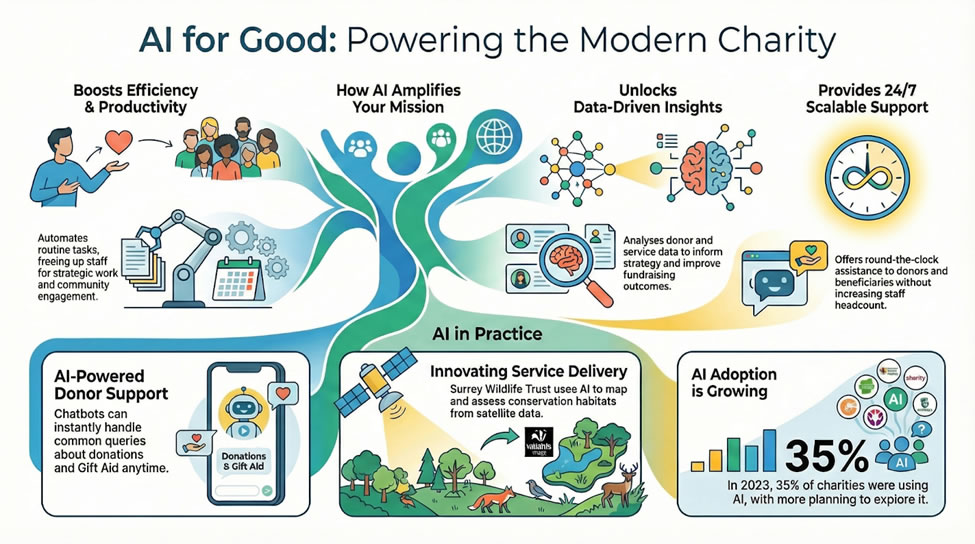
One of AI’s biggest promises is to handle time-consuming, resource-intensive tasks on behalf of your team. For example, instead of staff spending hours sifting through data or answering the same basic questions from supporters, an AI system could do the heavy lifting. This frees up human workers to do what they do best – building relationships, engaging communities, and crafting strategy. A trustee of a UK charity recently noted that AI has the potential to “free up valuable time spent on resource-intensive tasks, which can then be redirected to higher priorities. In practice, this might mean an AI tool summarises a 50-page impact report in seconds, giving leadership more time to act on the insights, or a chatbot handles routine donor inquiries so the supporter care team can devote attention to complex cases.
2 – Insight and Decision Support
Charities accumulate lots of data (donations, service usage statistics, social media interactions, etc.). AI can analyse these mountains of information far faster than any person, identifying patterns and trends that inform strategic decisions. In a charity setting, this could translate to predictive models that help you understand donor behaviour – for example, highlighting which supporters are likely to lapse so you can intervene, or which outreach methods yield the best response rates. As we’ll see, organisations like Charity: Water have used AI-driven analysis to segment donors and tailor communications, resulting in improved engagement and fundraising outcomes. In short, AI can act as an “analytics assistant,” guiding leaders to make data-informed choices in fundraising, marketing, programme design, and more.
3 – 24/7 Service and Scalability
Many charities serve people or stakeholders who need information or assistance at all hours. AI doesn’t sleep – a well-designed AI chatbot can offer 24/7 responses to common questions from donors or beneficiaries. This is especially valuable for charities operating across time zones or during emergency appeals. For instance, an AI-based donor support agent could instantly handle queries about how to donate or provide Gift Aid details, even at midnight. That level of responsiveness can enhance supporter satisfaction and trust. Similarly, AI can help scale up operations without equivalent increases in headcount – handling a surge of enquiries during a campaign, processing thousands of forms, or translating materials into multiple languages almost instantaneously.
4 – Innovating Service Delivery
Beyond back-office efficiency, AI can also play a direct role in programme delivery. Charities are starting to experiment with AI to amplify their impact on the ground. A notable example is the Surrey Wildlife Trust in the UK, which embarked on a three-year “Space4Nature” project using AI and satellite imagery to map habitats. By combining volunteer observations with AI analysis of Earth observation data, they can assess conservation areas far more effectively than with human effort alone. This kind of innovation shows how AI isn’t just about money-saving; it can unlock new ways of achieving the mission that were previously impossible or impractical.
5 – Maintaining Purpose Alignment
Importantly, any use of AI should be guided by the principle that it furthers your charity’s purposes. AI is not a shiny goal in itself. Charity leaders and trustees should continually ask, “Will this AI application help us deliver our mission better?” For example, an AI tool that writes quicker reports is only valuable if those time savings are channelled into beneficial work or strategic improvement. Likewise, personalising donor outreach with AI is useful only if it translates into sustained support for your cause. Used thoughtfully, AI can strengthen almost every facet of a charity’s operations – but it must be implemented in service of strategy, not as a gimmick.
It’s also worth noting that charities vary in readiness. While some larger charities have already embedded AI in parts of their work, others are at the very beginning. In 2023, about 35% of charities were using AI for certain tasks, and another 26% were planning to explore it.
By 2024–25, adoption has accelerated, especially among larger organisations. This means we are reaching a tipping point: AI capabilities are becoming more mainstream in the sector, and charities that take a proactive, strategic approach to AI can gain significant advantages in fulfilling their mission. In the next section, we’ll clarify the different types of AI and what each can do – giving you the vocabulary to spot AI opportunities in your charity.
Different Types of AI and What Each One Does
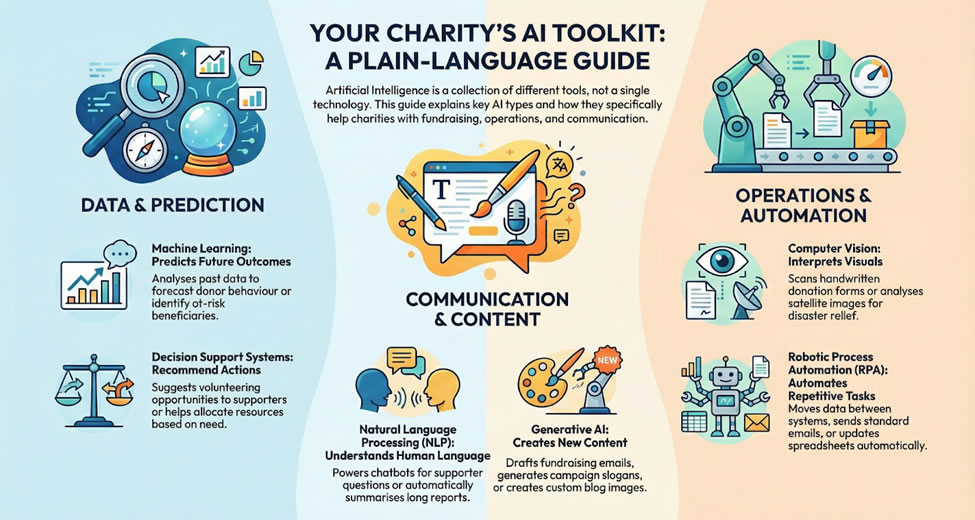
Not all “AI” is the same. It’s a broad umbrella term encompassing various technologies and techniques. Here are some of the key types of AI (in plain language) that are most relevant to charities, and what each does:
1 – Machine Learning (Predictive Analytics)
This is the classic form of AI where algorithms learn from historical data to make predictions or classifications.
What it does: Finds patterns and correlations in data to predict future outcomes. For example, machine learning can analyse your donor database and predict which donors are most likely to respond to an appeal, or which service beneficiaries might need extra support. It can also classify things – like automatically tagging expense transactions into categories. In fundraising, predictive analytics helps identify “high propensity” donors or forecast donation income based on trends. The more quality data you feed these models, the better they get at forecasting (though they’re never 100% right). For a charity, ML is like having a crystal ball that’s informed by all your past data.
2 – Natural Language Processing (NLP)
NLP is the branch of AI that deals with understanding and generating human language.
What it does: Enables computers to read, interpret, and even write text or have conversations. In practice, this powers chatbots and virtual assistants that can conversationally answer supporter questions, or tools that automatically summarise long reports and meeting transcripts. NLP also covers language translation (e.g. translating a document from English to Arabic) and sentiment analysis (e.g. scanning social media comments to gauge public sentiment about a campaign).
Many charities are finding NLP useful – for instance, generative AI writing tools can draft fundraising copy or social media posts based on a prompt, saving staff time on blank-page writing. Speech-to-text tools (a form of NLP) can transcribe interviews or meetings, which several charities use to avoid manual note-taking. Essentially, NLP helps charities communicate and process text at scale.
3 – Generative AI
A subset of AI (often using advanced NLP and other models) that creates new content. This includes AI that can write content, create images, compose music, or even generate video. The most famous examples are large language models like GPT-4 (which can draft emails, letters, reports) and image generators like DALL-E or Midjourney (which can produce illustrations or graphics from a text description).
What it does: Produces original-looking output based on patterns it has learned. In a charity context, generative AI can be a content generator – for example, producing a first draft of your annual report narrative, generating ideas for campaign slogans, or creating a custom image for a blog post when you lack a graphic designer. Some charities have begun using generative AI to help with fundraising materials, bid writing, speeches, and policy drafts. As with any AI-generated content, human review is needed (to ensure accuracy and tone), but it can dramatically speed up the creative process.
4 – Computer Vision
This is AI that interprets and understands visual information – basically, “eyes” for a computer.
What it does: Analyses images or videos to identify objects, faces, text, or patterns. For example, computer vision can automatically scan a stack of scanned donation forms and pull out the handwritten amounts and donor names (using OCR – optical character recognition). It can also be used in the field: e.g., an environmental charity could use AI to count animals in camera trap photos, or a disaster relief charity might use AI analysis of satellite images to assess damage to buildings after a crisis.
A real example is the habitat mapping by Surrey Wildlife Trust, where satellite images combined with AI help assess environmental features that would be impossibly time-consuming to survey manually. For most office-based charities, computer vision’s common uses might include reading documents, automating photo tagging, or enhancing accessibility (like describing images to visually impaired users).
5 – Robotic Process Automation (RPA) and Intelligent Automation
While not AI in the cognitive sense, RPA often gets discussed alongside AI. RPA uses software “bots” to automate repetitive routine tasks by mimicking user actions (clicking, copy-pasting, filling forms).
What it does: Think of RPA as a very obedient, non-thinking intern that can follow a script endlessly – for example, moving data from your fundraising CRM to your accounting system nightly by clicking through screens. When combined with AI (making it “intelligent automation”), these bots can even make simple rule-based decisions.
In a charity, RPA can automate things like issuing standard acknowledgement emails, updating spreadsheets, or scheduling social media posts. It’s particularly handy for administrative processes – saving staff from drudgery and reducing errors. Some charities use RPA to handle finance chores (like reconciling transactions or sending reminders), which pairs well with AI tools that might flag anomalies for a human to review.
6 – Decision Support and Recommender Systems
These AI systems provide suggestions or decisions based on data inputs. For example, a recommender system could suggest to a charity’s website visitor which volunteering opportunities they might like, based on their past engagement. Or an AI decision support tool might help an NGO allocate resources by recommending which regions have the highest need (using predictive models).
In fundraising, you see this in donor recommendation engines – e.g. DonorsChoose uses AI to match potential donors with classroom projects that fit their preferences, improving conversion rates. These systems often combine multiple AI techniques (ML, data analytics, sometimes NLP) to provide actionable recommendations.
In summary, AI is not one thing but many tools in a toolbox. As a charity leader, you don’t need to become a data scientist, but it helps to know the basic categories. That way, when a problem or opportunity arises – say, “we spend too much time answering the same email questions” – you might recall, “Ah, an NLP-powered chatbot could help with that,” or if you wonder, “Can we predict our donation shortfall?” – you’ll think “machine learning predictive model.”
In practice, modern AI solutions often blend these capabilities. For example, an AI donor assistant might use NLP to converse with donors, machine learning to predict their questions, and computer vision to scan documents the donor uploads. The good news is that you don’t have to build these from scratch – many affordable tools (as we’ll outline later) put these AI powers at your fingertips.
Next, let’s weigh the general benefits and limitations of AI for charities, so you have a balanced view of what it can and cannot do.
Benefits and Limitations of AI for Charities
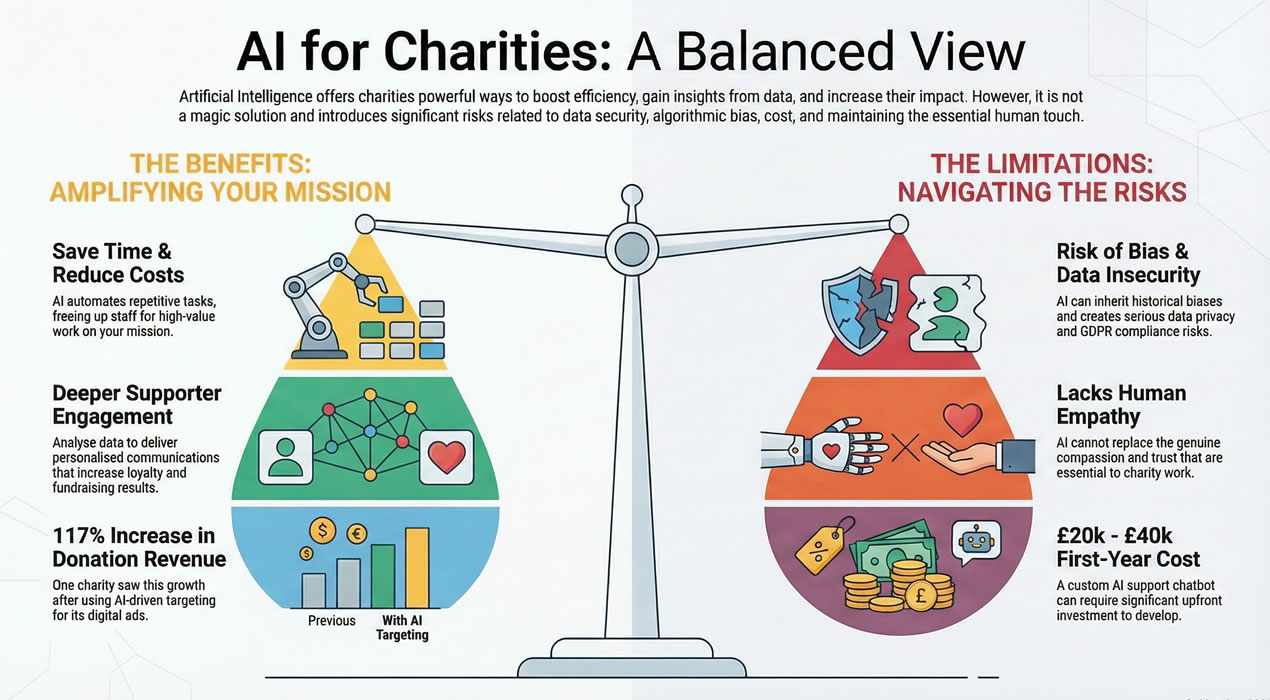
Adopting AI in a charity can offer numerous benefits, but it also comes with limitations and risks that need to be managed. Understanding both sides will help in making informed decisions and setting realistic expectations.
Benefits of AI for Charities
Let’s understand some key benefits of AI for charities.
1 – Saving Time and Increasing Efficiency
AI can automate repetitive, mundane tasks that currently eat up staff hours. This ranges from data entry and scheduling emails to processing applications. By letting AI handle routine processes, your team can spend more time on high-value activities like building donor relationships or delivering services. For example, a chatbot answering common supporter queries can free up your Supporter Care team to focus on complex or sensitive inquiries. AI doesn’t get tired or bored, so it can maintain efficiency 24/7.
2 – Working Smarter with Data
Charities often struggle to make sense of all the data they collect. AI excels at sifting through large datasets to find patterns and insights that humans might miss. This means better decision-making. You can quickly identify donor giving patterns or volunteer engagement trends and respond accordingly. Predictive analytics can flag which lapsed donors are likely to return with a nudge, or which communities might need extra resources next quarter. Essentially, AI can turn your data into actionable intelligence in a way that’s far faster and sometimes more accurate than manual analysis.
3 – Personalising Supporter Engagement
Today’s supporters (especially younger generations) are used to personalised experiences in digital life. AI allows even resource-strapped charities to deliver a degree of personalisation at scale. For instance, machine learning can segment your donor base into distinct profiles and tailor messaging to each segment’s interests and history.
Generative AI can help craft slightly different versions of a newsletter for different audiences (major donors see one emphasis, volunteers see another, etc.). This personal touch at scale can deepen engagement. Chatbots can also provide 1-to-1 conversational experiences, making each supporter feel heard and catered to. When well-implemented, these personalised experiences can increase donor satisfaction and loyalty – one charity reported improved donor engagement and fundraising results after using AI to customise communications.
4 – 24/7 Availability and Scalability
Unlike humans, AI tools can operate around the clock without breaks. This is a huge benefit for providing information or services at any time. If someone wants to donate at 3 AM or a beneficiary needs help after office hours, an AI assistant can be there. This constant availability can also help you scale up operations without a linear increase in staff. For example, during a disaster appeal, you might receive thousands of similar questions (“How can I donate clothes?”, “Where will my money go?”). A well-trained AI chatbot can handle a large volume of these inquiries simultaneously, something not possible with a small human team. Scalability also means AI can grow with your organisation – it’s often just a matter of increasing computing capacity, not training new staff.
5 – Reducing Costs and Doing More with Less
Many AI tools are free or low-cost, especially compared to the expense of hiring additional staff for the same tasks. For small and medium-sized charities, this is a game-changer. For instance, instead of hiring a data analyst, you might use a free AI service to generate reports from your data. Instead of contracting a graphic designer for every social media post, you could use a free AI image generator to create illustrations for campaigns. Over time, efficiency gains from AI – like automated workflows or improved targeting of fundraising can lead to substantial cost savings or improved ROI. One American charity used AI-driven targeting for digital ads and saw donation revenue 117% above its previous benchmark, meaning the investment in AI expertise paid for itself many times over in better outcomes.
6 – Innovation and Enhanced Mission Impact
By leveraging AI, charities can innovate in how they deliver services or run programs. This can increase impact. For example, an AI model that predicts which service users are at risk of crisis allows a charity to intervene proactively, potentially transforming lives. AI-driven translation tools can instantly convert your materials into multiple languages, greatly extending your reach in MENA regions or among refugee communities without hiring multiple translators. Embracing AI can also signal to funders and supporters that your organisation is forward-thinking and maximising modern tools to fulfil its mission, which can be a competitive advantage. In short, responsible use of AI can amplify a charity’s ability to achieve outcomes that would have been out of reach otherwise.
Limitations and Challenges of AI for Charities
1 – Data Privacy and Security Concerns
AI systems often require a lot of data to train and operate effectively. Charities must be extremely careful with personal and sensitive data (donor information, beneficiary details, etc.). Sending data to a third-party AI service could risk privacy if not done properly. Compliance with regulations like GDPR is non-negotiable – you need to ensure any AI tools or vendors you use handle data securely and lawfully.
There’s also the risk of data leaks or breaches when using new technology. Charities working with vulnerable groups have an extra duty to protect data (imagine the consequences if an AI inadvertently exposed details of at-risk beneficiaries). Thus, limitations on using AI are often limitations on what data you can or should feed it. Not all tasks are appropriate for AI if they involve sensitive info and there’s no secure setup.
2 – Bias and Inaccuracy (AI Is Not Infallible)
AI systems can be wrong – sometimes confidently so. They learn from past data, which may carry historical biases or errors, and thus can perpetuate those issues. For example, an AI tool might systematically under-recommend projects in poorer regions if past funding favoured wealthier areas, not out of malice but due to biased training data. Generative AI can also produce factually incorrect or nonsensical answers (a phenomenon popularly called “hallucinations”).
We’ve seen cases where AI chatbots confidently give out misinformation or even made-up statistics. As a result, AI outputs always need human verification, especially in critical or external-facing tasks. Trustees and staff must remember that AI is a work in progress and won’t always get things right. If a chatbot cannot answer a question, it might improvise an answer that sounds plausible but is wrong – which could mislead supporters. This limitation means AI should not be blindly trusted, and mechanisms for oversight and correction are essential.
3 – Lack of Context and Empathy
AI lacks human understanding and empathy. It operates on patterns, not true comprehension. This means that subtle context, emotional nuance, or ethical judgment calls are often beyond AI’s capability. For instance, an AI might compose a technically perfect email to a bereaved donor, but miss a sensitive tone that a human would naturally apply. Or it might flag a beneficiary as “low priority” because of data patterns, not knowing there are unquantifiable personal circumstances.
Charities trade in compassion and trust, and AI by itself cannot replicate genuine human empathy. This limitation is why AI should augment, not replace, human interaction in areas like supporter relations or frontline services. The human touch remains key – AI can assist by providing information or suggestions, but people need to make the final judgment calls, especially where ethics are concerned.
4 – Initial Costs and Skills Gap
While many AI tools are inexpensive or free to use, there can be upfront costs in terms of time and training. Implementing AI is not simply a plug-and-play affair; it requires choosing the right tools, possibly setting up systems, and training staff to use them properly. There may also be indirect costs – for example, cleaning up your data so it’s suitable for AI analysis, or paying for cloud computing resources for large tasks. In some cases, especially if you want a custom AI solution (like a tailored chatbot with your organisation’s knowledge base), you might need to hire experts or consultants.
One detailed case study estimated that building and rolling out a sophisticated AI donor support chatbot could cost on the order of £20,000–£40,000 in the first year, once you factor in development and training time. While that investment could yield big benefits, not every charity has the spare budget for it. Additionally, staff need to develop new skills to work alongside AI – from formulating good prompts for text generators to interpreting AI analytics. There may be a learning curve and some resistance from staff who are less tech-confident.
5 – Change Management and Staff Concerns
Introducing AI can raise fears among employees and volunteers. Some might worry that AI will make their jobs redundant or devalue their expertise. There can also be scepticism or even ethical objections from team members (“We don’t want robots dealing with our beneficiaries!”). These human factors are a limitation in the sense that any AI project must include change management – communication, training, and assurances to staff about how AI will be used.
A culture of trust and openness is needed so that staff see AI as helping them, not spying on them or replacing them. Moreover, without leadership championing and clear policies, staff may use AI in an ad-hoc way (or not at all). Indeed, a 2024 charity survey found only 22% of organisations felt prepared to respond to AI opportunities and challenges. So internal readiness is as much a limitation as the tech itself.
6 – Quality of Data and Outputs
The old saying “garbage in, garbage out” applies to AI. If your data is incomplete, outdated, or biased, the AI’s performance will suffer. Many charities do not yet have high-quality, well-organised data (e.g. scattered spreadsheets, inconsistent CRM use), and AI isn’t a magic wand that can clean or fix that automatically. It might even amplify the noise. So a limitation is that charities often need to invest in data hygiene and IT infrastructure alongside AI adoption. Similarly, an AI tool might produce a perfectly formatted report – but if the underlying data had errors, the report will too, just with a nice veneer. The AI’s recommendations are only as good as the information available to it.
In short, while AI offers powerful benefits – efficiency, personalisation, insight – it is not a plug-and-play cure-all. It comes with pitfalls that need mitigation: ensuring data privacy, guarding against biases and errors, and maintaining the human element in all decisions. The key is to approach AI with eyes open: leverage its strengths, but have checks and balances for its weaknesses. In the next section, we delve deeper into those critical issues of authenticity, ethics, and trust, which are particularly important for charities, where reputation and values are paramount.

Authenticity, Ethics, and Trust in AI Use (Third Sector Perspective)
Charities operate on a foundation of public trust. Supporters, donors, and beneficiaries expect charities to act ethically and authentically. Introducing AI into your operations must be done in a way that preserves and strengthens trust. Here are the key considerations around authenticity and ethics when using AI in the third sector:
1 – Transparency with Stakeholders
One ethical question is whether (and when) to disclose AI involvement. For example, if a donor is chatting with what they think is a staff member but is actually an AI assistant, could that be seen as deceptive? While it’s not always necessary to label every AI-generated email (especially if it’s been reviewed by a human), charities should be transparent when AI is used in ways that might affect trust. Many organisations choose to let users know when they’re interacting with a bot (e.g. the chatbot might introduce itself as “I’m an automated assistant that can help with common questions”). Honesty maintains authenticity – supporters generally appreciate knowing if content was AI-assisted, as long as the content is still accurate and aligned with the charity’s voice.
2 – Maintain the Human Touch
As emphasised earlier, AI should augment, not replace, human empathy and judgment. Human oversight is non-negotiable for ethical AI use. This means having people in the loop to supervise AI decisions and outputs. For instance, if an AI tool drafts a policy report, a knowledgeable staff member should edit and approve it. If a chatbot is handling beneficiary queries, have staff review transcripts regularly to ensure quality and intervene in complex cases. Human oversight ensures that errors or inappropriate AI responses can be caught and corrected before harm is done.
It also ensures that the values of the organisation – like dignity, compassion, and fairness – are being upheld. Trustees remain responsible for decisions, and they must not delegate critical judgment entirely to AI. A charity’s board would be failing in its duty if it blindly followed an AI-generated strategy plan without question. Always ask: “Does this AI output make sense? Is it in line with our mission and values?”
3 – Bias, Fairness and Inclusion
AI systems can inadvertently introduce or perpetuate bias, which is a serious ethical issue. If the data AI learns from isn’t representative or has historical biases (regrettably common in societal data), the AI might make biased decisions – for example, undeserving a minority group in resource allocation because the training data had fewer examples of that group. Charities need to be vigilant about this. It may be necessary to audit AI systems for bias: checking that outcomes are fair across genders, ethnicities, regions, etc., relevant to your work.
If you find disparities, you’ll need to adjust the approach or data. Some organisations might even involve beneficiaries in evaluating AI fairness (e.g. getting feedback on whether an AI-driven service is meeting everyone’s needs without discrimination). Ethically, it’s also important to ensure AI doesn’t create new barriers – for instance, if a charity moves everything to a chatbot, is it excluding those who aren’t tech-savvy or don’t have internet access? A balanced approach might offer an AI service but keep traditional channels open as well.
4 – Privacy and Data Ethics
Charities often deal with sensitive personal data (medical information, refugee addresses, donor financial details). Using AI responsibly means rigorously protecting this data. Any AI tool that processes personal data should be evaluated for compliance with data protection laws. Some AI services, for example, might use input data to further train their models – which could be a big no-no if you’re feeding in confidential information. Always check vendor policies or use privacy-preserving options (many providers now allow opting out of data retention, or you can run AI tools locally so data never leaves your control).
It’s wise to update your privacy policies to mention AI usage if applicable, so donors and service users are informed. Additionally, consider the data you feed an AI: just because you can use certain data doesn’t always mean you should. For example, profiling donors with AI is powerful, but it should be done in line with ethical fundraising guidelines – avoid crossing the line into undue intrusion or manipulation. Use data in ways that supporters would reasonably expect and be comfortable with.
5 – Accountability and Governance
With AI making or influencing decisions, clarity on accountability is crucial. If an AI-driven screening tool wrongly deprioritises certain beneficiaries, who is accountable? The charity must take ownership of outcomes – you can’t blame “the algorithm” in the eyes of the public or regulators. This is why establishing an AI governance framework or working group is recommended. For instance, the British Heart Foundation took early steps by setting up an internal AI working group and strategy in 2023.
That kind of initiative ensures there are guidelines on how AI is chosen, used, and reviewed. Many sector reports urge self-regulation and charity-specific guidelines for AI. Developing an AI ethics policy or protocol can outline acceptable use cases, prohibited uses (e.g. “We will not use AI to generate donor testimonials or images of beneficiaries that aren’t real”), and an escalation path for AI-related issues. It’s also wise to brief your trustees on AI plans – they should oversee that AI is furthering the mission and not creating new risks.
6 – Public Perception and Donor Trust
How the public feels about charities using AI is evolving and generally encouraging. Research by the Charities Aid Foundation found that people are cautiously optimistic about charities using AI – a majority believe efforts should be made to help charities access AI, seeing the potential benefits. However, there are reservations too. Many donors worry about AI causing bias, job losses, or data breaches in the charity sector.
This means charities need to communicate their use of AI in a way that reassures the public. Emphasise that AI is being used to improve effectiveness and donor funds’ impact, not to replace staff wholesale. Highlight data security measures. It can help to share success stories: for example, explaining how an AI tool saved £X in admin costs that could be redirected to the frontline, or how a chatbot helped serve 1,000 extra people last quarter.
When supporters understand the practical value being added, they are more likely to support the use of AI. Conversely, any scandal or misuse (like an AI spamming people with inappropriate messages or a data leak via an AI app) could damage trust significantly. So the onus is on the charity to implement AI carefully and be ready to respond transparently to any concerns.
7 – Preventing Misinformation and “Deepfakes”
A growing ethical concern is the potential of AI to generate misleading content. Deepfake images, videos, or audio can be used maliciously – imagine someone spoofing a charity CEO’s voice to give false statements, or fake images of a disaster used in fundraising. While this is more of a societal issue than something a charity would do, organisations should be aware of the risk. It’s part of your reputational risk management to have a plan for combating AI-driven misinformation that might target your charity or cause.
Internally, ensure any AI-generated content you use is clearly vetted so you don’t accidentally spread something inaccurate. For example, if using AI to generate a photo of a generic beneficiary for a brochure, think carefully – could that be seen as deceptive or inauthentic if it’s not a real person? Some charities opt to only use real images to maintain authenticity, or clearly label illustrative AI images as such. These are new terrain questions, so keeping an ethical lens is key.
In conclusion, responsible AI adoption in charities is about maintaining trust and amplifying your values. Use AI in ways that respect the dignity of your stakeholders and the integrity of your organisation. Make ethics a discussion point at the start of any AI project, not an afterthought. By being transparent, keeping humans in charge, and safeguarding against bias or privacy missteps, charities can harness AI’s benefits while upholding the high ethical standards expected of them.
Next, let’s get very practical and look at where AI can help in each department of a charity, from fundraising to operations, to illustrate concrete opportunities.
Department-by-Department Breakdown: Where AI Can Help
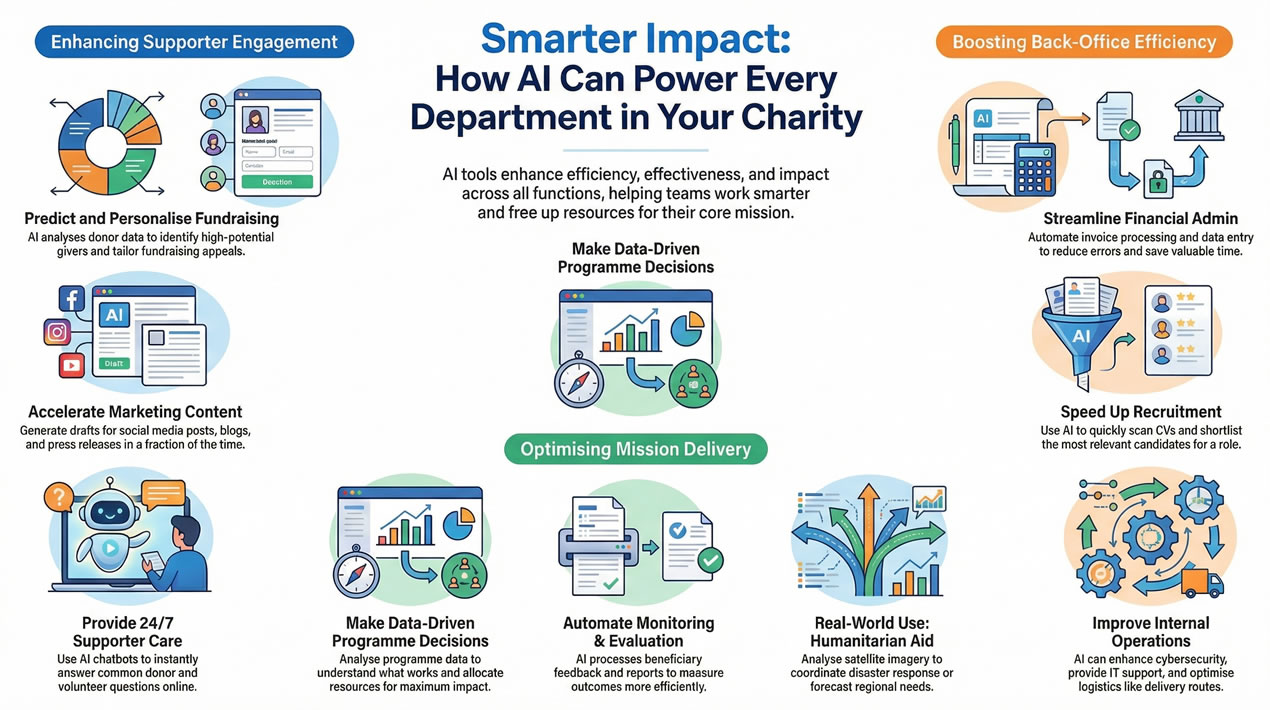
AI can permeate almost every department of a medium or large charity. Below is a breakdown of key areas – Fundraising, Marketing, Supporter/Donor Services, Finance, Programmes, and Operations – with examples of how AI can add value in each:
1 – Fundraising
This is one of the most promising areas for AI in charities. AI can analyse donor databases to identify patterns and segment donors by likelihood to give, preferred communication channels, and interests. This means fundraisers can tailor appeals more effectively (e.g. Charity: Water used machine learning to target communications and saw better donor engagement). Predictive models can flag which donors are at risk of lapsing so you can intervene with a personalised message.
AI writing assistants help draft fundraising emails, campaign copy or grant proposals – providing a first draft that a human can refine, thereby speeding up content creation. Chatbots can also play a role in fundraising by answering donor queries on your website or even guiding someone through a donation form (imagine a supporter typing “I’d like to donate £50” and the AI walks them through securely). Some charities have experimented with AI-driven fundraising coaches: for example, the Movember Foundation used machine learning to identify what factors made peer-to-peer fundraisers successful, then provided personalised guidance to volunteers (like tips and reminders), leading to improved fundraising outcomes.
AI can also optimise campaign timing and targeting – deciding who should get that Facebook ad versus who gets an email, based on data. Overall, fundraisers leveraging AI can work smarter: focusing efforts on the most promising prospects and crafting appeals that resonate individually, rather than blasting one-size-fits-all messages.
2 – Marketing and Communications
AI tools are revolutionising marketing by enabling rapid content generation and data-driven strategy. For charities, which often have small comms teams, this is a huge help. Content creation AI (like GPT-based tools) can generate social media posts, blog articles, or press release drafts in a fraction of the time, which the team can then tweak to perfection. AI can also repurpose content across formats – for instance, turning a written case study into a short video script or generating an infographic outline.
There are AI video generators now that can produce simple explainer videos or testimonials without any filming (some charities are looking at tools to create avatar-led videos to explain their work, using just a script). AI image generators can create custom illustrations or graphics for campaigns (and many are free to use). On the analytics side, AI can optimise your digital marketing: analysing past campaign data to identify what messaging, imagery or timing yields the best results.
A notable example: the American Cancer Society applied machine learning to its digital ads to target the most likely donors, resulting in donation revenue 117% above benchmark for that campaign. That was achieved by letting AI figure out which ad variations and placements engaged people who would donate, and doubling down on those. AI can also manage A/B tests at scale, fine-tuning your charity’s website or email designs for maximum engagement. In sum, AI empowers marketing teams to produce more content, more quickly, and to base decisions on data insights rather than hunches, all while potentially expanding reach without proportional budget increases.
3 – Supporter Services (Donor and Volunteer Support)
Charities pride themselves on caring for their supporters. AI can enhance supporter services by providing immediate, helpful responses and freeing staff for more complex interactions. The prime example is AI-powered chatbots or virtual assistants on websites, email, or messaging apps. These assistants can answer Frequently Asked Questions (“How do I update my Gift Aid status?”), provide information on upcoming events, or help volunteers find the right application form.
For instance, an AI-based donor support agent was designed to handle common donor inquiries via chat and WhatsApp, even helping schedule recurring donations and sending out donation receipts automatically. By handling routine queries 24/7, the AI agent reduced the workload on staff and ensured donors got quick answers, boosting satisfaction. In addition, AI can triage incoming emails or messages – prioritising those that need human attention versus those it can handle. Beyond chatbots, AI can personalise supporter care: imagine an AI that scans donor communications and suggests the best response tone or flags an upset donor email for immediate personal follow-up (via sentiment analysis).
For volunteer management, AI could answer basic questions about volunteering opportunities, or match volunteers to roles based on their skills (using an algorithm to sort through volunteer profiles and suggest good fits). It’s important, of course, that when someone needs a human (complex cases, sensitive issues), the system hands off smoothly. But by front-loading support with AI for common issues, even a small charity can provide concierge-level service to a large base of supporters.
4 – Finance and Administration
In finance departments, accuracy and efficiency are king, which makes them ripe for AI and automation. Invoice processing and bookkeeping can be significantly streamlined with AI: tools now can automatically scan invoices or receipts, extract key data (supplier, amounts, dates), and enter them into finance systems with minimal human intervention. This reduces errors and saves time on data entry. AI can also assist in financial analysis and forecasting.
Machine learning models can forecast cash flow or donation revenue based on historical trends and external data (like economic indicators), helping with budgeting and scenario planning. They can also detect anomalies – flagging unusual transactions or potential fraud by spotting patterns outside the norm (e.g., an unusually large expense claim). For charities handling grants or restricted funds, AI can help track and report on expenditures by intelligently classifying transactions into the right categories. Another emerging use is in audit and compliance: AI tools can quickly review expense reports or grant reports for compliance issues, highlighting items that need further review.
Charities with investment portfolios or endowments might use AI-driven analytics to monitor performance or even optimise investment decisions (with professional oversight). Additionally, AI can generate plain-language summaries of financial data for boards or annual reports (“In Q1, income was 5% above forecast due to X, while expenditures stayed flat.”).
Administrative departments can use AI for things like document management – automatically organising contracts or HR documents, and even answering staff questions by searching policy documents (“What’s our policy on parental leave?” asked an internal AI assistant). Overall, AI in finance/administration reduces paperwork and manual number-crunching, which improves accuracy and frees staff to focus on strategic financial management and ensuring accountability.
5 – Programmes and Service Delivery
This is the heart of many charities – delivering on-the-ground impact – and AI is increasingly being applied here in creative ways. Data-driven decision-making: AI can analyse program data to figure out what’s working and what’s not. For example, a health charity might use AI to predict which clients are likely to miss appointments or medication refills, so they can target interventions to those individuals. In humanitarian work, AI might analyse satellite imagery or social media data to identify areas with emerging needs or to coordinate disaster response more efficiently.
We already saw how an environmental programme used AI (with satellite data) to map habitats in Surrey – similarly, agricultural or poverty-alleviation programmes might use AI to allocate resources to regions where it will have the most impact, based on predictive modelling. Monitoring & Evaluation is another big area: AI can churn through surveys, reports, and even qualitative data (like analysing common themes in beneficiary feedback) to help measure outcomes and learn lessons. Natural language processing can translate feedback from multiple languages automatically, which is great for international programmes.
Charities working in conflict or crisis zones have started to use AI for things like mapping refugee movements or forecasting famine by analysing weather, crop, and pricing data. AI-powered tools (often open source) can also assist beneficiaries directly – for instance, a simple SMS chatbot that answers farmers’ questions about best practices (trained on agricultural expertise), or a mental health chatbot that provides guided but clearly not-human support as an interim between therapy sessions (always with proper ethical guardrails).
In education programmes, AI tutors can help personalise learning for students by providing practice exercises adapted to their level. The possibilities are vast. The key is that programme staff should see AI as a support tool: helping them allocate efforts wisely, reach more people, or provide additional services that would be hard to scale with humans alone. At the same time, programmes involving AI should be closely monitored to ensure they are effective and not causing unintended harm (e.g., if an AI model’s suggestion for resource allocation overlooks a community that doesn’t produce much data, staff need to catch that).
6 – Operations, HR, and Internal Support
The day-to-day running of an organisation – HR, IT, facilities – can also benefit from AI.
Human Resources: AI can streamline recruitment by quickly scanning CVs to shortlist candidates that meet role requirements, or even by scheduling interviews based on everyone’s calendars. (Be cautious to use AI hiring tools that have been checked for bias – you don’t want to filter out diversity inadvertently). HR chatbots can answer staff questions like “How do I file an expense claim?” by pulling info from policy manuals, saving HR staff time. AI-based learning platforms can personalise staff training – for example, recommending courses or resources to an employee based on their role and goals.
IT and Infrastructure: AI can help with cybersecurity by detecting unusual network activity or phishing emails, acting as an ever-vigilant security guard for your digital assets. It can also assist in tech support – using an AI assistant to help staff troubleshoot common IT issues (“Have you tried resetting your password? Here are the steps…”), reserving IT personnel for more complex problems.
Operations/Logistics: If your charity deals with logistics (say, distributing supplies or managing a fleet of vehicles), AI optimisation algorithms can plan routes or inventory more efficiently, cutting costs and time. For example, an AI could optimise delivery routes for a food bank to save on fuel and reach more people.
Another operational use is knowledge management: large organisations have tons of internal documents; AI-powered search (using NLP) can help staff find information much faster (“find the latest risk register for water projects”). Some charities use AI scheduling tools for booking meetings or managing their volunteers’ rotas (the AI finds the optimal schedule that meets everyone’s constraints). Even energy management in offices can be optimised by AI (smart systems learning usage patterns to save electricity). While these might seem small, they contribute to a more efficient operation, which ultimately supports the mission by freeing up resources.
As we can see, every department has relevant AI use cases – some immediate and simple (like automating admin tasks), others more strategic (like predictive analytics for donor behaviour). It’s important for each department head to identify pain points or opportunities where AI could help, and then pilot a solution in that area. We will discuss how to get started with such pilots and upskill your team shortly. But first, let’s look at some real-world success stories of charities using AI, to ground this in tangible outcomes and lessons.
Real-World Examples of Charities Using AI Successfully
It’s inspiring and instructive to see how peer organisations are already leveraging AI. Here are several real-world examples of charities employing AI tools, along with the outcomes or benefits they achieved:
Charity: Water – Donor Segmentation and Personalisation
Charity: Water, an international NGO, uses AI to analyse and segment its donor database. By leveraging machine learning, they identified patterns in donor behaviour that allowed them to tailor fundraising appeals to specific segments of donors. This targeted approach has proven more effective in engaging donors and increasing fundraising results. In practice, that meant donors received content that resonated with their interests (e.g., a donor who funded wells in Africa got impact updates about that region), leading to higher response rates.
2 – Movember Foundation – Optimising Peer-to-Peer Campaigns
The Movember Foundation (which focuses on men’s health) employed AI to boost its widespread peer fundraising campaigns. They used machine learning to analyse data from past campaigns and pinpoint the key factors that drive successful fundraising outcomes. For example, they discovered certain communication patterns or supporter behaviours that correlated with raising more funds. Using those insights, Movember provided personalised coaching and support to their fundraisers – nudging them to take effective actions. As a result, individual fundraisers were able to improve their efforts, and overall campaign performance increased.
3 – American Red Cross – “Hero” Blood Donation Chatbot
The American Red Cross developed an AI-powered chatbot named “Hero” to assist potential blood donors. Hero uses natural language processing to answer questions about blood donation – for instance, it can tell someone their eligibility based on criteria, dispel common fears or myths, and help them find nearby blood drives. By simplifying the process for potential donors and being available on demand, this chatbot has increased participation in blood donation campaigns. People are more likely to donate when their questions are answered quickly and accurately, and Red Cross staff have more time to focus on running donation events rather than answering repetitive queries.
4 – American Cancer Society – AI-Enhanced Digital Advertising
The American Cancer Society (ACS) applied machine learning in a fundraising context to maximise the impact of their digital ads. In a 2022 project, ACS used an AI-driven advertising platform to identify which of its online ad campaigns were generating the most donations and which audiences were most likely to donate. The AI analysed huge sets of advertising data (impressions, clicks, donation conversions) and learned how to target the most “probable donors” with the right messaging.
The results were impressive: the campaign guided by AI generated 117% more donation revenue than their previous benchmark, with a donor engagement rate of nearly 70%. Even click-through rates on interactive banners jumped to 87.5% above the charity’s benchmark. This real-world outcome shows how AI can dramatically improve fundraising efficiency – essentially doubling results without doubling spend, by being smarter about who and how to target.
5 – UNICEF – U-Report Youth Chatbot
UNICEF created a chatbot platform called U-Report to engage young people around the world. While not a fundraising tool, it’s a powerful programmatic example. U-Report uses AI to interact with millions of youths via SMS and social media, gathering their opinions on issues and sharing information. This not only gives UNICEF real-time data on youth sentiment in various countries, but it also raises awareness and keeps young people involved in UNICEF’s initiatives. The engagement through U-Report can indirectly support fundraising and advocacy by building a community of informed, engaged young supporters who may donate or take action later. It’s a great example of scaling outreach with AI while maintaining a conversational, youth-friendly approach.
6 – DonorsChoose – AI Matching Donors to Projects
DonorsChoose.org is a crowdfunding platform for school teachers’ projects, and they implemented AI to enhance the matching of projects with potential donors. The platform’s AI analyses project descriptions, donor preferences, and past donation history to recommend projects that particular donors are likely to fund. This personalised recommendation system means donors find projects that align with their passions more easily, and teachers get funding faster for their classrooms. The AI-driven matching increased the efficiency and effectiveness of fundraising on the platform – donors feel the site “just knows” what they care about, which in turn lifts donation conversion rates.
7 – Surrey Wildlife Trust – AI for Conservation Mapping
Earlier, we mentioned the Surrey Wildlife Trust’s Space4Nature project. Over three years, they have been using AI combined with satellite imagery and citizen science to map and assess habitats across the county. The AI processes vast amounts of data (like changes in land use seen in satellite photos) far faster than a human team could, providing up-to-date maps of ecosystems. Volunteers on the ground feed observations into the system, which the AI uses to improve its assessments.
The outcome is richer, more detailed environmental data that allows the Trust to focus conservation efforts where they’re most needed. This project is still ongoing, but it demonstrates how AI can elevate a charity’s field work – doing in minutes what might have taken months, and with greater precision, thereby guiding better decisions for wildlife conservation.
These examples underline some common themes in successful AI use: targeted problem selection, pilot testing, and human-AI collaboration. Each charity identified a specific need or opportunity (be it donor targeting, campaign analysis, user engagement, etc.) and applied AI as a solution, usually starting small. In all cases, humans are still very much in the loop – interpreting the AI’s findings, providing oversight, and adding the relational touch (e.g., fundraisers acting on the AI’s suggestions, or staff fine-tuning chatbot content). The outcomes – whether improved fundraising metrics, higher participation, or operational speed – show that AI, when aligned with clear objectives, can significantly boost a charity’s effectiveness.
For organisations considering AI, these case studies offer reassurance that practical benefits are being realised, not just tech-world hype. Now, a natural question is: what does it cost to implement these kinds of AI solutions, and what’s the return on investment? We address that next.
Cost of AI Implementation
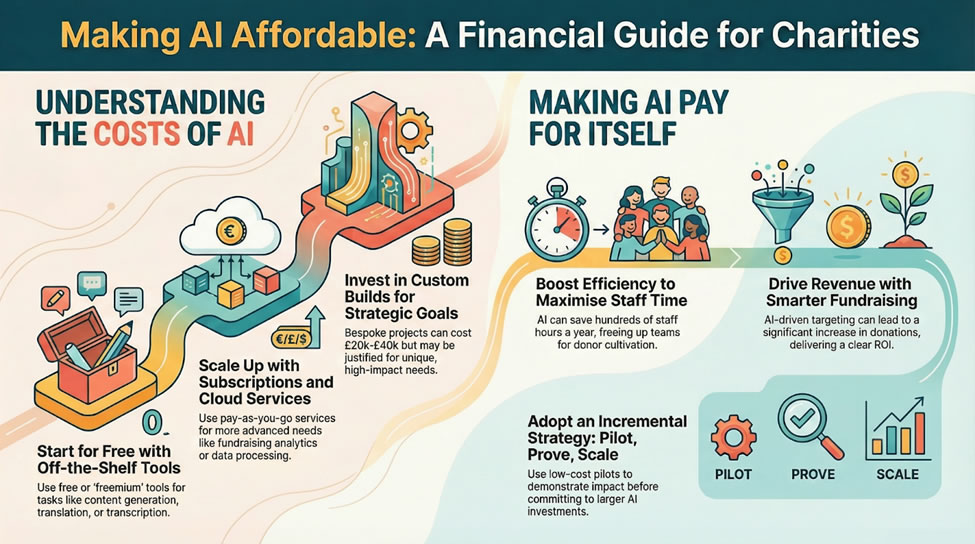
One of the first questions charity executives ask about AI is, “What will it cost us to adopt this technology?” The encouraging news is that implementing AI does not have to be prohibitively expensive, and in many cases, the entry barrier is quite low. However, costs can vary widely depending on the complexity of what you’re trying to do. Here, we break down the cost considerations and how to approach AI cost-effectively:
1. Off-the-Shelf Tools (Low/No Cost)
A large array of AI tools is available on a software-as-a-service or freemium basis, meaning you can start using them either for free or for a modest subscription. For example, using ChatGPT for content generation can cost nothing (with the free version) or about £16/month for the “Plus” version – far less than hiring a copywriter for equivalent output volume. Similarly, image generation tools like Bing Image Creator or Playground AI are free up to certain usage limits.
Many productivity AI plugins (for email, spreadsheets, etc.) are available at little or no cost. This means a charity can pilot AI capabilities without significant upfront spend. A small charity could experiment with AI translations or meeting transcription with free tiers (e.g., Google Translate or Otter.ai’s basic plan). In these cases, the primary “cost” is staff time to learn and use the tool, rather than cash outlay.
2. Subscription and Cloud Services
For more advanced or heavy usage, there might be ongoing subscription or usage fees. For instance, an AI fundraising analytics platform or a donor CRM with built-in AI features might charge a monthly fee or a percentage of funds raised. Cloud providers (Amazon, Google, Microsoft) offer AI services (like vision API, language understanding, etc.) that typically charge per request or per volume of data processed. The costs can add up if you’re processing millions of records, but for a medium-sized charity’s data, it’s often in the order of tens or hundreds of pounds, not thousands.
When budgeting, consider the scale: e.g., running a language model on 1000 donor letters to summarise them might cost a few pounds on an API. Many big tech companies also offer credits or discounts to non-profits – for example, Google’s non-profit programme and Microsoft’s Tech for Social Impact often provide cloud credits that could subsidise your AI implementations. It’s worth exploring those partnerships to defray costs.
3. Custom Development (Higher Cost)
If your needs are very specific or integrated (like building a custom AI chatbot that ties into your databases and payment systems), costs will be higher. Custom AI solutions might involve hiring developers or paying a solution provider. As referenced earlier, a comprehensive AI project like developing a bespoke donor support agent can be on the order of tens of thousands of pounds.
This includes initial development, training the AI, and iterative testing. For example, the case study for an AI-based donor agent estimated a Year 1 cost of roughly £20k–£40k to cover discovery, building an MVP, integrating with payment and CRM systems, and launching. This is a significant investment, usually justifiable for larger charities or those with a strategic reason to build something unique. The return might be improved donor retention and operational savings in the longer run – but up-front funding is needed. Many charities pursuing such projects seek grants specifically for digital innovation or allocate part of their digital transformation budget for it.
4. Hidden and Indirect Costs
Aside from direct software or development costs, consider indirect costs: – Staff Training and Upskilling: You might need to invest in training sessions or learning resources so staff can effectively use AI tools. This is often a matter of time (e.g., giving staff a few hours a week to learn), but could include workshop fees or hiring a consultant for training. – Data Preparation: Making sure your data is ready for AI can require effort. This might mean data cleaning by a database officer or upgrading your data storage solutions.
It’s labour cost, but important to factor in. – Process Change and Integration: Integrating an AI tool into your workflow might require changes in processes or minor IT development. For example, connecting a chatbot to your live database might need a developer’s time for a week or two. – Maintenance: Some AI implementations need ongoing tuning. If you deploy a chatbot, someone should periodically update its knowledge base with new information (like new campaign details). Predictive models might need retraining every so often as data evolves. Budget a bit of staff time for this maintenance.
5. ROI – Return on Investment
It’s crucial to evaluate the cost of AI in light of potential returns or savings:
Efficiency Gains: How many staff hours could this AI save, and what is that worth? For example, if an AI tool saves your fundraising team 10 hours a week in research and writing, that’s 520 hours a year freed. Those hours can be redirected to donor cultivation that brings in more income. The monetary value of time saved is a key ROI component (some organisations actually quantify this).
Increased Revenue: As seen in the American Cancer Society example, investing in AI-driven targeting led to a significant increase in donations. If an AI initiative can raise an extra £50,000 in a year and it costs £10,000 to implement, that’s a clear positive ROI.
Cost Avoidance: AI might help you avoid having to hire additional staff or external services. For instance, instead of hiring an extra support line staff for 24/7 queries, a chatbot could handle out-of-hours questions. Instead of paying for expensive data analysis consultants, an AI service might allow your existing team to do the analysis in-house.
Intangible Benefits: Some returns are harder to monetise but still valuable – improved supporter experience (leading to long-term loyalty), better decision-making (leading to more effective programmes), or simply the reputational boost of being seen as an innovative charity (which might attract new donors or partners).
6. Barriers and Budgeting
According to sector research, a lack of funding and capacity is a major barrier for charities in advancing their digital (including AI) efforts. Small charities, in particular, report struggling due to squeezed finances – 68% of charities said organisational finances are a top barrier to moving forward with digital, and 45% specifically cited lack of digital funding.
This highlights the need to budget for AI within your overall plans and perhaps to seek dedicated funding. There are increasing grant opportunities focused on digital innovation in non-profits. Also, making the internal case to invest in AI might require framing it as a capacity-building expense that will pay off in efficiency or income gains. When small charities successfully adopt AI, it’s often because leadership carved out some budget (even if modest) to allow experimentation, recognising that standing still could be costlier in the long run (in terms of missed donations or inefficiencies).
In summary, start with the low-hanging fruit that offers high value at low cost. Use free trials and pilots to demonstrate impact. For more ambitious projects, do a cost-benefit analysis and seek funder support if needed. Remember that not investing in technology can carry an “opportunity cost” – if peer organisations streamline operations with AI or raise more funds through better targeting, those who don’t invest might find themselves at a disadvantage. The key is to approach AI investments incrementally and strategically: prove the concept, measure the results, then scale up spending as justified by returns.
Next, we’ll discuss how to get started with AI in your charity, including assembling the right team, picking tools, establishing policies, running pilot projects, and upskilling staff for this journey.
How to Get Started with AI in Your Charity
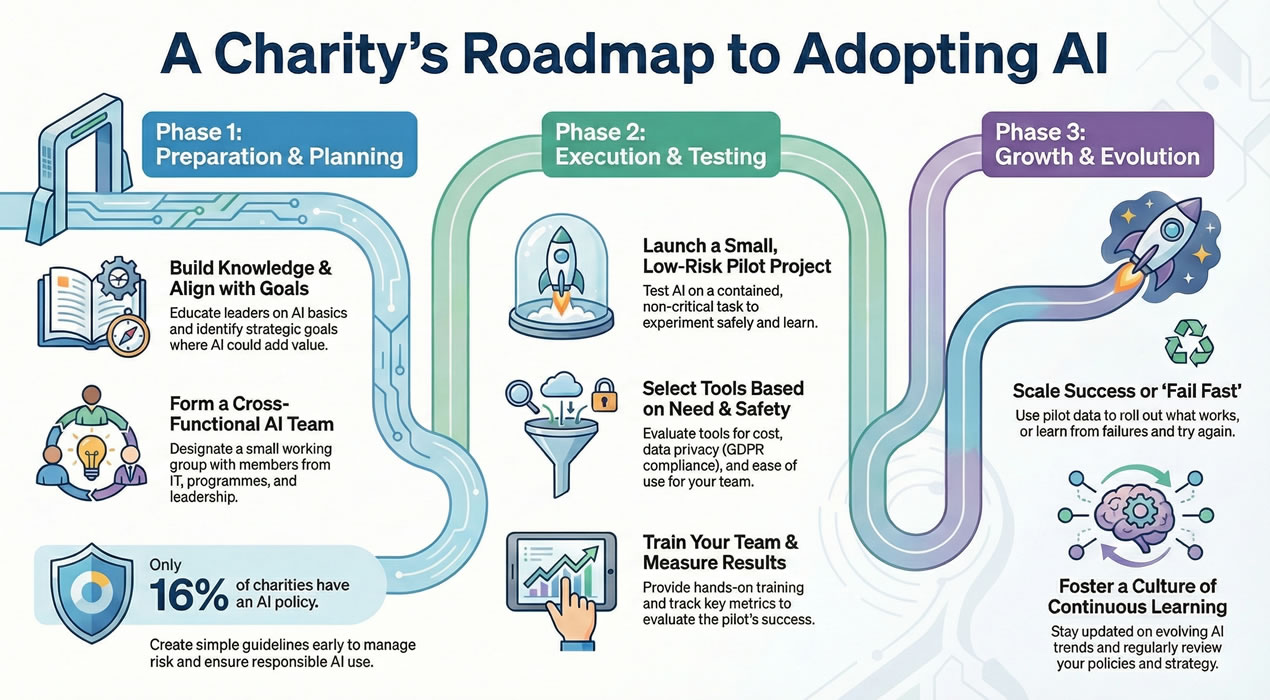
Embarking on AI adoption might feel daunting, but a structured approach can make the journey manageable and rewarding. Here’s a step-by-step guide for charity leaders on getting started with AI – covering people, tools, policies, pilots, and skills:
1. Educate Yourself and Key Team Members
Begin by building a basic understanding of AI among your leadership and project teams. This doesn’t mean becoming tech experts, but getting familiar with core concepts and possibilities. Attend a webinar or workshop on “AI for Non-profits” (these are increasingly offered by sector bodies or tech partners). Read case studies (like some mentioned above) to see how peers are using AI.
A shared knowledge base dispels myths and sets a realistic tone. Leaders should know enough to ask the right questions. For example, a charity CEO in 2025 doesn’t need to code an algorithm, but should understand terms like “machine learning” or “generative AI” in context and have a sense of the ethical considerations. This foundational step will enable informed decision-making.
2. Start the Conversation and Set Goals: Bring AI into strategic discussions
With trustees, directors, and staff. What areas of your charity might benefit most from AI? Encourage an open but focused brainstorm. It’s important to root this in your strategic goals: e.g., “Our goal is to increase fundraising by 15% – could AI help by identifying new donor opportunities or automating some of our outreach?” or “We need to improve support to beneficiaries in remote areas – could an AI tool extend our reach?” Ensure that everyone understands AI is a tool, not a threat. Address fears or misconceptions here. Having these conversations early fosters buy-in and surfaces internal champions.
As the Charity Commission suggests, consider the advantages and risks of AI in the context of your mission and duties. Identify a few gaps or pain points where AI might add value (for instance, “we’re drowning in data and not extracting insights” or “supporter queries are taking too long to answer”). These will be your candidates for pilot projects.
3. Form an AI Working Group or Task Force
Depending on your organisation’s size, it helps to designate a small cross-functional team to lead the AI initiative. This might include someone from IT/digital, a person from the program or fundraising team (depending on use-case focus), and a member of leadership to champion it. Their job is to evaluate options, drive pilot implementation, and develop internal guidelines. For example, the British Heart Foundation established an internal AI working group and even a wider community of AI users to shape an AI strategy.
You may not need a full “strategy” at first, but a clear mandate for a team to explore AI ensures it doesn’t fall by the wayside. This group can periodically report to senior management or the board on progress. Pick people who are enthusiastic or at least curious about tech, but also grounded in the charity’s work (so they focus on practical use, not tech for tech’s sake).
4. Develop a Simple AI Policy (Start with Guidelines)
Early on, draft some basic guidelines for AI use in your charity. This doesn’t have to be lengthy – a one-page set of principles is a good start. For instance, guidelines can state: “We will ensure human review of all externally facing AI-generated content. We will not feed sensitive personal data into public AI tools. We will maintain transparency with stakeholders about AI use when appropriate. We will abide by our values and equality commitments in any AI project.” Only 16% of charities have an AI policy in place so far, but creating one helps set the tone and manage risks from the get-go.
If staff start using AI tools informally, a policy guides them on what’s okay. Review your data protection and cybersecurity policies in light of AI as well, because using AI may introduce new considerations (for example, if staff use ChatGPT, the policy should remind them not to paste confidential data into it, unless via approved secure channels). You don’t have to reinvent the wheel – resources like Charity Excellence or the CIOF have templates for AI ethics and governance frameworks. Adapt one to your context. Having a policy signals to everyone (internal and external) that you’re approaching AI thoughtfully and responsibly.
5. Choose a Pilot Project (Start Small)
With potential use cases identified, pick one or two pilot projects that are feasible and likely to show clear results. It’s often wise to start with something relatively contained and not mission-critical, so you can experiment safely. For example, pilot an AI writing assistant to draft thank-you letters for one segment of donors, or try a chatbot on a specific section of your website (like the FAQ page for event sign-ups).
Alternatively, pilot an internal AI tool like a meeting transcription service or an AI that helps classify inbound emails. Keep the pilot scope limited – perhaps a 2-3 month trial. Define what success looks like (e.g., “reduce staff time on X task by 50%” or “improve response time to enquiries by 1 day”). It’s also beneficial to have a control or baseline to compare against. By limiting scope, you contain risk and can manage the project with minimal resources. Remember to involve end users in the pilot – if it’s a tool for your fundraising team, get their input and feedback continuously.
6. Select Tools and Vendors Carefully
Based on the pilot needs, evaluate a few tool options. You might issue a very small RFP or simply research online. When selecting AI tools:
- Check pricing (does the free tier suffice for pilots? What are the costs if scaling up?).
- Check data policies (do they claim rights over input data? Is it GDPR compliant? Can you opt out of data sharing?).
- Consider ease of use (a tool with a friendly interface may be better than a slightly more powerful one that requires coding, especially for non-technical staff).
- Look for charity-specific offerings – some vendors tailor their AI tools for charities or offer discounts.
- If building something custom, maybe partner with a tech volunteer or pro-bono support (tech companies sometimes have employees looking to volunteer expertise to charities).
- Keep IT in the loop to ensure new tools meet security standards and can integrate if needed. For instance, if the pilot is a chatbot, you might compare a platform like Google Dialogflow (which has a free tier and integration options) with a specialised non-profit chatbot service or an open-source solution like Rasa. Choose one that fits your team’s capacity to implement.
7. Upskill Your Team (Training and Culture)
As you roll out the pilot, invest in training the staff who will use or manage the AI. This can be hands-on sessions (“Lunch and Learn” workshops where team members play with the tool and learn best practices). It can also be encouraging self-learning – pointing staff to free online courses or tutorials. For example, if using an AI writing tool, provide a short guide on crafting effective prompts and reviewing AI outputs.
Emphasise that it’s okay to experiment and make mistakes in the pilot phase – that’s how everyone learns. Creating a culture that encourages learning and curiosity around AI is important. Some organisations form an internal “community of practice” for AI or digital, where staff across departments share tips and experiences.
Also, training should cover the ethical and policy aspects – e.g., remind staff of the guidelines: “We always review AI outputs before they go out, here’s a checklist.” Bringing staff along the journey will reduce fear and increase adoption. Many respondents in surveys express that they need training and guidance to feel comfortable with AI, so provide that support. This might include addressing concerns like “Will AI take my job?” by clarifying that the goal is to free them to do more important work, not replace them. Highlight success stories as they happen in the pilot to build confidence.
8. Monitor, Measure, and Iterate
During the pilot, keep track of how it’s going. Collect data: if it’s a chatbot, how many questions did it answer, and what was the satisfaction rate? If it’s an AI writing tool, how much time did it save the team and did the letters still maintain quality (maybe have a quality rating)? Gather feedback from staff and, if applicable, from users (e.g., did donors find the chatbot helpful?).
Also monitor for any issues: inaccuracies, cases where the AI fails, ed so you know its limits. This monitoring not only helps evaluate the pilot but also identifies any tweaks needed. Perhaps the AI needs more training examples, or the staff need an additional training session on using it effectively. Be prepared to iterate – maybe the first attempt isn’t perfect, but you can refine settings or process. Set a checkpoint (say at 3 months) to decide: do we scale this up, modify it, or try a different approach? For example, you might find the chatbot is great at answering 80% of questions but struggles with 20% – you could then add those 20% into its knowledge base for improvement, or ensure those get routed to humans.
9. Scale What Works (and Don’t Be Afraid to Pivot)
If your pilot yields positive results – congratulations! Develop a plan to roll it out more broadly. That might involve integrating it with more systems, training more staff, or increasing the budget for a paid tier. Document the business case using pilot data to secure any needed investment. However, if a pilot shows mixed or poor results, don’t be discouraged. This is about learning. Analyse whether the issue was the tool choice, the data, or maybe the problem selection itself.
You can pivot to another solution or adjust and try again. It’s better to “fail fast” on a small scale than to invest big and fail later. Many organisations try a couple of AI tools before finding the right fit. Use what you learned to pick the next trial. The key is to keep the momentum: refine the approach or choose a different pilot that might be more feasible. Each iteration builds internal capacity.
10. Continue Developing Skills and Keeping Up-to-Date
AI technology is evolving quickly (what’s cutting-edge today might be standard tomorrow). Encourage a mindset of continuous improvement. This could mean sending staff to an annual digital conference, subscribing to newsletters or communities (like the AI for Good community or sector-specific innovation forums). As part of professional development, perhaps include AI familiarity as a goal – e.g., have fundraisers learn a bit of data analytics, have programme managers learn basics of data privacy in AI, etc.
Also, review and update your AI policy and strategy annually. As new regulations or best practices emerge (and they will), adapt accordingly. Remember that only 9% of charities in a survey were focused on improving data maturity and capability for AI – by making this a priority, you set your organisation ahead. And as you gain successes, celebrate them internally and externally. Show your staff (and supporters) the positive impact – “By adopting this new tool, we saved X hours or helped Y more people.”
Starting with AI is a journey, not a one-time project. By taking these steps, you create a solid foundation and an agile approach: you learn, you iterate, you expand. Importantly, this journey should align with your organisation’s culture and capacity. Some charities might race ahead with ambitious AI labs, while others fold AI quietly into their everyday work – both are fine as long as it serves the mission.
Now that we’ve covered how to start, let’s look at the landscape of tools available today – many of which are affordable or even free – to give you concrete options to consider as you embark on pilots and projects.
Categories of AI Tools Available Today (Affordable or Free for Charities)
The AI tool ecosystem can be overwhelming, but it helps to bucket them into categories. Below are key categories of AI tools that charities can use now, most of which have free versions or are relatively low-cost. Knowing these categories allows you to pick the right tools for your needs without breaking the bank:
1 – AI Writing Assistants
These tools generate or help refine text content. They can draft emails, blog posts, grant proposals, social media captions, and more based on your prompts. Examples: ChatGPT (by OpenAI) is a versatile conversational writer that’s free for basic use; Jasper and Claude.ai are other AI writing platforms popular for marketing copy (with free trials or non-profit discounts).
These tools are great for getting past writer’s block or creating first drafts that you can then polish. For instance, you can ask, “Draft a 200-word thank-you letter for a first-time donor to our education programme” and the AI will produce a solid starting point. Always review and edit AI-written text for accuracy and tone, but many charities find that this dramatically speeds up communications. (Cost: Many have free tiers; paid plans range from ~£10-£30/month.)
2 – AI Meeting Note-Takers and Transcription
If you have a lot of meetings or interviews to document, AI can transcribe and summarise them automatically. Examples: Otter.ai and Fireflies.ai can join your virtual meetings (Zoom, Teams, etc.) and generate transcripts and key point summaries.
Google Meet has built-in captions and summaries in some editions. These tools save staff from the tedious task of note-taking, ensuring nothing is missed. They’re also useful for accessibility (e.g., providing transcripts for those who need them). Some tools offer limited free transcription hours per month. (Cost: Free basic plans with limits; pro plans may be ~£10/month.)
3 – Design and Image Generation Tools
You no longer need advanced graphic design skills to produce appealing visuals for campaigns or reports. AI-assisted design tools can help create images, graphics, and even lay out content. Examples: Canva – widely used for designing social media graphics and flyers – has AI features now (like suggesting layouts or generating images) and offers free premium access to registered charities.
Adobe Express is another user-friendly design tool with some AI capabilities. For more AI-driven image creation, Bing Image Creator or Playground AI can generate custom images from a description (useful for illustrating concepts when you lack a photo). For artistic or specific image styles, Midjourneylow-costst subscription) or Stable Diffusion (open-source, free) let you create unique visuals – e.g. “generate an image of children reading under solar lamps, in a painting style” for a fundraising story. Always ensure you have the rights to use generated images (many AI tools give full usage rights, especially open-source ones, but check the terms). (Cost: Many free options; others may bee £10-£20/month for higher usage.)
4 – Data Analysis and Insights Tools
These are AI tools that help you draw insights from data without requiring a data analyst. They range from AI assistants that work with spreadsheets to full analytics platforms. Examples: ChatGPT Plugins or Microsoft 365 Copilot can work with Excel – you can literally ask in plain English, “Analyse this donor data for trends” and get answers or charts (Copilot is an upcoming paid feature, but ChatGPT can do some CSV analysis with plugins).
Google’s Looker Studio has some AI-driven insights as well. For surveys and text data, tools like Luminoso or even free ones like MonkeyLearn can do text analysis to find common themes. These tools can be affordable shortcuts to what used to require a data team. They can, for instance, forecast fundraising outcomes, cluster your service users into groups, or identify which factors drive successful outcomes in your programmes. Many charities start by using AI in Excel or Google Sheets; some add-ons provide predictive analysis or anomaly detection. (Cost: Some features rolling into existing Office/Google subscriptions; standalone tools vary, but some open-source libraries are free if you have a tech person to use them.)
5 – Chatbot and Conversational AI Platforms
Setting up a chatbot no longer requires a big IT project – there are platforms with drag-and-drop interfaces and generous free tiers. Examples: Dialogflow (by Google) offers a free tier and is fairly user-friendly for creating chatbots that can live on your site or Facebook Messenger. ManyChat or Chatfuel are popular for social media chatbots (often used by charities for Facebook engagement). IBM Watson Assistant has a Lite plan that some charities use for more custom chatbots. There’s also open-source Rasa for those who want full control (though that needs a developer).
These platforms allow you to define the questions/answers or integrate with your database via APIs for dynamic info. As mentioned, a chatbot can handle supporter FAQs, guide users through forms, or collect information (like a mini survey). For voice-based assistants, Alexa Skills or Google Actions could be considered – though those require some development, they enable voice donations or information (e.g., “Alexa, ask Charity X for volunteer opportunities”). Many such tools are free to develop and deploy, charging only if usage is high. (Cost: Free tier often sufficient to start; costs scale with high usage or advanced features.)
6 – Scheduling and Productivity Assistants
AI tools can automate tasks like scheduling meetings, managing calendars, or sorting emails. Examples: Motion or x.ai are AI scheduling assistants – you cc them in an email, and they help find a meeting time for all involved. Some of these have free versions or were recently made free.
Microsoft Outlook and Google Gmail also have increasing AI features: for instance, Gmail’s Smart Compose uses AI to suggest email phrases as you type (saving time drafting routine emails), and Outlook’s Play My Emails can summarise emails to you.
Notion AI (if your team uses Notion for notes/wiki) can summarise and generate content in your workspace. These fall under general productivity, but can save a lot of micro-effort daily. Even simple automations, like using Zapier or IFTTT (which incorporates some AI) to connect apps can streamline workflows (e.g., automatically updating a Google Sheet with new donor info from emails). Many of these have free plans for small usage. (Cost: ranges from free to maybe £8-£12/month for premium versions.)
7 – Specialised AI Tools (Domain-Specific)
Depending on your area of work, there might be AI tools tailored for it. For example:
- Fundraising: Donor prospecting AI (like Gravyty or iWave) that suggests who to contact and even drafts initial outreach emails. These tend to be for larger charities and come at a cost, but they target fundraising ROI specifically.
- Humanitarian/Mapping: Tools like MapAI or the UN’s Jetson platform use AI for crisis mapping and predictions.
- Advocacy: Some advocacy groups use AI to analyse legislative documents or social media sentiment (tools like Quorum or Brandwatch with non-profit pricing).
- Translation: DeepL and Google Translate provide AI translation of documents – often free for basic use – which is great for multilingual regions (accuracy is very high for many language pairs).
- Voice and Video Generation: Tools like Synthesia or HeyGen allow you to create videos with AI avatars speaking your script (imagine a virtual spokesperson giving a message). They’re not free but have trial options and could be cheaper than hiring a filming crew for short explainer videos. ElevenLabs or Resemble AI can generate realistic voice-overs from text, helpful for creating podcast-style content or accessibility narration on a budget.
- Predictive dialers or AI call assistants: For charities with call centres (fundraising or service delivery), AI can assist agents by guiding conversations or transcribing calls. Large-scale, but something to note for bigger ops.
In selecting tools, remember to align with your needs and capacity. Often, the “good enough” free tool is better than an expensive, overly complex system you won’t fully utilise. A 2025 report showed that AI usage in UK fundraising jumped from 57% to 77% between 2024 and 2025, largely because these accessible tools made it easier for charities to adopt AI without huge investments. Many charities are already harnessing simple generative AI for content and predictive AI for data, as discussed.
When trying out tools: – Start with free tiers to pilot their usefulness. – Keep security in mind: use official or self-hosted versions if dealing with sensitive data. – Leverage community: communities like “AI for Good” or forums (even LinkedIn groups of charities tech folks) often share recommendations and tips on tools – a quick way to learn which free tools are working well for others.
This toolkit approach enables you to gradually build up an “AI toolkit” for your organisation, much like you have a standard office software toolkit.
Finally, having looked at tools, it’s worth stepping back for a broader perspective: what happens if you embrace AI versus if you don’t? We’ll examine that through a quick SWOT analysis of adopting AI in a charity context, versus avoiding it.

SWOT Analysis: Charities Using AI vs. Not Using AI
It’s useful to analyse the situation of a charity that embraces AI and one that forgoes AI, in terms of Strengths, Weaknesses, Opportunities, and Threats. This comparison can help leaders understand the strategic implications of their choice to adopt or avoid AI.
SWOT Analysis For Charities Embracing AI:
Strengths
These organisations typically gain efficiency and productivity advantages.
- They can do more with the same resources (or less) – e.g., automating routine tasks means staff have more time for high-touch work.
- AI can also enhance their decision-making and strategy by surfacing data-driven insights that others might miss, potentially leading to better outcomes (like more effective fundraising campaigns or impactful programmes).
- Another strength is innovation reputation: being seen as forward-thinking can attract progressive talent, tech partnerships, and even younger donors who appreciate a modern approach. Internally, using AI might improve staff satisfaction if it takes away drudge work and allows them to focus on fulfilling parts of their job.
Weaknesses
On the flip side, reliance on AI can expose an organisation to certain weaknesses.
- There’s a dependency risk – if the AI system fails or produces errors, operations could be disrupted (imagine if your AI donor database wrongly flags donors as low value due to a glitch – you might neglect important relationships).
- There’s also a skills requirement: staff need to manage and interpret AI outputs; not having those skills in sufficient depth can lead to mistakes or under-utilising the tools.
- Additionally, if not careful, an AI-embracing charity might inadvertently introduce biases or impersonal elements into their work – for example, supporters might feel a communication was a bit “robotic” if the human touch is lost.
- Ensuring quality control and training is an ongoing need (which is a resource and time investment).
- Another potential weakness is that early adoption might involve some trial and error; things might not work perfectly initially, which can cause momentary inefficiencies or costs.
Opportunities:
The opportunities for those using AI are significant.
- They can scale their impact faster – reaching more beneficiaries through automation, raising more funds through better targeting, etc.
- They might discover entirely new ways of working (like developing an AI-driven service model that sets them apart in the sector).
- AI could enable hyper-personalisation of donor journeys or volunteer experiences, leading to stronger engagement and community building around the cause.
- There’s also an opportunity to collaborate with tech companies or researchers; an AI-using charity can partner in pilot projects or get corporate support (since many tech firms want to showcase social good uses of their AI).
- As regulations shape AI, early adopters could help shape standards by sharing their experiences, thereby positioning themselves as sector leaders. Perhaps the biggest long-term opportunity is that by mastering AI tools, these charities continuously improve efficiency, which is crucial in a world where need often grows faster than resources.
Threats
Even as they lead, AI-embracing charities face threats.
- A major one is ethical or reputational missteps: a badly handled AI (say, an insensitive chatbot response or a data breach via an AI tool) could erode trust quickly. They must guard against that through strong oversight and ethical use.
- Another threat is the external dependency on tech providers – if an AI service changes its pricing or policy, it could leave the charity in a lurch (for example, an API going from free to expensive).
- There’s also the broader societal threat: if public sentiment turns against AI (perhaps due to high-profile incidents in other sectors), donors might be wary of charities using it, or regulators might impose strict rules that require sudden changes in systems.
- AI systems can also be targets of cyber attacks (e.g., feeding malicious data to a charity’s AI to manipulate outcomes), so security threats are a consideration.
- Lastly, competitors (other charities) are all adopting AI too; the advantage might be temporary. If every charity can communicate personally with 1 million supporters through AI, the fundraising landscape could become even more competitive in personalisation, and those not continuously innovating could lose any early edge.
SWOT Analysis For Charities Not Using AI:
Strengths
- These organisations might highlight their human-centric approach as a strength.
- They rely on personal interactions and may thus avoid some of the pitfalls of automation (like impersonal communication or algorithmic bias).
- They might also have fewer data privacy worries if they aren’t using external AI services with supporter data. In some cases, a traditional approach could appeal to certain donor segments who are sceptical of technology – for instance, a donor who values that a real person writes them a handwritten letter rather than a generated email might appreciate a non-AI charity’s style. Non-AI users also avoid the costs and learning curve associated with new tech (short-term, at least), meaning they can focus resources on methods they know well.
- There’s a straightforwardness in processes that might simplify oversight and compliance (fewer complex systems to monitor).
Weaknesses
- However, refusing or lagging in AI adoption often leads to inefficiencies and missed opportunities.
- These charities may be slower and less efficient, spending time on manual tasks that others have automated (data entry, routine queries, etc.), which can strain staff and budgets.
- They may lack the rich insights that AI can provide, making their decision-making more reactive or gut-driven rather than data-driven. This can particularly hurt in fundraising – not using AI means potentially not identifying valuable donor patterns or failing to personalise outreach, as well as others.
- Their staff might end up overloaded with work that could be eased by AI, potentially leading to burnout or high turnover. Additionally, not engaging with AI means not upskilling staff in these areas, which over time could make the organisation less attractive to top talent (future employees may gravitate to organisations where they can use modern tools).
Opportunities
- For those not using AI yet, there is the opportunity to learn from pioneers’ mistakes and adopt later with the benefit of hindsight.
- They can be fast followers once tools mature, possibly avoiding the cost of early mistakes.
- There’s also an opportunity to differentiate based on authenticity and personal touch – for example, “100% human-made, no AI” might be a marketing angle in certain contexts (though likely niche). If they decide to adopt AI later, they’ll have a clearer menu of proven solutions, maybe even sector-specific AI tools, and possibly more affordable options as technology commoditises.
- In the interim, they might double down on their current strengths, like community building, using analogue methods (events, phone calls) to foster loyalty that technology alone might not achieve. Essentially, their opportunity, if choosing not to use AI, is to excel so much in the human elements that it compensates for their lack of AI augmentation.
Threats
- The threats to non-adopters are significant in a landscape where AI is proliferating.
- One major threat is competitive disadvantage: as other charities streamline costs and improve outcomes with AI, those savings might allow them to offer more to beneficiaries or invest more in donor acquisition, potentially outcompeting less efficient charities. For example, if Charity A can handle support inquiries with a small team plus AI, and Charity B needs twice the staff for the same workload, Charity B is spending more for less service, which, over time, is unsustainable.
- Another threat is donor expectations: as society gets used to personalised and quick service (thanks to AI in commerce and elsewhere), donors may expect the same from charities. A charity that takes weeks to send a thank-you or provides generic appeals might lose donors to one that responds instantly with tailored communications.
- Also, funders and partners could start to favour organisations that demonstrate innovation and efficiency (some institutional donors ask about how orgs are leveraging tech).
- Non-AI use may be perceived as being behind the times or not maximising impact, making it harder to secure funds. Lastly, internal threat: staff might get frustrated using outdated methods if they see the sector moving on; retaining younger employees could become harder if they feel they’re falling behind in skills by staying at a tech-shy organisation.
In summary, embracing AI positions a charity to be more efficient, data-driven, and innovative, but requires investment in skills and ethical guardrails to avoid missteps. Avoiding AI might preserve a traditional approach and avoid short-term risks, but it increasingly means falling behind in effectiveness and missing out on growth opportunities. The strategic balance clearly leans towards thoughtful adoption – leveraging AI where it aligns with mission and values – rather than wholesale avoidance. As one sector report put it, AI offers “unparalleled opportunities for efficiency and personalisation” but also challenges requiring guidelines and training. Charities that navigate this smartly will likely strengthen their position relative to those who do not.
Finally, let’s cast an eye to the horizon and discuss how AI might further evolve in the charitable sector – and what leaders should be ready for in the near future.
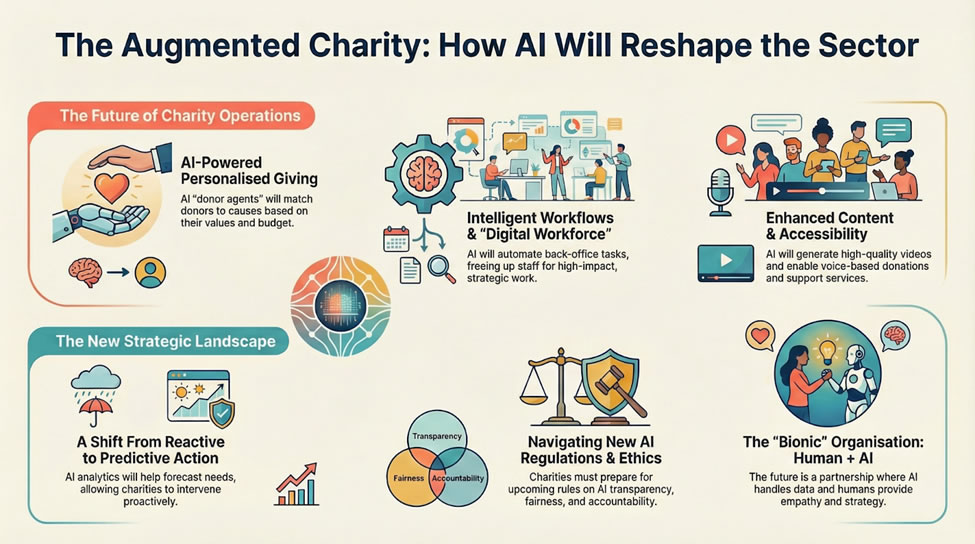
The Future of AI in the Charitable Sector
Looking ahead, AI is poised to become even more integrated into how charities operate and deliver impact. The next few years will likely bring advances and new considerations in areas such as donor engagement, automation, voice technology, and regulation. Here are some future trends and scenarios to consider:
AI-Powered Donor Agents and Personalised Giving
We may soon see the rise of AI donor agents – essentially AI “advisors” that help donors decide how to give, or even semi-autonomous agents that represent donors’ philanthropic preferences. Imagine a donor has an AI assistant (perhaps built into their smart home or phone) that knows their values and financial situation; the donor could say, “Please allocate my £500 charitable budget this month to where it will do the most good for education.” The AI might then research and suggest (or even execute) donations across different charities that align with those criteria, perhaps even coordinating with charities’ systems.
Charities will need to be ready to interface with such donor agents – for instance,e by providing open data about their projects and impact that these AI advisors can consume. This could make donor recruitment less about broadcasting messages widely and more about ensuring your cause is “discoverable” and transparently appealing to AI-driven matchmaking. Some platforms are already hinting at this by using AI to match donors to needs (like DonorsChoose did in a basic way).
We might also see AI-driven donor engagement bots on the charity side – AI that can carry on personalised conversations with donors over the long term, nudging them to renew support or updating them on impact in a very tailored manner, essentially acting as a concierge for each donor at scale.
2 – Further Automation and Intelligent Workflows
The future will likely bring deeper automation into back-office and programme processes. We can expect more intelligent workflows where multiple AI components string together – for example, an incoming grant application might be auto-analysed by an AI for completeness, then important details extracted and summarised for a human decision-maker, cross-checked against your funding criteria by another AI, all before a human even opens the file. Routine decisions (that are low-risk) might be delegated to AI entirely, under human policy supervision.
Supply chain and logistics in humanitarian operations could be optimised in real-time by AI agents that allocate resources, schedule deliveries, and reroute based on changing conditions (with minimal human input except for exceptions). Robotic Process Automation will merge with AI to handle complex multi-step tasks: think of a future “digital workforce” where you have AI bots as part of your team handling defined roles (some companies already speak of “AI employees” for repetitive tasks – charities might have an “AI finance clerk”, for instance). This raises efficiency but also will require robust oversight to ensure these automated processes are correct and fair.
3 – Voice Technology and Accessibility
Voice interfaces will become more prevalent in how people interact with services, including charities. Already, devices like Alexa and Google Assistant allow voice donations (“Alexa, donate £10 to the British Red Cross”), and this convenience could drive more impulse micro-donations in the future. Charities should ensure they are integrated into these voice ecosystems – for example, by registering with voice donation programs or creating their own voice apps for engagement (imagine an official charity Alexa skill that provides daily stories of impact or lets users inquire about programs and donate).
Moreover, voice AI could enhance accessibility of services: a beneficiary who is illiterate or visually impaired could speak to an AI assistant to request help or information from a charity, rather than filling out forms. With improvements in natural language understanding, these voice assistants will handle more complex conversations. We might also see charities using voice cloning tech ethically – perhaps to give a personalised thank-you message from a founder or well-known figure, synthesised by AI (with their permission). For instance, a famous ambassador for a charity might lend their voice model so every donor gets a “thank you” message in that voice, making the experience special. This has to be handled carefully to avoid the uncanny valley or deception, but it could be a powerful engagement tool if transparently managed.
4 – AI-Enhanced Storytelling and Content Creation
In the future, creating compelling content – from videos to interactive experiences – may involve AI heavily. We already see early signs: OpenAI is developing models (like the rumoured “Sora”) to generate high-quality video from text prompts. In a few years, a charity could produce a short fundraising video featuring photorealistic scenes and maybe a generated spokesperson, just by describing what they need, with minimal cost. This democratises creative production – a small charity could have an explainer video as polished as one from a large charity, thanks to AI tools.
There’s also potential for personalised storytelling: AI might generate individualised impact reports for each donor (“Here’s what your donation achieved, with a story of a person you helped”) with pictures and narrative tailored to what resonates with that donor, assembled dynamically from a content library. Such personalised content can deepen connection, but charities will need to ensure authenticity – possibly by blending AI-generated content with real stories and data in transparent ways. The flip side is the risk of deepfakes and manipulation – charities will need to commit to authenticity (maybe adopting watermarks or disclosures for AI-generated media, as standards likely will require).
5 – Predictive and Preventive Analytics
As AI models get more powerful and more data (including open data and government data) becomes available, charities can move towards preventative interventions. For example, rather than reacting to a homeless individual seeking shelter, an AI might predict who is at risk of homelessness by analysing various economic and personal factors, allowing a charity to intervene earlier with support. Similarly, health charities might predict outbreaks or patient crises and preempt them.
This “upstream” work is a big promise of AI and could increase impact significantly, but it also edges into territory requiring careful ethics (making sure predictions aren’t used to stigmatise or unfairly allocate resources). Still, we can foresee consortia of NGOs and researchers pooling data to train models that can, say, forecast famine, conflict flashpoints, or disease spread with high accuracy, giving humanitarian actors a vital head start.
6 – Increased Collaboration via AI Platforms
We might see sector-wide AI platforms that multiple charities use collectively. For instance, a shared AI service that all mental health helplines use to triage and suggest responses (learning from aggregated, anonymised data across them all). Or a collaborative donor intelligence platform where data (privacy-compliant) is pooled to help each charity identify likely philanthropists or grant opportunities, powered by AI analysis that a single charity alone couldn’t afford. This kind of collective approach could be facilitated by umbrella bodies or tech partners, ensuring smaller organisations aren’t left behind. It would also raise new questions of data governance and competition vs. collaboration (charities would need trust frameworks to share data).
7 – Regulation and Standards
On the regulatory front, governments and international bodies are actively discussing AI governance. The EU’s AI Act (likely in effect by 2025/26) will classify AI uses by risk and impose requirements – for instance, “high risk” AI (like something affecting people’s rights or access to services) might need to meet strict transparency and auditing standards. A charity using AI to decide who receives services might fall under such scrutiny, meaning they’d need to document how the AI works, ensure no bias, etc. Additionally, data protection regulators could issue guidance on AI specifically, reinforcing things like not using personal data in AI without a proper lawful basis, etc.
The Charity Commission in the UK has indicated it doesn’t plan separate AI guidance yet, instead encouraging the application of existing governance to AI. But that could change if AI use becomes common – we might see sector guidelines, perhaps from bodies like the Chartered Institute of Fundraising or others, on ethical AI in fundraising, for example. Self-regulation will be key: charities might adopt codes of conduct for AI (some have called for this). There’s also the possibility of needing to label AI-generated content to maintain trust (e.g., if your annual report’s cover photo is AI-generated to illustrate a concept, maybe noting that to avoid any confusion with reality). Smart charities will stay ahead of this by building ethical considerations now and being ready to adapt to new rules.
8 – Don’t Forget the Human Element
In all this future-gazing, one thing is clear: the human element remains vital. AI will get more powerful, but the unique role of charities – building human relationships, advocating with empathy, caring for individuals – will always require humans. The future likely holds a model of “bionic organisations”, where humans and AI work in tandem. Routine tasks and analysis might be AI-driven, while strategy, empathy, and creative decision-making come from people.
For example, you might have an AI that can draft 100 versions of a campaign message tailored to different audiences, but a human fundraiser will choose the tone and approve the final outputs that truly align with the charity’s ethos. AI might pinpoint who needs help, but human volunteers or staff will deliver that help with compassion. As AI handles more, the quality time humans spend – whether with donors or beneficiaries – can increase, ironically making the sector even more humane if balanced correctly.
In summary, the future of AI in charities is one of augmentation and possibility. Leaders should keep an eye on emerging technologies like advanced generative AI (for rich content and conversations), predictive analytics (for proactive service), and collaborative AI platforms. They should also remain agile with policies as regulation catches up – likely focusing on transparency, fairness, and accountability of AI systems. Those charities that embrace these future trends thoughtfully will find themselves with powerful new tools to fulfill their missions – perhaps solving problems that were previously unsolvable or reaching scales of impact that once seemed out of reach. The key will be to do so responsibly, keeping ethics and trust at the forefront, even as we innovate.
Conclusion
AI is not a silver bullet, but it is undeniably becoming a pivotal tool for charities to advance their missions in a fast-changing world. For executive leaders in the UK, Ukraine, MENA and beyond, the message is clear: responsible, practical adoption of AI can yield substantial benefits – from operational efficiencies to deeper supporter engagement – and help your organisation amplify its impact.
In this comprehensive guide, we’ve explored what AI is in simple terms and how it already plays a role in the charity sector. We broke down the types of AI and demystified their uses, assessed the tangible benefits (and the limitations and ethical cautions) for charities, and examined how AI can support each department’s objectives. Real examples from peer organisations have shown that AI is not just hype; it’s delivering real value in fundraising results, service reach, and supporter satisfaction when applied thoughtfully. We discussed costs and learned that many AI initiatives can start small and affordably, often paying for themselves through increased revenues or saved time. We outlined a roadmap for getting started – emphasising pilot projects, team capacity building, and good governance. We also listed current tools (many free or low-cost) that charities can leverage right away to begin their AI journey.
The SWOT comparison highlighted that charities that embrace AI carefully stand to strengthen their work and stay relevant, whereas those who ignore it risk inefficiency and falling behind. And as we peeked into the future, it’s evident that AI will become even more embedded – with donor-agent interactions, voice-driven engagement, predictive interventions, and a need for new standards. Importantly, the future will favour charities that keep humans at the heart of their strategy, using AI as a powerful assistant rather than a replacement for human connection and judgment.
For a C-suite audience, the takeaway is strategic: Integrating AI aligns with both competitive necessity and mission fulfilment. It can help you deliver services more effectively, reach new supporters, personalise communication at scale, and operate with the kind of agility that today’s environment demands. But this integration must be done deliberately – anchored in your charity’s values of authenticity, transparency, and equity. Create an environment where your staff are empowered by AI, not threatened, by providing training and clear ethics guidelines. Cultivate trust with your stakeholders by being open about how and why you’re using AI, and always keep a human lens on the outputs.
To conclude, think of AI as a journey of innovation similar to the adoption of the internet or mobile technology in past decades – those charities that adapted thrived, and those that didn’t struggled. We are at a similar inflexion point. Starting now, even with small steps, is crucial. Use AI to free your people from the menial, inform your strategies with data, and extend your reach in meaningful ways, all while upholding the compassion and integrity that define the charitable sector. In doing so, you not only improve your charity’s competitive stance, but more importantly, you enhance your ability to fulfill your mission and better serve your beneficiaries and supporters.
AI is a tool – a very powerful one – and in the hands of purpose-driven organisations like charities, it has the potential to be a force multiplier for good. By embracing it with wisdom and care, charities can write the next chapter of social impact in the 21st century, one where technology and humanity work hand in hand to create positive change.
Fundraise 20% more with AMCM.Agency
Building an affiliate fundraising campaign isn’t just about setting up tracking and waiting for partners to join. Success comes from knowing where to look, who to contact, and how to build lasting relationships with affiliates and influencers that align with your cause. That’s where AMCM.Agency comes in.
We are specialists in affiliate fundraising for charities. With over 20 years of experience in affiliate marketing, our team has the knowledge and tools to cut through the noise and find the partners who really matter. Unlike most charities starting from scratch, we already maintain a bank of over 10,000 publishers – bloggers, cashback platforms, coupon sites, and content creators – who can give your campaign the kickstart it needs.
By partnering with AMCM.Agency, your charity benefits from:
- Immediate access to pre-vetted affiliates and influencers who understand cause-driven fundraising.
- Professional campaign setup and management on the right networks and platforms.
- Hands-on recruitment and outreach to align you with publishers who genuinely connect with your mission.
- Ongoing optimisation, so your campaign isn’t just launched, but continues to grow and deliver year after year.
Our goal is simple: to help your organisation raise at least 20% more in donations by building a sustainable, performance-based affiliate fundraising program. We know the sector, we know the tools, and we know the partners who can make it happen.
If you’re ready to turn your affiliate fundraising ambitions into real results, let AMCM. Agency launches and manages your campaign. We’ll connect you with the right affiliates, negotiate the right deals, and ensure your program is set up for long-term success.
👉 If your charity is ready to increase online donations through affiliate fundraising, download AMCM Agency’s media kit here or contact AMCM Agency today to discuss how we can help.