How Charities Raise Money Through Cashback and Loyalty Sites
The mechanics, the platforms, and the launch playbook for adding reward-based fundraising to your charity’s mix.
Introduction
Right now, somewhere in your supporter database, dozens of people are shopping online. They’re booking holidays on Expedia. Buying groceries from Sainsbury’s. Renewing insurance. Picking up gifts on Amazon.
If they did all of that through a cashback site that supports your charity, you’d earn money. They’d pay nothing extra.
That’s it. That’s the whole pitch for cashback fundraising. And yet, it’s one of the most overlooked income streams in the charity sector.
In this guide, we walk through how cashback fundraising actually works, the global platforms worth signing up for (UK, US, Canada, Europe, Australia, India, Malaysia and the Middle East), the most common objection charities raise about commission, and a few real examples of how organisations are using this channel well.
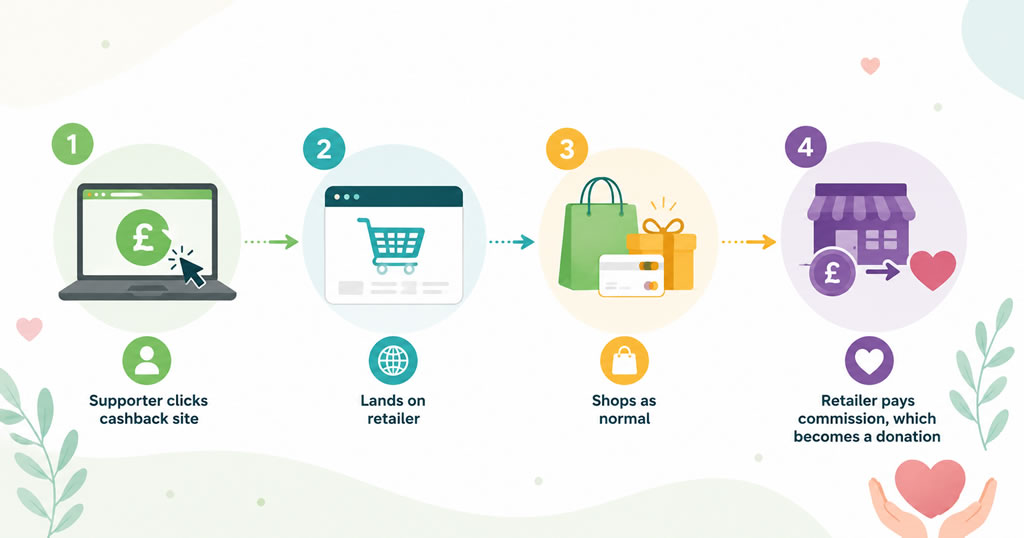
What Is Cashback Fundraising?
The mechanic is simple, and it sits inside the broader world of affiliate marketing.
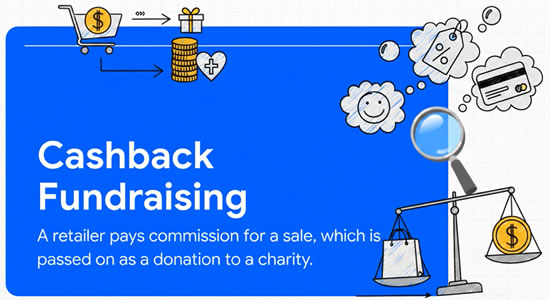
When a supporter clicks through a cashback site to a retailer (Amazon, Argos, Tesco, Booking.com) and makes a purchase, the retailer pays the cashback site a commission. That commission usually sits between 1% and 15%, depending on the retailer and category.
The cashback site then either keeps it (rare), pays it back to the shopper (the standard consumer cashback model), or passes some or all of it on to a charity the shopper has nominated (the charity cashback model).
A few key points worth holding onto:
- The shopper pays nothing extra. The price they see is exactly what they would have paid going direct.
- The retailer, not the charity, pays the commission. They treat it as a marketing cost, the same way they’d pay Google for an ad click.
- The donation is essentially “free money” from the supporter’s perspective. It’s an entirely passive way to give.
- Cashback platforms typically take a small slice of the commission to cover their operations. The rest goes to the cause.
Why This Should Be on Your Fundraising Mix
Let’s drop a few numbers to make the case.
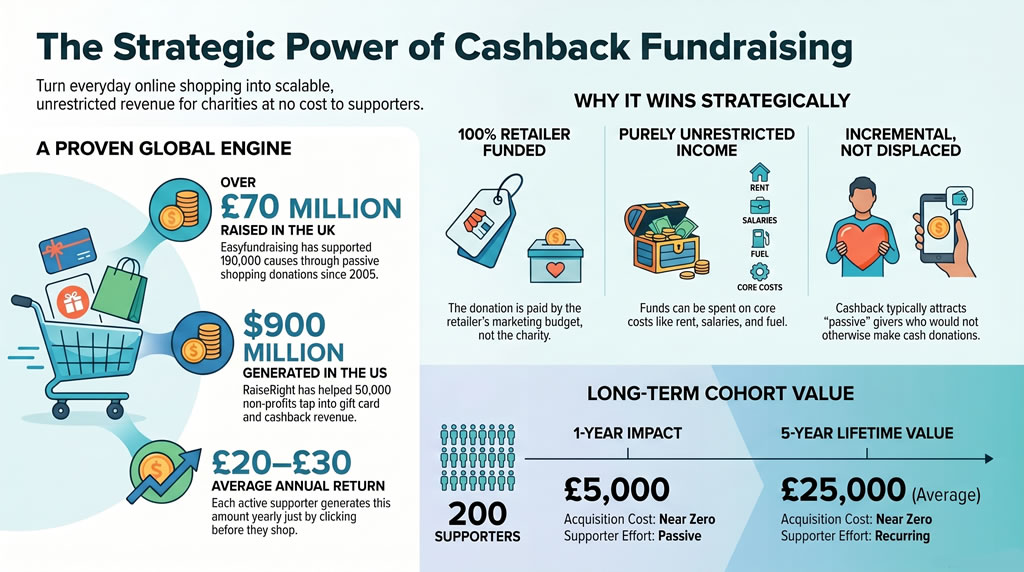
Easyfundraising in the UK has raised over £70 million for around 190,000 causes since 2005. Their members raise an average of £20 to £30 per supporter per year, just by shopping. Across thousands of supporters, that compounds into a high, unrestricted income.
In the US, RaiseRight has helped over 50,000 non-profits raise more than $900 million through gift cards and cashback shopping. Their model is older than AmazonSmile (which Amazon shut down in 2023, leaving a gap many of these other platforms have been racing to fill).
Australia’s Shopnate has paid out over $1.8 million to causes. ShopBack in Asia powers more than $4 billion in annual sales across its 11 markets and runs a #ShopBackGiveBack initiative with major Asian charities.
These aren’t fringe channels. They’re now infrastructure. And the income they generate has some lovely properties.
Cashback fundraising is:
- Unrestricted. No grant restrictions, no campaign-specific tags. You spend it on what you actually need: rent, salaries, core costs, and fuel for vans.
- Recurring. Once a supporter is signed up, donations come in for years.
- Cost-free to acquire. No ad spend, no event budgets, no fundraising fees beyond what the platform takes from the retailer’s commission.
- Passive for the supporter. They don’t need to remember to give. They just need to click before they shop.
Even better, cashback supporters often go on to do more. They sign up for newsletters. They become event participants. They give Gift Aid declarations. They tell their friends. The cashback signup is the first step in a longer relationship.
“But We Don’t Want to Keep Paying Commission”: Let’s Tackle That Objection Head On.
This is the most common pushback we hear from charity finance teams and trustees:
“The cashback site keeps taking a cut every time. We’re paying commission again and again. Wouldn’t it be better if the supporter just donated directly?”
It’s a fair instinct. Let’s break down why it’s actually flawed thinking.
1. The Charity Doesn’t Pay the Commission. The Retailer Does.
This is the single most important point.
When Sarah shops at Argos through Easyfundraising, Argos pays Easyfundraising a commission of (let’s say) 4%. Easyfundraising splits that. Most of it goes to your charity as a donation. A bit covers their operating costs.
Sarah pays nothing extra. Your charity pays nothing. Argos pays the commission as part of its marketing budget. They’ve already decided that paying affiliate commission is cheaper than paid Google ads or display banners. Easyfundraising is just one of the channels they’re already paying for.
You aren’t losing income. You’re gaining income that wouldn’t exist otherwise.
2. These Donors Rarely Give Cash Instead
The fundraising team’s next instinct is: “If Sarah didn’t have cashback, she’d just give us £30 directly each year.”
In practice, that’s rarely true.
Most cashback supporters are passive givers. Many would never write a cheque, set up a direct debit, or click “donate” on a fundraising email. The whole appeal of cashback is that it costs them nothing. Take that away, and most of them just stop giving entirely.
The supporter base for cashback is almost always bigger than your active donor base. It includes friends of staff, distant family members, ex-volunteers, and casual social media followers. People who care about your cause a bit, but not enough to write a cheque.
The cashback donation isn’t competing with a £30 cash gift. It’s competing with zero.
3. Lifetime Value Tells the Real Story
Let’s run rough numbers. Say your charity gets 200 cashback supporters in year one. Each raises an average of £25 a year. That’s £5,000 in year one.
But here’s the kicker. Cashback supporters tend to stick around for 4 to 6 years on average. So that 200-person cohort is worth somewhere between £20,000 and £30,000 over its lifetime. The acquisition cost? Almost nothing beyond a few social posts.
Now compare that to a paid Meta ad campaign that costs you £10 to acquire each new monthly donor. The maths is firmly on cashback’s side.
4. The Commission Funds the Infrastructure That Makes It Possible
Cashback platforms do real work. They negotiate with thousands of retailers, build tracking infrastructure, handle GDPR compliance, send promotional emails to keep supporters active, manage chargebacks and disputes, and process payments to charities every quarter. The slice they keep funds for all of that.
If you tried to build the same direct relationship with even ten retailers yourself, you’d burn through more in salary costs than the platforms ever take.
5. It’s Genuinely Incremental Income
Almost no charity has ever had to choose between “regular fundraising” and “cashback fundraising”. It’s a parallel channel. The major donor doesn’t suddenly become a cashback shopper. The Gift Aid signer keeps signing. Cashback adds new income on top.
So when you hear “we’re paying commission every time” from a colleague, the answer is gentle and simple: no, the retailer is. And every transaction is incremental income, not displaced income.
That’s the case. Now, on to the platforms.
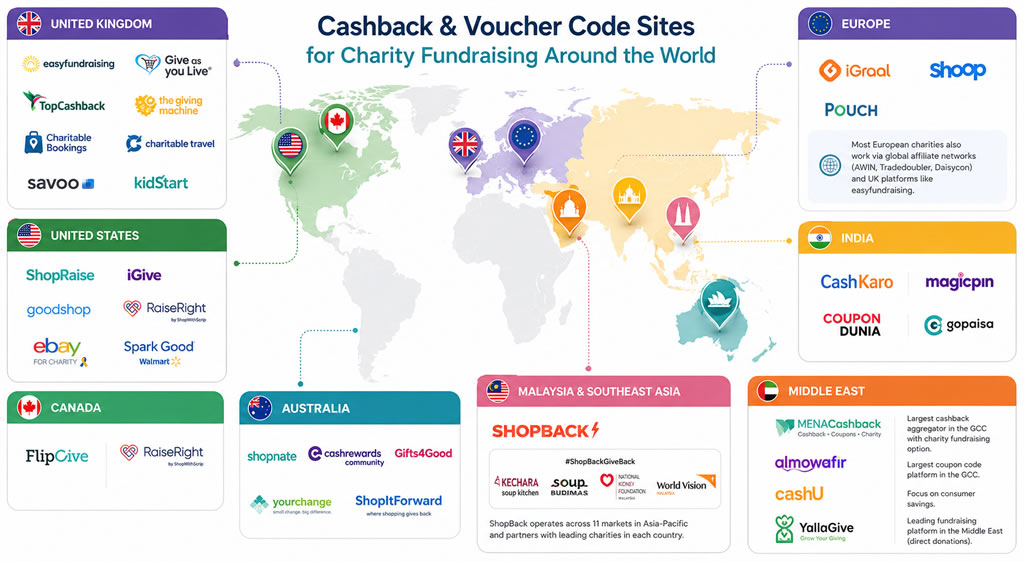
Global Cashback Platforms for Charities, Region by Region
Coverage varies massively by country. Here’s the practical picture as it stands.
🇬🇧 United Kingdom
The UK has the most developed charity cashback ecosystem in the world. If you’re a UK charity, getting onto these is essential.
- Easyfundraising is the biggest. 8,000+ retailers, 2.4 million users, over £70 million raised since 2005. Free for charities. Quarterly payouts once you’ve raised £15.
- Give as you Live has raised over £24 million for UK charities. 5,500+ retailers. 2.5% donation processing fee, no setup or monthly fees.
- TopCashback is a mainstream UK cashback site (around 8.7 million monthly visits) where users can donate their cashback to charity. Charities can apply to be added to its list.
- The Giving Machine has raised over £2 million. Free for charities, focused on grassroots causes.
- Charitable Bookings donates around 30% of the commission on travel bookings to your nominated charity. Roughly £5 per £250 booked.
- Charitable Travel donates 5% of every holiday booking, with no extra cost to the customer.
- Savoo is a voucher code site that donates up to 50% of its affiliate commission to the user’s chosen charity.
- KidStart is a family-focused cashback site that lets parents save for kids and donate to schools or causes.
🇺🇸 United States
AmazonSmile shut down in 2023, but the gap has been quickly filled.
- ShopRaise is the most popular AmazonSmile alternative. 2,500+ retailers, including Amazon, Target and Walmart. Up to 10% per purchase. Free for nonprofits and donors.
- iGive has been around since 1997. 1,500+ retailers. Donates an average of 3% per qualifying purchase. 35,000+ nonprofits supported.
- Goodshop is a sister network with 1,500+ retailers and broad cause support.
- RaiseRight specialises in gift card fundraising. 750+ brands, 50,000+ nonprofits, $900 million+ raised since 1994. Now also offers online shopping fundraising via FlipGive (which it acquired in 2025).
- eBay for Charity lets sellers donate a percentage of their sales to a chosen charity.
- Spark Good is Walmart’s nonprofit programme, including registry and round-up donation tools.
🇨🇦 Canada
- FlipGive is Canada’s main cashback fundraising platform. 800+ brands including Canadian Tire, Walmart, Indigo and Apple. Now part of the RaiseRight family, but the brand and Canadian operations continue. Has given back over $55 million to teams and causes.
- RaiseRight also services Canadian non-profits via FlipGive.
🇦🇺 Australia
A surprisingly mature ecosystem.
- Shopnate is the biggest, with 600+ retailers and over $1.8 million paid to causes. Quarterly payouts once a charity reaches $25.
- Cashrewards Community is Australia’s biggest mainstream cashback site (1,200+ retailers). Shoppers keep their cashback, but a 1% donation goes to the charity of their choice.
- Gifts4Good is similar in model, with an emphasis on schools.
- YourChange focuses on round-up donations from purchases.
- ShopItForward is another option in the same space.
🇪🇺 Europe
The European cashback market is dominated by two big platforms (iGraal and Global Savings Group), but both focus on consumer cashback rather than dedicated charity fundraising.
- iGraal is the leading cashback site in France, with operations in Spain too. 12 million European users, 4,000 partner sites.
- Shoop is iGraal’s German equivalent (same parent company, Global Savings Group).
- Pouch is a UK and European browser extension, also part of GSG.
- Charity-specific cashback platforms in continental Europe are still rare. Most European charities work via global affiliate networks (AWIN, Tradedoubler, Daisycon) rather than dedicated charity cashback platforms. UK platforms like Easyfundraising sometimes have European retailers in their network too, which can work for charities with European supporter bases.
🇮🇳 India
India has a fast-growing cashback market with a few options for charity giving.
- CashKaro is India’s biggest cashback platform, partnered with Amazon, Flipkart, Myntra and 1,500+ other retailers. Has a charity programme (the iCharity partnership) where users can donate cashback directly to causes.
- MagicPin is strong in offline and dining purchases. Users can choose to donate points.
- CouponDunia has 9 million+ active users and lets users redeem cashback for causes.
- GoPaisa is another mainstream cashback site where users can donate earnings.
Most Indian platforms don’t yet offer dedicated charity registration in the same way Easyfundraising does. The model is usually: the user earns cashback first, then chooses to donate it to a registered cause.
🇲🇾 Malaysia and Southeast Asia
- ShopBack is the dominant cashback platform across Asia-Pacific. Operates in Malaysia, Singapore, Indonesia, the Philippines, Thailand, Vietnam, Taiwan, Hong Kong, South Korea, Australia and Germany. 40+ million shoppers across 11 markets.
- ShopBack runs #ShopBackGiveBack in Malaysia, partnering with Kechara Soup Kitchen, the Budimas Charitable Foundation, the National Kidney Foundation of Malaysia and World Vision Malaysia. Users can route their cashback to these causes.
- For charities operating regionally in Southeast Asia, ShopBack is by far the most accessible donor channel.
🇦🇪 Middle East
The Middle East has the least developed charity cashback ecosystem of all the regions covered here. The reasons are partly structural (charity regulation in the GCC requires donations to flow through approved channels) and partly market-driven (cashback culture is still relatively new in the region).
- MENACashback is the largest cashback aggregator in the GCC, with a dedicated charity fundraising option and also offering white label b2b solution.
- Almowafir is the largest coupon code platform in the GCC, but doesn’t currently run a dedicated charity donation programme.
- CashU and similar local players focus on consumer savings rather than charity fundraising.
- YallaGive is the leading Middle East fundraising platform for charities, but it’s a direct donation portal rather than a cashback site.
- For Middle East-based charities looking at this channel today, the practical option is either to work with global cashback sites that target diaspora supporters in the UK or US (Easyfundraising and Give as you Live both list international charities) or to look at local card-linked offers and mobile wallet rewards (Mashreq Salaam, ADCB TouchPoints) that occasionally offer charity donation features.
This is a market we expect to grow significantly over the next few years as Gulf-based charities professionalise their digital fundraising.
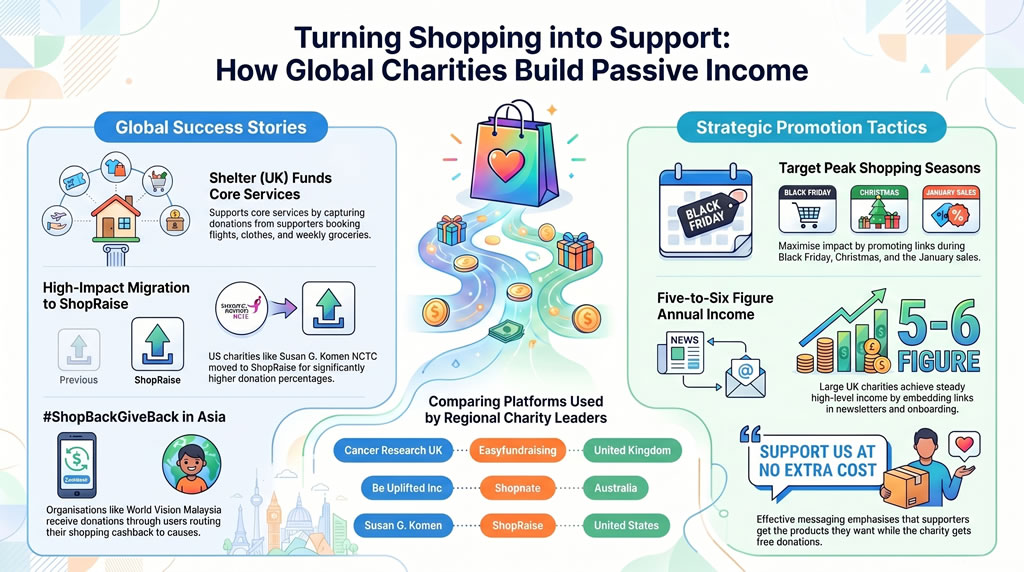
How Real Charities Use These Channels
Theory is fine. Let’s look at how charities actually pull this off.
Shelter (UK)
Shelter, the housing and homelessness charity, has a dedicated supporter page on Easyfundraising. Their supporters raise money simply by booking flights, buying clothes, and doing the weekly shop. Shelter promotes it via email, on social media around peak shopping seasons (Black Friday, Christmas, January sales) and in their supporter onboarding sequence. It’s one of multiple unrestricted income streams that help fund their core services.
Susan G. Komen North Carolina (US)
Komen NCTC’s executive director, Pam Kohl, famously used AmazonSmile to “stay in front of donors year-round.” When AmazonSmile ended, the charity migrated to ShopRaise, where the percentage donated is significantly higher than Amazon ever offered.
Be Uplifted Inc (Australia)
The Brisbane breast cancer charity uses Shopnate as a key passive income stream. They promote it heavily during fundraising peaks and especially around the holiday season, with messaging around “support us at no extra cost.”
One Girl (Australia)
The girls’ education charity uses Shopnate and promotes the model as win-win. Supporters get the products they want, and the charity gets a free donation.
Cancer Research UK, RSPCA, RNLI, the Trussell Trust
All of the UK’s biggest charities are on Easyfundraising and Give as you Live. They promote signups in their supporter newsletters, on their websites, in legacy giving conversations and at events. For most of them, it’s now a steady five or six-figure income line every year.
Multiple Asian Charities
Kechara Soup Kitchen, World Vision Malaysia and the National Kidney Foundation of Malaysia receive donations through ShopBack’s #ShopBackGiveBack programme, where users choose to route their cashback to these causes.
The pattern across all of these is the same: the charity gets registered, then promotes it consistently to existing supporters. The platforms themselves don’t do most of the marketing. Your team does.
How to Actually Launch a Cashback Fundraising Programme
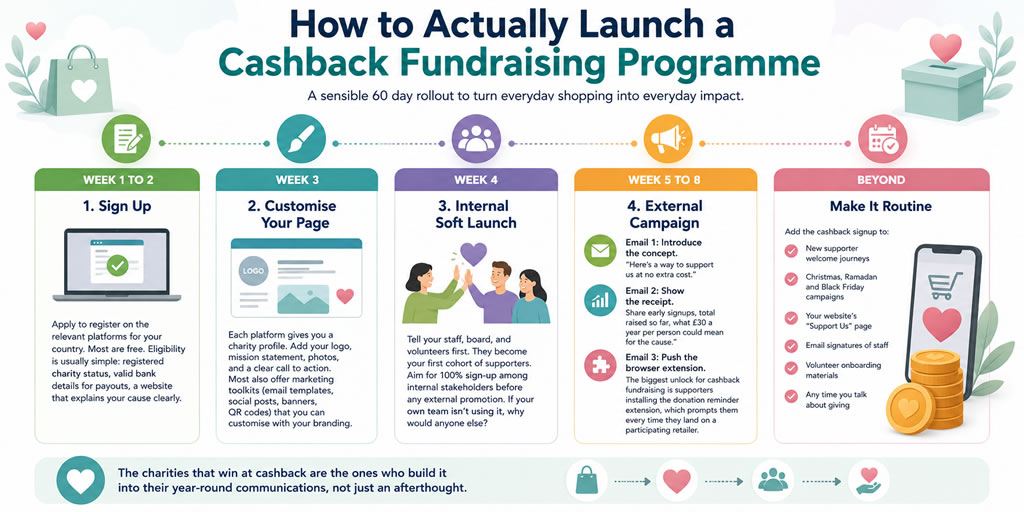
If you’re new to this, here’s a sensible 60-day rollout.
Week 1 to 2: Sign Up
Apply to register on the relevant platforms for your country. Most are free. Eligibility is usually simple: registered charity status, valid bank details for payouts, and a website that explains your cause clearly.
Week 3: Customise Your Pag
Each platform gives you a charity profile. Add your logo, mission statement, photos, and a clear call to action. Most also offer marketing toolkits (email templates, social posts, banners, QR codes) that you can customise with your branding.
Week 4: Internal Soft Launch
Tell your staff, board, and volunteers first. They become your first cohort of supporters. Aim for 100% sign-up among internal stakeholders before any external promotion. If your own team isn’t using it, why would anyone else?
Week 5 to 8: External Campaign
Roll out to your supporter list. A simple three-touch email sequence works well:
- Email 1: Introduce the concept. “Here’s a way to support us at no extra cost.”
- Email 2: Show the receipt. Share early signups, total raised so far, and what £30 a year per person could mean for the cause.
- Email 3: Push the browser extension. The biggest unlock for cashback fundraising is supporters installing the donation reminder extension, which prompts them every time they land on a participating retailer.
Beyond: Make It Routine
Add the cashback signup to:
- New supporter welcome journeys
- Christmas, Ramadan and Black Friday campaigns
- Your website’s “Support Us” page
- Email signatures of staff
- Volunteer onboarding materials
- Any time you talk about giving
The charities that win at cashback are the ones who build it into their year-round communications, not just an afterthought.
Common Pitfalls to Avoid
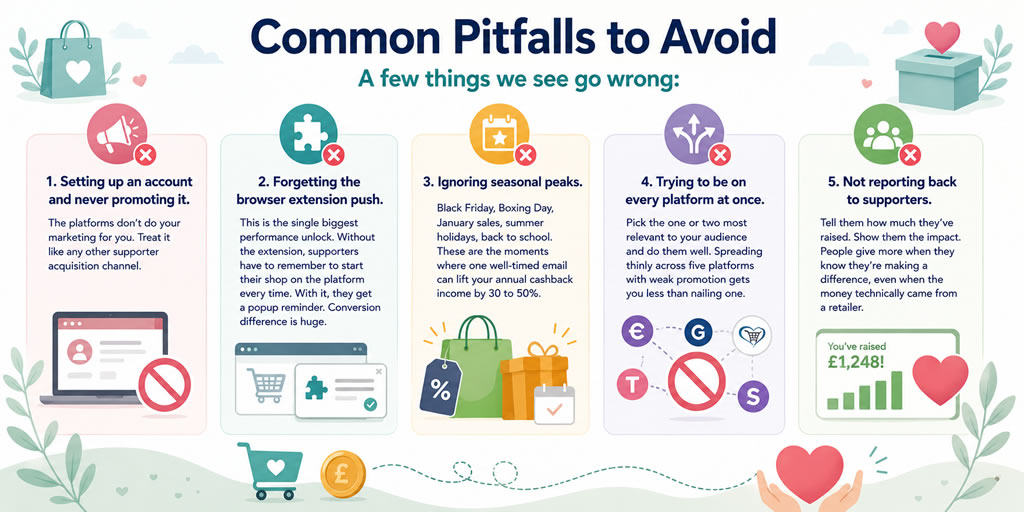
A few things we see go wrong:
- Setting up an account and never promoting it. The platforms don’t do your marketing for you. Treat it like any other supporter acquisition channel.
- Forgetting the browser extension push. This is the single biggest performance unlock. Without the extension, supporters have to remember to start their shop on the platform every time. With it, they get a pop-up reminder. The conversion difference is huge.
- Ignoring seasonal peaks. Black Friday, Boxing Day, January sales, summer holidays, and back to school. These are the moments where one well-timed email can lift your annual cashback income by 30 to 50%.
- Trying to be on every platform at once. Pick the one or two most relevant to your audience and do them well. Spreading thinly across five platforms with weak promotion gets you less than nailing one.
Not reporting back to supporters. Tell them how much they’ve raised. Show them the impact. People give more when they know they’re making a difference, even when the money technically came from a retailer.
How This Fits with the Rest of Your Affiliate Programme
At AMCM, cashback is one slice of a wider affiliate marketing pie. A complete affiliate programme for a charity typically includes:
- Cashback and voucher sites (this article)
- Content publishers (bloggers, comparison sites, niche reviewers)
- Influencer partnerships
- Email and newsletter affiliates
- Loyalty and rewards platforms
- Coupon and deal aggregators
Each of these sub-channels behaves slightly differently. Cashback supporters skew slightly older, are habitual online shoppers, and become extremely loyal once acquired. Content publishers are better for awareness building. Influencers drive bursts of new audience.
Used together, they form a complete affiliate stack that sits alongside paid search, email, social and direct mail in your fundraising mix.
If you want to talk about how to structure your affiliate programme to include cashback as part of a broader strategy, drop us a message. It’s literally what we do.
Download the PDF Presentation or watch a short YouTube Video on this topic.
Final Thoughts
The objection that cashback “keeps eating commission” is the biggest reason charities miss out on this income. We hope this guide has cleared that up. The retailer pays the commission, not you. The income is incremental, unrestricted, and recurring. And the platforms have done all the hard infrastructure work for you.
For UK charities, especially, not being on Easyfundraising or Give as you Live is leaving money on the table. For US charities, ShopRaise and RaiseRight should be on the list. For everywhere else, the regional options above are your starting point.
Set it up once. Promote it consistently. Watch a small income stream slowly become a meaningful one.
AMCM Agency works with charities globally to design and run affiliate marketing programmes. If you’d like to talk about how cashback, voucher codes, or content publisher partnerships could fit into your fundraising mix, we’d love to chat.


