Latest SEO, AEO, GEO and SGE Strategies for Islamic Charities
How to Win Organic Traffic in the Age of AI Search
Foundations: What SEO Really Means in 2025
SEO in 2025 is about holistic visibility, not just keywords. Search engine optimisation today means earning trust and authority across all search platforms – not “gaming” the system. Modern SEO spans traditional search results and new AI-driven interfaces like Google’s Search Generative Experience (SGE) and ChatGPT. Whether someone types a query into Google or asks an AI assistant, they are still searching for trusted content and expertise. In fact, SEO is no longer about manipulative tricks; it’s about providing valuable, authoritative content that algorithms (and users) recognise universally.
Search behavior has changed dramatically. Instead of ten blue links, users now often see AI-generated answers at the top of Google (via SGE) or get responses from chatbots. For example, Google’s SGE can synthesize information from multiple sources and give a conversational answer with citations. Traditional search is like a library index, whereas SGE is like a knowledgeable friend summarizing what you need to know. Similarly, Bing’s AI and tools like Microsoft Copilot or ChatGPT provide direct answers. However, this doesn’t mean “SEO is dead” – search is just fracturing across platforms. Crucially, the same core signals still matter across Google, AI chats, and social search: providing authoritative, original, and trustworthy content.
Key dimensions of SEO today: We can think of modern SEO as four pillars:
- Traditional SEO: Ensuring your website ranks in regular search results (with on-page optimization, keyword targeting, etc.).
- Content-led SEO: Creating educational, fresh content that attracts and engages users. Top SEOs have long focused on publishing useful, data-driven content that drives traffic and builds authority.
- Technical SEO: Optimising site health – mobile-friendly design, fast loading, clean structure, schema markup – so search engines can easily crawl and index your site.
- Authority & Trust (E-E-A-T): Demonstrating Experience, Expertise, Authoritativeness, and Trustworthiness in your content and website signals. This includes things like expert authors, reputable backlinks, brand mentions and consistent information. Google’s guidelines put Trust at the center of E-E-A-T, especially for sensitive topics like charity and finance.
In simple terms, SEO in 2025 means “being the best answer” wherever people search. It’s about serving user intent with quality content and sound web practices. An executive at an Islamic charity should know that good SEO is fundamentally about being credible and useful online – across Google, AI, voice, and beyond.
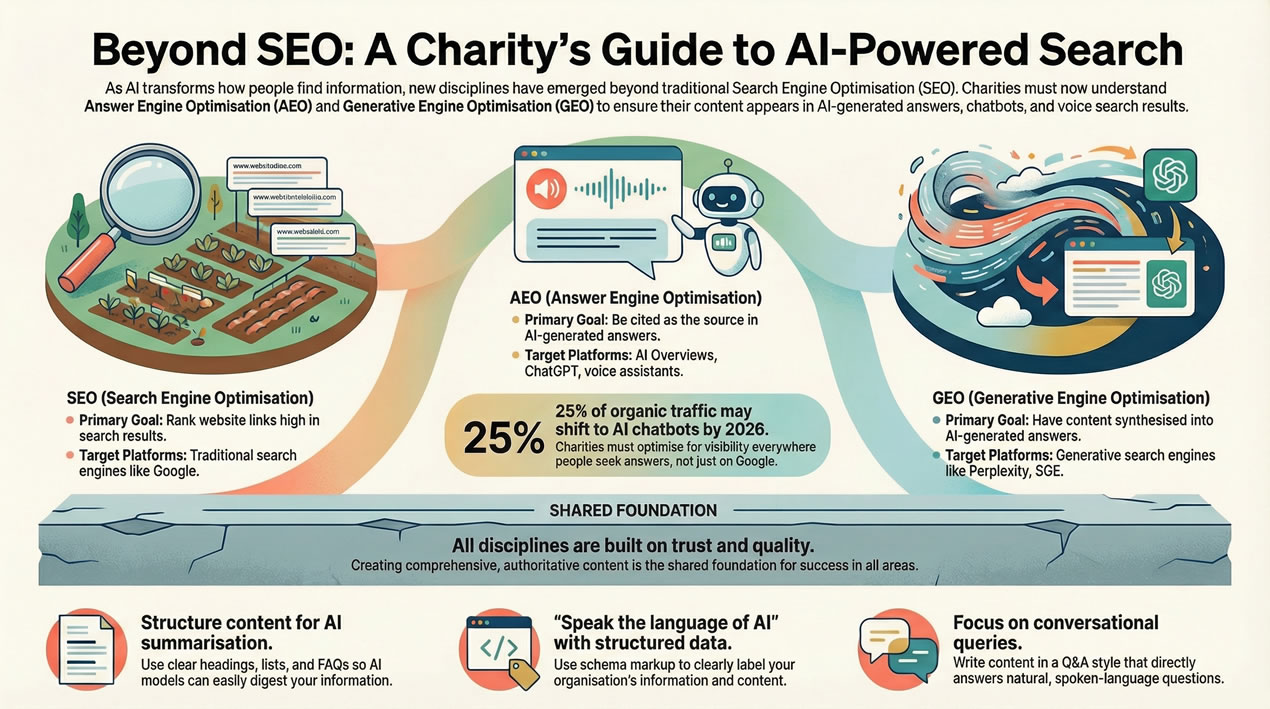
Beyond SEO: New Search Disciplines Charities Must Understand
Modern search has sprouted new disciplines beyond classic SEO. Two important ones are Answer Engine Optimisation (AEO) and Generative Engine Optimisation (GEO), which focus on visibility in AI-driven answer platforms.
AEO (Answer Engine Optimisation)
This is about optimising your content to be picked up in AI answers and snippets – think ChatGPT, Bing Chat, Google’s AI overviews. AEO improves a brand’s visibility in AI-powered platforms by earning mentions, citations, and placements in conversational responses. It differs from traditional SEO because it targets conversational queries (“What’s the best Islamic charity for refugees?”) rather than just keywords, and success is measured in mentions and citations by AI systems rather than just website clicks.
However, AEO and SEO share fundamentals: the goal is visibility, and the tactics overlap (creating authentic content, getting reputable backlinks, using schema). AEO has grown in importance as about 25% of organic traffic is predicted to move to AI chatbots by 2026. Charities need to ensure their content is structured and authoritative so that an AI assistant will quote it when answering questions about Zakat or humanitarian issues.
GEO (Generative Engine Optimisation)
GEO means optimising for AI-generated search results. It’s the process of making your website content visible to AI-driven search engines and chatbots like ChatGPT, Google’s SGE, Perplexity, and Microsoft Copilot. Whereas SEO targets traditional search engines, GEO focuses on content that AI systems will synthesize into answers.
For instance, SEO aims to rank a page of your site on Google’s first page, while GEO aims for your content to be pulled into a chatbot’s answer. GEO involves providing well-structured, semantically clear information that AI models can easily digest. This means using schema markup, clean HTML, and “speaking the language of AI” with structured data about your organisation and FAQs. The good news is GEO is built on the same values as good SEO – if you’re already producing comprehensive, trusted content (e.g., an in-depth guide about how to calculate Zakat with citations), you’re positioning yourself well for AI engines.
Google’s Search Generative Experience is Google’s AI summary on the search results page. Optimising for SGE means structuring your content for AI summarisation. Content that is well-organised (with clear headings, lists, FAQs) and authoritative is more likely to be included in SGE answers.
SGE Optimisation
For example, Google SGE will cite sources, so having factual, up-to-date content with schema and clean structure improves your chances of being that cited source. Early observations suggest formats like FAQs, how-to steps, and schema-tagged content perform well in SGE. Also, featured snippets still matter – content that directly answers common questions (e.g., “What is Sadaqah?”) in a concise way can be lifted into both traditional snippets and AI overviews.
Voice Search & Conversational Search
With more people using voice assistants (“Hey Google, how can I pay Zakat easily?”), optimising for conversational queries is wise. Voice searches are often longer questions. Islamic charities should ensure their content answers natural language queries. For instance, a voice query might be, “What’s the best way to donate during Ramadan?” Content written in a Q&A style or with a conversational tone can match these. Voice search often ties into AEO – voice assistants typically pull answers from featured snippets or trusted sources (like how ChatGPT might answer verbally). Ensuring your site loads fast and uses structured data (so voice assistants can parse it) will help.
In summary, SEO vs AEO vs GEO: Traditional SEO is about ranking links in search engines; AEO is about being the source of direct answers in AI and voice platforms; GEO is about making sure your content is ingested and used by generative AI. For decision-makers, the mental model is: we must optimize everywhere people seek answers. As one guide put it, think of it as “search everywhere optimization”. Rather than separate silos, these disciplines overlap – all require quality content and trust. But charities should allocate some strategy to AEO/GEO specifics, like schema, monitoring where your site is cited by AI, and crafting content that answers questions succinctly.
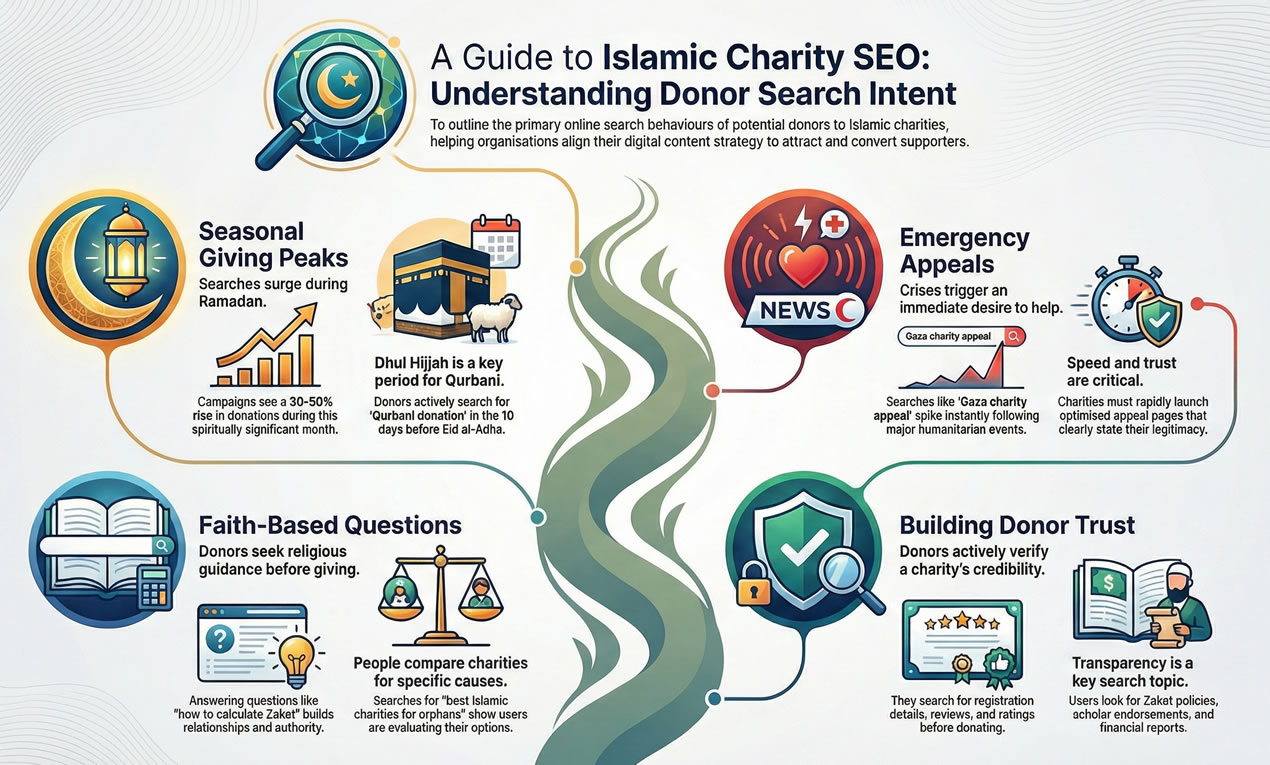
Islamic Charity Search Intent Mapping
Islamic charities face a unique spectrum of search intents from their supporters. Understanding these intents is crucial for creating content that matches what Muslim donors and community members are looking for.
1. Religious Seasonal Intent
A huge share of Islamic giving is seasonal. For example:
Ramadan: Web searches surge for terms around charitable giving in Ramadan. In the lead-up to Ramadan, online activity increases significantly – search queries related to Ramadan rise by ~16%. People search for “Ramadan donation appeal”, “give Zakat in Ramadan”, “Ramadan food drive”, etc. Charities also see massive engagement: one UK-based Muslim crowdfunding platform observes a 30–50% increase in campaigns and donations during Ramadan compared to other months. This is when donors actively look to pay their Zakat or Sadaqah to maximize spiritual reward. Islamic charities must capture this intent by optimising pages for queries like “Ramadan donations 2025”, “Zakat in Ramadan calculator”, “fidya/kafarah payments”, and producing content explaining the virtues of giving in Ramadan.
Dhul Hijjah (Hajj season): The first 10 days of Dhul Hijjah (leading to Eid al-Adha) are another peak. Donors search for “Qurbani donation”, “best charity for Qurbani”, “Dhul Hijjah give daily charity”. Ensuring your Qurbani campaign pages and educational content (e.g., “What is Qurbani? How to donate?”) are SEO-optimized will meet this demand.
Zakat Deadlines: Many Muslims give Zakat annually, often aligned with Ramadan or Islamic year-end. Searches like “Zakat due date” or “calculate Zakat end of year” spike. If your site has a Zakat calculator or guide, it should rank well for those queries. (For example, Islamic Relief and others provide Zakat calculators – these tools attract significant traffic by meeting this intent.)
2. Emergency Appeals Intent
When crises occur, donors rush to search how to help:
Terms like “Gaza charity appeal”, “donate for Yemen”, “Turkey Syria earthquake donate” spike immediately after events. During the 2023 Gaza crisis, some charities saw donations skyrocket as people looked for trustworthy channels to give aid. Make sure your site quickly publishes appeal pages with clear titles (“Pakistan Floods Emergency Appeal”) and that these pages are optimized (fast, mobile-friendly, clear calls to donate). Also, anticipate related queries: e.g., “best Islamic charity for Palestine” or “Zakat eligible Syria relief”. Having blog posts or FAQs about how Islamic principles guide emergency giving can capture informational intent around these events.
Trust matters here: In emergencies, new donors will search “Is [Charity Name] legitimate for X crisis?”. We discuss trust searches below, but be ready with content that affirms your credentials (e.g., “We are registered and 100% of Gaza appeal funds go to aid”).
3. Faith-Based Informational Intent
Many users search for Islamic guidance and information, not directly to donate. Charities that provide this information can build relationships that later lead to donations. Key types:
Zakat Questions: e.g., “Is Zakat wajib on gold?”, “How to calculate Zakat on salary?”, “Zakat calculator UK”. These are highly searched by Muslims wanting to fulfill obligations. Charities like National Zakat Foundation built entire content hubs on such questions. By ranking for these, you attract users precisely when they’re considering paying Zakat – and can then guide them to pay through your platform.
Religious Rulings and Advice: Queries such as “What is fidya for fasting?” or “Can I give zakat to an Islamic charity?” appear. If your website has scholar-approved answers or fatwa content on these, it establishes expertise. For example, a blog post titled “How to Calculate Fidya for Missed Fasts” or “Zakat Eligible Donations Explained” meets this intent.
“Best Islamic charities for…”: People often search for the “best” or “top” charities aligned with certain causes (education, orphan care) or for trust (“best Islamic charities UK”). Ensuring your site highlights endorsements, awards, and impact can help if someone is comparing options.
4. Trust & Legitimacy Intent
Muslim donors are often diligent about verifying a charity’s credibility and Sharia compliance before giving. Common intents:
Charity Legitimacy Searches: e.g., “Islamic Relief UK Charity Commission”, “Muslim Aid rating Charity Navigator”, “Is [Charity] legitimate?”. Users want to ensure the charity is registered and reputable. They will search for your charity’s registration number or look for reviews. In the UK, donors might search the Charity Commission site or look for transparency reports.
It’s wise to have a page on your site like “Why Trust Us” or an FAQ: “How do I know my donation is in safe hands?” that addresses these queries. As one Muslim media site notes, as Ramadan approaches, many Muslims will search for a reliable charity to donate to – they actively check for red flags.
Transparency & Compliance Queries: These include “Does XYZ charity have a 100% Zakat policy?”, “scholar endorsements for [Charity]”, “where does my donation go [Charity]”. Ensure your site has clear content on governance, zakat policy, financial reports, and any religious advisory boards. For example, if you have scholar endorsements or fatwas, publish those. Many sophisticated donors will look for that information (or just search your charity name + “fatwa” or “endorsement”). Providing this on-page (and marked up with schema if possible) can even land you in Google’s snippets for “is [Charity] trustworthy?”.
Navigational searches: Simply, many will Google your charity’s name instead of typing the URL. Ensure your homepage and about pages have the right metadata to show sitelinks, and that any negative news or misinformation is countered by your own content (perhaps via an “About Us” that emphasizes positive facts).
Mapping Intent to Content
We can categorise these search intents:
- Informational: User seeks knowledge (e.g., “how to calculate zakat”). Content needed: guides, fatwa Q&A, calculators, blog posts.
- Navigational: User looks for a specific site or page (“Islamic Relief donate”). Ensure your landing pages (donation pages, login pages) are SEO-friendly and ranking for your name + relevant keywords.
- Transactional: User is ready to donate or act (“donate Syria appeal now”). Here you need well-optimized landing pages with clear “Donate” calls, fast checkout, and SEO for keywords like “donate + [cause]”.
- Trust-validation: User seeks assurance (“[Charity] reviews” or “legit?”). Provide content like testimonials, independent ratings (if you have Charity Commission reports or Charity Navigator ratings, mention those), and robust About/FAQ content. This not only helps SEO (by capturing those searches) but also improves conversion by answering doubts.
By understanding these intents, your charity can align its SEO strategy to be present at every step of the donor journey – from learning about Zakat, to deciding when and where to donate, to verifying that your organisation is the right choice.
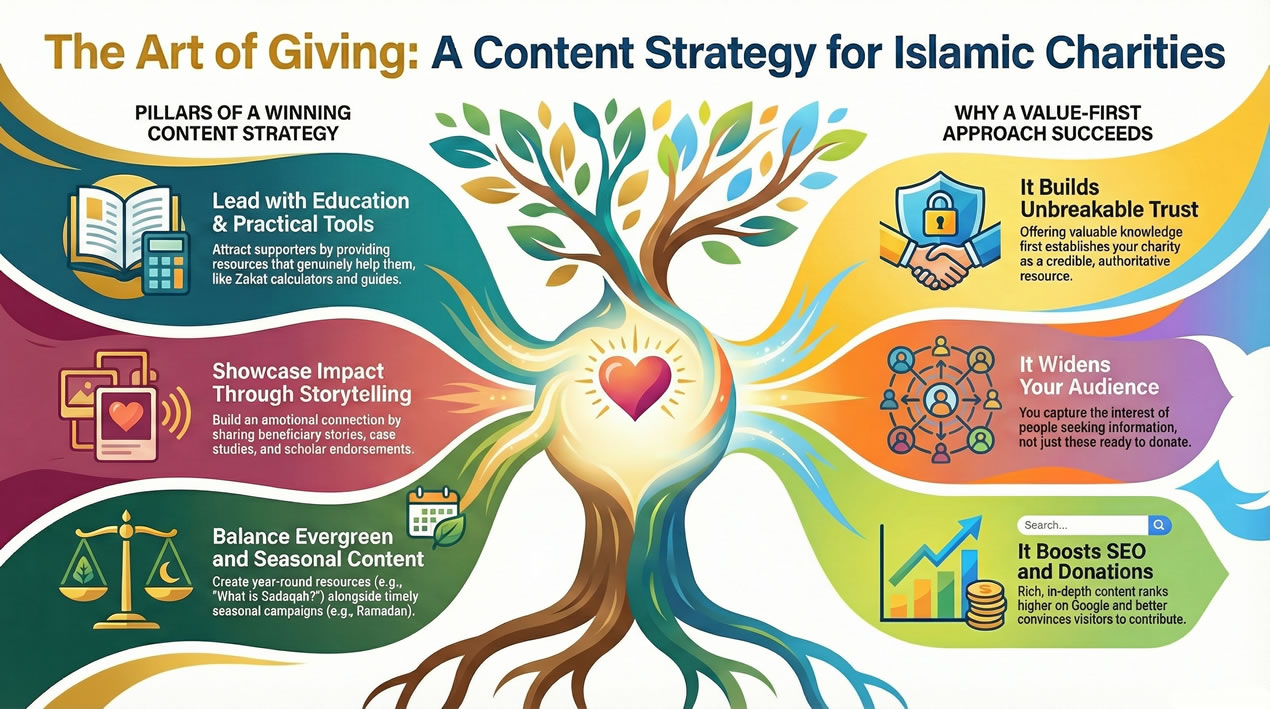
Content Strategy That Works for Islamic Charities
“Content is king” might sound cliché, but for charities – especially faith-based ones – content strategy is the cornerstone of organic growth. The right content can educate supporters, build trust, and ultimately drive donations. Here’s what actually works:
1. Educational, Value-First Content
Islamic charities that prioritise education tend to see long-term SEO success. Rather than just asking for donations on every page, provide resources that genuinely help the user. For example:
- Zakat Calculators: These interactive tools are often high-traffic assets. People searching “Zakat calculator 2025” will find tools from charities like Muslim Aid or Islamic Relief. By offering a precise calculator (with nisab values updated) and perhaps an explanation of Zakat, you not only get that traffic but often the donor’s Zakat payment. This content is inherently shareable and often ranks well due to high relevance.
- Fatwa-Style Guides and FAQs: Many donors have questions like “Who can receive Zakat?”, “What is Kaffarah for breaking a fast?”. If you publish scholar-verified articles or fatwas addressing these, you demonstrate expertise. For example, an article “Zakat vs Sadaqah – What’s the Difference?” or an FAQ “Is my charity Zakat-eligible?” can rank for those queries. These also reassure donors of your Islamic compliance.
- How-To and Tip Articles: Think along the lines of “How to make the most of giving in Ramadan” or “5 Ways to Teach Your Kids About Charity”. These are engaging and sharable, and position your charity as a community educator, not just a fundraiser.
2. Storytelling and Impact Content
Donors search for more than rulings – they want to see impact and feel connected.
- Impact Stories and Case Studies: Blogs or video posts that tell how donations changed lives (“Meet Amina: How your Sadaqah built her a home”) can perform well both in SEO (if optimized with the beneficiary’s country or situation as keywords) and in conversion (emotional resonance). While these might not be top-of-funnel traffic drivers, they serve as excellent supporting content for engaged users.
- Scholar Endorsements and Messages: Content such as “Message from Shaykh So-and-so on why he supports [Charity]” can be powerful. This might not drive generic search traffic, but anyone searching that scholar’s name and your charity could find it – boosting credibility.
3. Evergreen vs Seasonal Content
You need both:
- Evergreen: These are pages that remain relevant year-round and year-to-year. Examples: “What is Zakat?” guide, “Our History and Values” page, “Zakat Calculator” (updated annually). Evergreen content is great for building steady organic traffic. For instance, a detailed “How to Calculate Zakat (Ultimate Guide)” can rank for years, with minor updates. It educates users continually and brings in those considering paying Zakat.
- Seasonal: These pages spike in certain periods. Ramadan campaign pages, Qurbani (Udhiya) pages for Eid al-Adha, year-end giving appeals, etc. You should update and optimize seasonal pages each year, rather than starting from scratch. A mistake is making a new page every year (e.g., “Ramadan Appeal 2024”, then “Ramadan Appeal 2025” separately) with similar content – that can dilute SEO. It’s often better to have a single authoritative Ramadan page updated annually (or if separate, ensure each is substantial and cross-linked). Seasonal blog posts like “10 Tips for a Rewarding Ramadan (2025)” are also useful for catching timely searches and sharing on social media.
4. Why Thin “Donate Now” Pages Fail
A common SEO mistake is having dozens of nearly identical appeal pages with minimal content – e.g., a page with a title, one image, a paragraph saying “Please donate to our Syria appeal”, and a donate button. Google tends to ignore “thin” pages with little unique content. If you have multiple appeals, each page must provide real value – details of the crisis, how funds will be used, updates, maybe FAQs (“Is my Zakat used here?”). If not, it won’t rank well (and even users who land may not be convinced to give). It’s better to create rich appeal pages with background info, beneficiary stories, quotes, and images. Not only will this rank better, it will convert better by answering donor questions. In short, avoid duplicative boilerplate content – make each campaign page meaningful.
5. Formats that perform well
Based on what has worked for many charities:
- Blog Articles and Guides: for informational and inspirational content. E.g., “The Importance of Sadaqah: 5 Hadiths on Charity” can draw in those searching Islamic motivations for giving.
- Tools and Calculators: as mentioned, Zakat calculators, or even simpler tools like a “Zakat deadline reminder signup” – things that provide utility.
- FAQs Sections: Having a centralized FAQ (or sprinkled FAQs with schema markup on various pages) can get you featured snippets. Queries like “Can I give Zakat to a non-Muslim?” could trigger your FAQ answer if structured well.
- Landing Pages for Key Topics: For example, a page dedicated to “Zakat ul-Fitr” (the charity given at Eid al-Fitr) ahead of Eid, with all details and a donate link. Or a “Ramadan Hub” that links out to all related content (fasting info, charity campaigns, videos). Content hubs signal to Google that you have topical authority.
- Multimedia (Videos, Infographics): While text content drives SEO, embedding a well-optimized YouTube video (“What is Qurbani?”) can enhance a page’s engagement (and videos can rank on YouTube search as well). Infographics about how donations are used can earn backlinks (people love citing stats from a nice infographic).
Why education-first content drives donations
Islamic teachings emphasize understanding (ilm) and intention (niyyah). By providing educational content, you build trust and goodwill. A user who learned something on your site (say how to calculate their Zakat correctly) is far more likely to donate through you – you’ve added value before asking for anything. This approach also widens your funnel: you’ll attract people who weren’t explicitly looking to donate yet, but came for information and then became donors. One SEO agency notes that high-ranking, informative content builds trust, and trust drives action. This is especially true for charities – if your site becomes a go-to knowledge resource, it naturally becomes a go-to donation platform when the time comes.
In summary, focus on content that answers questions, solves problems, and inspires. By doing so, you satisfy both the search engines (content relevance and depth) and the hearts of donors. Avoid shallow content; invest in rich storytelling and helpful resources. Over time, this content becomes an organic traffic engine and a donor conversion pipeline.
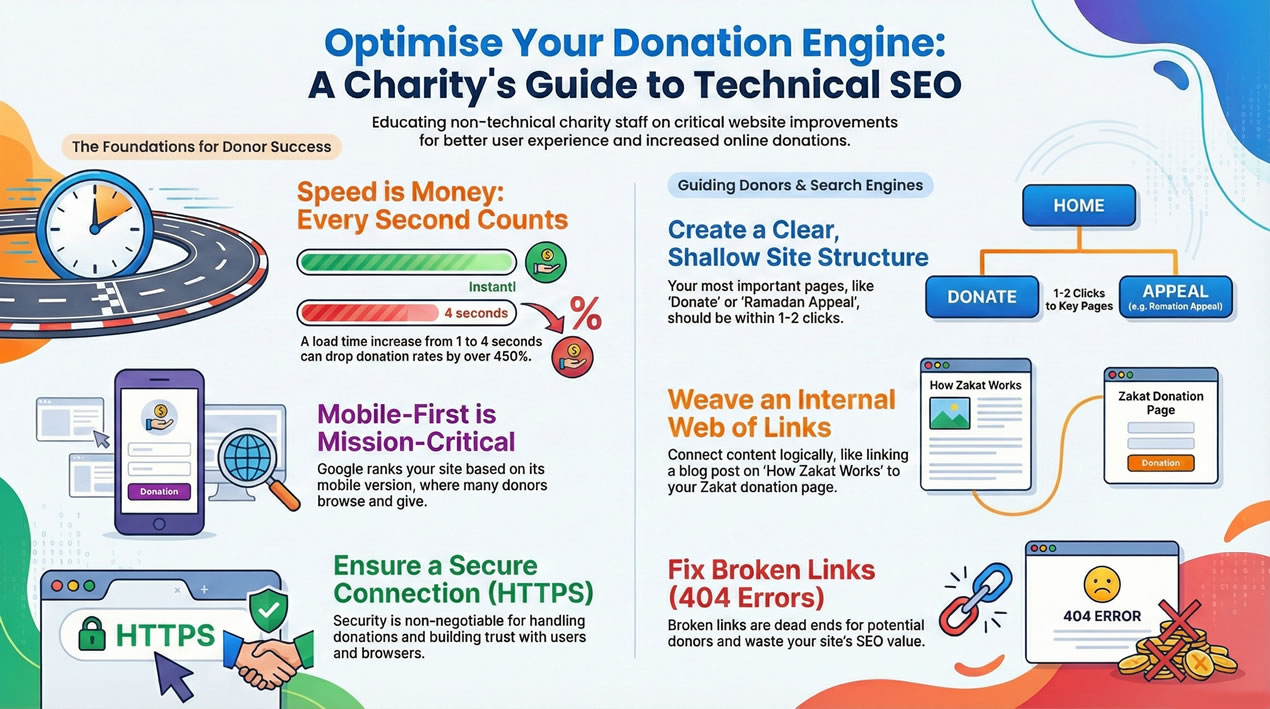
Technical SEO Essentials (Without Developer Jargon)
You don’t need to be a tech guru to grasp technical SEO – but ignoring it can cost your charity dearly (in both traffic and donations). Here’s a plain-English rundown of the technical must-haves for 2025:
1. Core Web Vitals & Page Speed
In 2025, speed and user experience are critical. Google’s Core Web Vitals (metrics for loading speed, interactivity, and visual stability) are an official ranking factor. Why does this matter for a charity? Because a slow site not only ranks lower, it scares off donors. Research shows that if a donation page takes 4 seconds to load instead of 1 second, conversion rates can drop by over 450%. That is huge – imagine losing donors just because your page was sluggish. People have little patience, especially on mobile. Every second counts: as load time goes from 1s to 3s, bounce rates increase significantly. So, speed = more donations.
Practical steps: Ensure your site is lightweight. Compress images, use caching, and avoid heavy scripts. Use tools like Google PageSpeed Insights to identify issues. Perhaps share this eye-opener with your team: an average nonprofit site’s donation page loads in ~2.7s; shaving off even 1 second could mean thousands more in donations. Fast sites also make users feel respected and are more inclusive (not everyone has fast internet – a point especially relevant if you have donors in developing regions).
2. Mobile-First & Responsive Design
Google now uses mobile-first indexing, meaning it primarily judges your site by how it performs on mobile. If your charity site isn’t mobile-friendly, your SEO will suffer. More importantly, many Muslim donors browse after iftar on their phones or during mosque fundraisers via links – mobile is mission-critical. Ensure:
- Text is readable without zooming.
- Buttons (e.g., “Donate Now”) are easily tappable.
- No elements are cut off on a small screen.
- Page layouts adapt (responsive design).
A quick test: open your site on a phone and simulate a donation – if it’s annoying for you, it’s worse for others. Google Search Console can flag mobile usability issues too.
3. Site Structure & Navigation
A clear website structure helps both users and search engines. Think of it like an organized store: donors should find what they need in a few clicks. For SEO:
- One page per topic: Avoid multiple pages targeting the exact same thing, which can cause duplicate content confusion. It’s better to have one strong “Zakat” page than 3 thin ones.
- Shallow hierarchy: Key pages (e.g., “Donate”, “About Us”, “Zakat Calculator”, “Ramadan Appeal”) should be accessible from the main menu or within 1-2 clicks from the homepage. Don’t bury important content deep in subfolders.
- Use descriptive URLs and titles: e.g., /donate/zakat instead of /donate/page?id=123. Clean URLs with meaningful words rank better and make sense to users.
- Internal linking: This is a big win area often overlooked. Link your pages to each other in a logical way. For instance, your blog post on “How Zakat Works” should link to your “Donate Zakat” page, and vice versa (perhaps “Learn more about calculating Zakat” link to the blog). Internal links pass “SEO juice” and indicate what’s important. Unfortunately, many nonprofits have “stranded” pages with no links to or from them. Every important page (like a donation page or major campaign) should have multiple other pages linking to it – think of your site as a web where all key content is interconnected. Add relevant links in your content naturally (“Our Gaza emergency appeal has updates on how your aid is used” linking to that page).
- Footer links: A tip – adding links to your crucial pages in the footer menu (like “Zakat Calculator”, “Annual Reports”) can quietly boost their importance site-wide.
4. Fix Technical Errors
Nothing kills SEO like broken stuff on your site. Two main culprits:
- Broken links (404 errors): If you moved or removed a page (e.g., last year’s campaign), any links to it now go to a dead end. That’s bad for user experience and wastes any SEO value. Do a regular scan for broken links. Use 301 redirects to send old URLs to the new equivalent (if “Winter Appeal 2022” is gone, redirect it to a general “Current Appeals” page or the 2023 version). Google Search Console can help identify 404 errors. A quick win is to fix these – it can even regain lost traffic.
- Duplicate content and tags: As mentioned under content, duplicates confuse Google. Technically, duplicates can occur via URL quirks (http vs https, or printing pages, etc.). Use canonical tags (your developer or plugin like Yoast can set this automatically). Also, if you have a blog, be careful with tag pages – some charity blogs create hundreds of tag archive pages that end up mostly empty (one post per tag) which is thin/duplicate content. It might be better to noindex or limit tag pages if they’re not adding value. Stick to broader categories.
5. Multilingual and Localisation
If you operate in multilingual communities (perhaps English and Arabic, or Urdu), you need to handle that technically. Use proper hreflang tags so Google knows which language version to show to whom. Make sure each language page is indexed and not seen as duplicate. Also consider local SEO: if you have UK and USA donors, or branches in different cities, create location-specific pages and get Google Business listings if applicable (for local zakat offices, etc.). Local SEO (like appearing on “charities near me” or mosque partnerships) might not be primary for online donations, but it’s useful if you have community centers or events.
6. What to fix in-house vs outsource
Non-negotiable basics in 2025 (you or someone must do these):
- Site is secure (HTTPS): This is a given (especially as you handle donations). Browsers will flag you if not.
- Site is fast and mobile-optimized: You might need a developer to help with advanced speed fixes (like script optimization), but your team can compress images and use simpler page templates in the interim.
- Analytics and tracking: Set up Google Analytics/GA4 and Search Console. They’re free and critical to monitor your SEO and conversion. This doesn’t require heavy tech skills – but make sure it’s done early.
- Core Web Vitals monitoring: If you have web developers, ensure they know Google’s metrics (Largest Contentful Paint, etc.) and strive to meet them. If not, at least use PageSpeed Insights and aim for green scores.
You can outsource tasks like a comprehensive technical SEO audit or a complex site redesign, but your internal team should at least understand the reports and prioritise the recommendations. In 2025, a technically healthy site is not “nice to have”, it’s a must. The good news: getting the technical fundamentals right can significantly amplify all your other efforts. For instance, improving page load times not only helps SEO but directly boosts donation completion rates (fewer people abandon the process).
In short, think of technical SEO as optimising your “donation engine”. If content brings people to your site, technical SEO makes sure they don’t drop out due to a poor experience. It’s about removing barriers: a fast, error-free, easy-to-navigate website means both Google and your donors can achieve their goals smoothly. And that ultimately means more support for your cause.
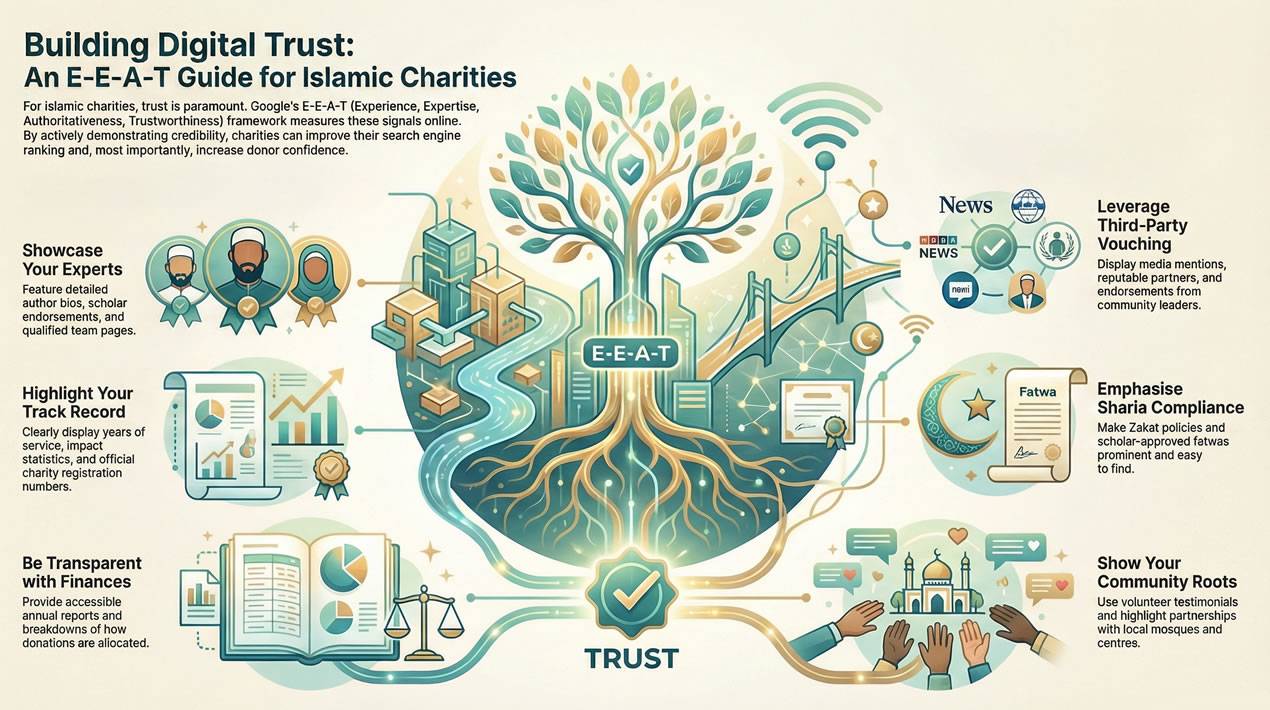
Authority, Trust & Islamic Credibility (E-E-A-T)
For charities, trust is everything – even more so for Islamic charities where religious credibility is at stake. In SEO terms, Google’s E-E-A-T framework (Experience, Expertise, Authoritativeness, Trustworthiness) essentially measures how trustworthy and authoritative your site is, especially on “Your Money or Your Life” topics (and donating definitely involves both money and life impact). Here’s how Islamic charities can build E-E-A-T and why it matters:
1. Showcase Experience and Expertise
Donors need to feel that you know what you’re doing (both in charity work and in Islamic compliance). Concretely:
- Author Bios and Scholar Endorsements: Have identifiable, credible authors for your content. If you publish an article about Zakat, note if it’s written or reviewed by a qualified scholar or an experienced staff member. For example, “by Mufti __, Sharia Advisor” adds huge legitimacy. Google and users both see that real expertise is behind the content.
- About Us and Team Pages: Create detailed pages showing your leadership, your Sharia advisors or board of trustees, and their qualifications. If you have well-known scholars or community figures supporting your charity, mention them. This isn’t boasting – it’s establishing authority. (Just as an academic site cites professors, you cite your experts.)
- Years of Experience & Impact: Mention “Serving the community since 1985” or “Over £50 million distributed in Zakat to date”. Longevity and proven impact contribute to E-E-A-T by showing experience and success.
In practice, Google’s algorithms and AI models do pick up on these signals. One GEO guide suggests nonprofits highlight their achievements, certifications (like a high Charity Navigator rating), and history on the site because even AI answers look for those trust signals. An Islamic charity might include a badge for “Registered with the Charity Commission #12345” and “100% Zakat Policy” clearly on the site – these act like trust badges.
2. Establish Authoritativeness with Third-Party Signals
Authority often comes from others vouching for you:
- Media Mentions & Backlinks: If your charity has been featured in news (e.g., BBC during Ramadan) or you have high-quality backlinks, flaunt it. A press page or “As seen in…” section can indirectly boost trust. Google’s concept of authority partly comes from backlinks – each reputable site linking to you is like a vote of confidence. Focus on getting links from Islamic finance blogs, community sites, or halal business directories. Perhaps collaborate on content (e.g., write an article for a Muslim lifestyle site, which links back to you). These not only help SEO but also position your name in trustworthy contexts.
- Partnerships and Endorsements: List your partners (mosques, Islamic centers, relief agencies, even government bodies if applicable). If a respected scholar or imam endorses you, consider an endorsements page. For instance, Human Appeal might list quotes from scholars endorsing their Zakat distributions. These act as qualitative trust signals to users (and such text could be picked up by NLP in search algorithms too).
- Transparency & Accountability: A big part of trust is showing you have nothing to hide. Have a “Financials” page with annual reports, breakdown of fund allocation, etc. Google’s quality guidelines favor sites that demonstrate who they are and that they are accountable. A transparent charity is less likely to be deemed “low quality”. Plus, donors often search for these (“[Charity] annual report”). Providing them builds trust and satisfies those queries.
3. Inject Trustworthiness into Content Itself
Ensure every piece of content answers: “Why should I trust this?” For example:
- Citations and Accuracy: If you state a fact (“£100m donated by UK Muslims each Ramadan”), cite a source or explain how you know this. Precise, accurate content reads as trustworthy. (Just like we’re citing sources in this guide!)
- Up-to-date Information: Outdated info erodes trust. Keep content current – update your Zakat guide with the latest nisab values, refresh your statistics, and clearly indicate the last updated date for crucial pages. Freshness signals that you are active and reliable. Generative AI and search engines both prefer recent, relevant info for queries.
- Tone and Ethics: Use an honest, compassionate tone in line with Islamic values. Avoid exaggerations or emotional manipulation that could backfire. Authentic storytelling (with permission from beneficiaries, respecting dignity) builds emotional trust. Ethical content practices (like respecting privacy in photos, not using harmful stereotypes) also matter for your brand trust.
4. Islamic Credibility Factors
This is unique to faith-based orgs:
- Sharia Compliance and 100% Zakat Policy: If you have a religious council or fatwa certifying your Zakat disbursement method, make that prominent. E.g., many charities have a fatwa document or a statement “Our Zakat is distributed according to Hanafi guidelines, supervised by [Scholar Name].” This can be linked or downloadable. Such content might not boost SEO in the traditional sense, but it absolutely boosts conversion – and if users search “[Charity] Zakat fatwa”, you’ll have the content ready.
- Values and Ethics Pages: Explain how you align with Islamic principles (no interest (riba) involved, ethical investments for waqf funds, etc.). Also address common donor concerns: “We have a 100% donation policy” or if not, explain transparently your admin costs. Honesty here is key to trust.
- Community Presence: Highlighting community initiatives (halal food drives, mosque partnerships) shows you walk the talk. Even including user-generated content like volunteer testimonials or beneficiary quotes can add “experience” signals (real people, real experiences with your org).
Why E-E-A-T matters more than ever: Google’s algorithms are getting better at evaluating site quality holistically. For charities, especially those dealing with donations (money) and religious guidance, having poor E-E-A-T could be disastrous (you might rank low, or not at all, for important queries because Google doesn’t “trust” you enough). On the flip side, strong E-E-A-T can be your competitive advantage. Many smaller charities neglect this – few details on their site about who runs it, scant content on how they use funds, etc. By investing in trust-building content, you not only appeal to donors but also to Google’s criteria for high-quality sites. Remember, in Google’s Quality Rater Guidelines, Trust is the most important element of E-E-A-T for pages that impact people’s money or well-being. A charity site is exactly that kind of page.
Moreover, in the age of AI search, LLMs like ChatGPT might pull answers about “the most trustworthy Muslim charities” from information available online. If your site and digital footprint scream “credible” (lots of endorsements, transparent info), you’re more likely to be recommended. Digital PR, good reviews, and solid E-E-A-T will feed those AI models in your favor.
In essence, build your online reputation like you build your real-world reputation in the community. Be open, consistent, and expert. It’s not just for SEO – it’s for winning hearts. SEO success will follow because trustworthiness is exactly what search engines (and donors) are seeking in a charity website.
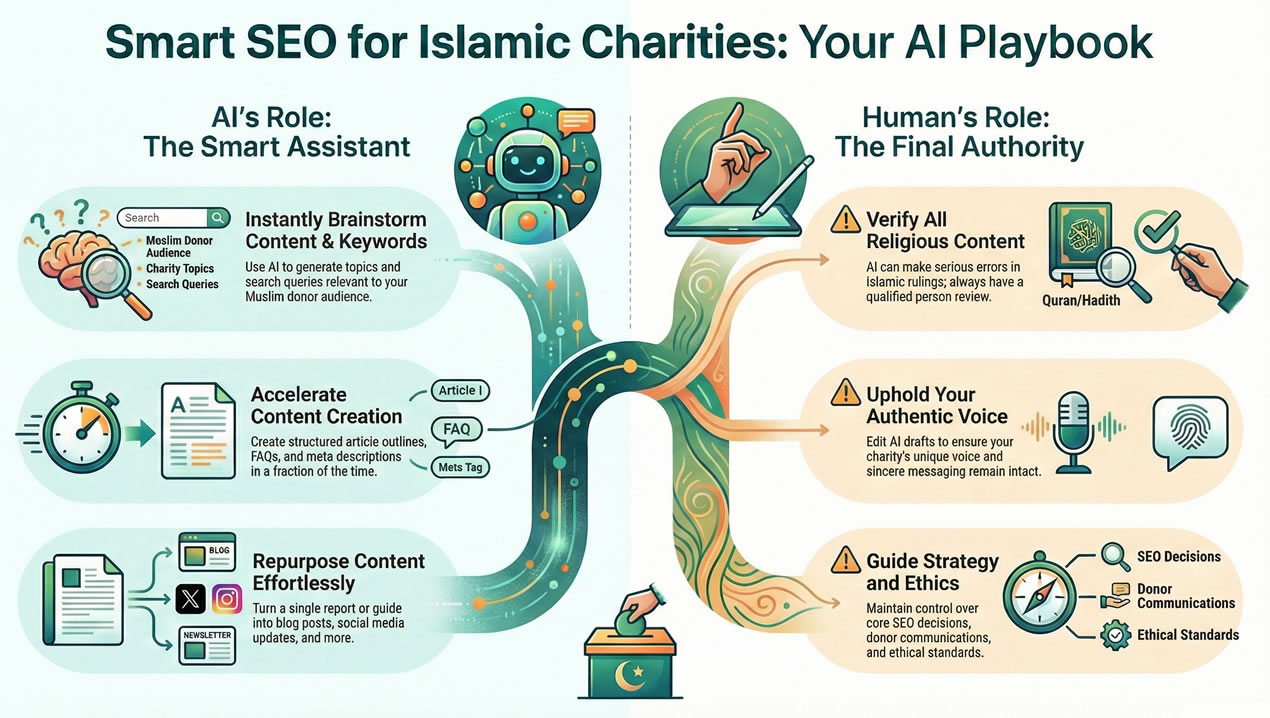
AI, Automation & SEO for Charity Teams
Small charity teams are often stretched thin – the good news is AI can be your ally in scaling SEO and content efforts. However, it’s crucial to use these tools wisely and ethically. Here’s how Islamic charity marketers can leverage AI, and what to be cautious about:
1. Using AI to Work Smarter
AI tools (like ChatGPT and others) can dramatically speed up many SEO tasks:
- Keyword Research and Ideation: Instead of manually brainstorming keywords, you can ask AI, “What topics might Muslims search for around Zakat and charity?” It can generate lists of related queries or even cluster intents. AI won’t have actual search volume data (you’ll still use tools for that), but it’s great for inspiration. For example, ChatGPT might suggest content ideas like “How does Zakat help communities?” or long-tail queries like “best way to give Sadaqah regularly” which you can then refine.
- Content Briefs and Outlines: If you need to write a new article (say, “Guide to Paying Zakat for Beginners”), you can prompt an AI to outline the key sections. It might generate a structured outline (What is Zakat, Who must pay, How to calculate, etc.). This can save you time structuring the content. Some marketers even use AI to draft portions of content. If doing so, ensure you review and fact-check – AI can make factual errors about Islamic rulings if not guided.
- FAQ Generation: AI is excellent at the Q&A format. You can give it some content (like your annual report or a page about a project) and ask “What questions might donors have about this?” It could spit out FAQs that you hadn’t thought of. You can then answer those and add to your FAQ pages or use them in blog posts. For instance, from a page on a water well project, AI might generate “How do you choose where to build wells?” – a perfect question to answer publicly.
- Meta Descriptions & Title Suggestions: Crafting enticing meta descriptions can be tedious. AI can take a page and generate a concise, catchy description. Remember to tweak it for accuracy and tone, but it’s a good starting point. Same for page titles – AI can suggest variations that include keywords.
- Internal Linking Suggestions: By feeding your site map or content list to an AI, you could ask, “Which pages are related and should link to each other?” This is experimental, but AI might spot connections (e.g., it might say “Your Zakat guide and your Syria appeal both mention poverty alleviation – consider linking them.”). There are also SEO tools with AI that analyze internal linking opportunities.
- Automation of Repetitive Tasks: Some advanced use-cases: writing simple product descriptions (if you have a charity gift catalog), generating social media captions for blog posts, or even using AI in spreadsheets to categorise keywords. Also, tools like Jasper or Writesonic can integrate into workflows to churn out content at scale – but again, that content needs human oversight to ensure quality and correctness.
In fact, marketers are finding ChatGPT useful beyond just writing – it can help in coding tasks (e.g., writing a Google Sheets script to format SEO data) or creating schema markup. One guide emphasizes that if you’re only using ChatGPT to write a bit of content, you’re missing many opportunities to streamline workflows and even generate code for SEO tasks. So explore its full range.
2. What Not to Automate (Fully)
While AI is powerful, there are areas to be careful:
- Core Messaging and Authentic Voice: Your charity’s unique voice, especially when talking about Islamic values and beneficiary stories, should not sound like a robot. AI-generated text can be a baseline, but humanize it. Donors will sniff out generic or inconsistent tone. Always review and edit AI drafts to align with your organisation’s voice and Islamic ethos.
- Religious Content Accuracy: This is crucial – do not rely on AI alone for Islamic rulings or sensitive content. AI might confidently generate incorrect Islamic guidance (e.g., it might mix up rules of Zakat). Always have a qualified person verify any religious info. Use AI to summarize or format that info, but not to decide it. The stakes are high: providing wrong religious advice can damage credibility or even be sinful if it misguides someone.
- “Set and Forget” SEO Decisions: Avoid automating things like massive site changes without oversight. For example, some might be tempted to auto-generate 100 blog posts with AI. Google is clear that spammy auto-generated content can violate guidelines – the content still needs to be helpful. Plus, if AI content isn’t fact-checked, you risk publishing inaccuracies or even inadvertently plagiarized phrasing.
- Link Building Outreach: While you can use tools to identify backlink opportunities, avoid automating outreach emails in a generic way – you might violate trust or come off as spam. Personal relationships matter in the Muslim community; an automated “Dear Sir/Madam, give us a backlink” email won’t go far.
- Sensitive Donor Communications: ChatGPT could draft thank-you emails or campaign updates, but adding a personal touch or specific details is important in donor relations. So use AI for a first draft to overcome blank page syndrome, but then personalize it. Don’t accidentally address a donor with “[Name]” because the AI template wasn’t updated!
3. Ethical Use of AI in Islamic Charities
This is a new frontier. Islamic ethics would stress honesty, justice, and ihsan (excellence) even in tech:
- Avoid AI Bias: AI can sometimes produce biased or culturally insensitive outputs (because it learned from the internet). Be vigilant that any content aligns with Islamic values and doesn’t unintentionally offend or misguide. For example, if using AI to generate images or graphics (with tools like DALL-E), ensure they are appropriate (no offensive depictions).
- Transparency: It might not yet be expected to announce “this article was AI-assisted”, but internally be transparent with your team and maybe in subtle ways ensure content is reviewed by a human (you might even include a note like “Reviewed by our Islamic scholars” on guidance content – which implies human oversight).
- Efficiency vs. Authenticity: Islam encourages using resources wisely (no waste), so using AI to save time is good stewardship. But not at the expense of sincerity (ikhlas). Donors might be disillusioned if everything feels mass-produced. Use the time AI saves you to engage more with your community on a personal level.
4. Small Team Tips
If you’re maybe one marketing person wearing multiple hats:
- Use AI as your multitool assistant. Think of it as an intern who can draft, research, and brainstorm with you any time. It can help you produce more content than you could alone.
- That said, prioritise. Maybe you can’t write 50 new blogs – but you could have AI help you write 10 really good ones and update 20 old ones. Quality > quantity, especially for SEO in 2025.
- Continuously learn: AI in search is evolving. Keep an eye on news (like how Google’s algorithms treat AI content, or new tools that come out). What you automate today might change tomorrow.
- Example Use-Case: Suppose you have a big Ramadan guide PDF from last year. You can use AI to repurpose it: ask for a summary blog series out of it, extract FAQs for social media, etc. This way, AI helps multiply one piece of content into many formats.
In summary, AI can feel like having an extra team member (who works lightning fast). Embrace it to cover more ground – from SEO analysis to content creation. Just ensure the human stays in the driver’s seat for strategy, heart, and final approval. A balance of automation and human insight will let your small team punch above its weight in digital efforts.
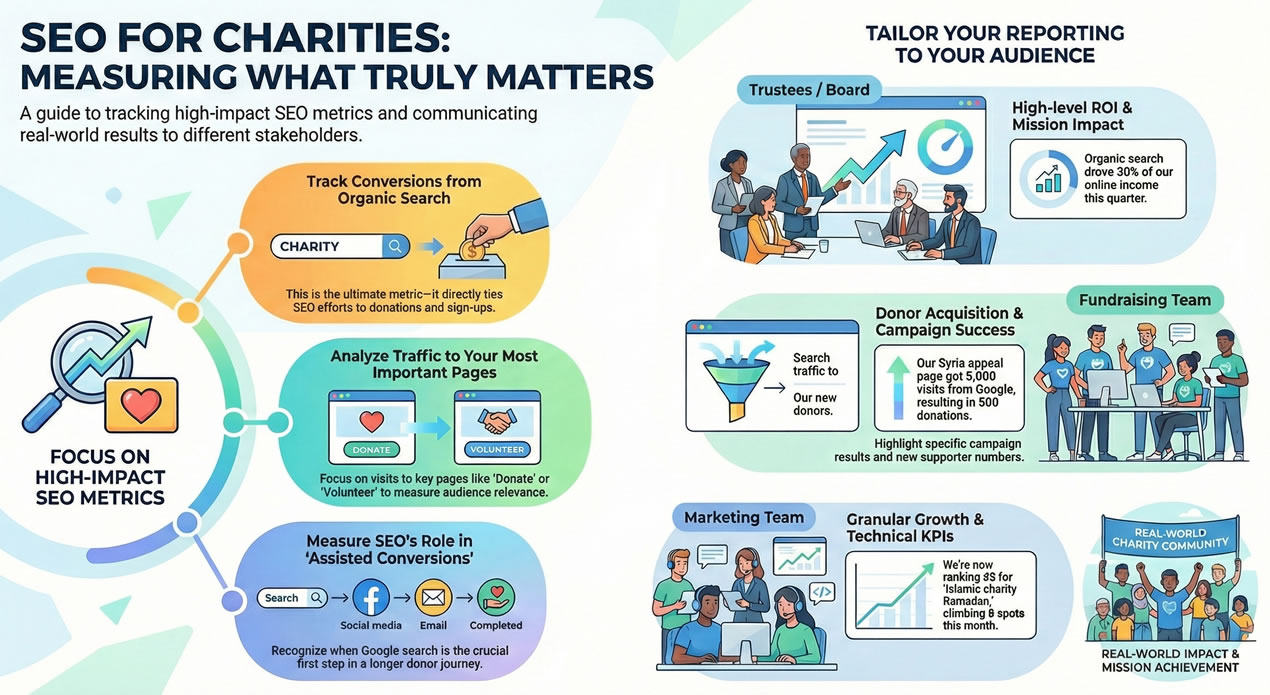
Measurement & KPIs for Organic Growth
To know if your SEO and content efforts are truly helping the charity, you need to measure the right things. It’s easy to get lost in a sea of metrics, so focus on what matters and tailor it to your audience (trustees vs marketing vs fundraising). Let’s break it down:
Key SEO KPIs for Charities:
- Organic Traffic (by Key Pages): Instead of just overall sessions, look at organic visits to important pages. For example, how many people are coming from Google to your “Donate” page, your “Zakat guide”, or your “Volunteer signup” page. This shows if SEO is driving the right audience to the right places. An increase in overall traffic is nice, but an increase in relevant traffic (like more people landing on your Zakat donation page via search) is gold.
- Conversions from Organic: This is arguably the ultimate metric. Track how many donations, sign-ups, or other conversions result from organic search visitors. You can set up conversion goals (e.g., a donation thank-you page visit) and segment by source = organic. For instance, you might find that last month 50 donations totaling £5,000 came directly from people who found you on Google. This is the kind of metric that makes boards pay attention (it ties SEO to revenue).
- Conversion Rate & Engagement: Also note the conversion rate of organic traffic vs other channels. Often, organic can have a high conversion rate because those visitors were actively seeking something. If it’s low, that might mean the wrong keywords are bringing people or your pages need improvement. Engagement metrics like bounce rate or time on page for organic visitors can also hint if your content meets their needs. (High bounce on a landing page might mean they didn’t immediately find what they expected.)
- Keyword Rankings (and Branded vs Non-branded split): Track a set of keywords important to you (Ramadan donations, Zakat calculator UK, your brand name, etc.). See how you rank and how that improves. Also note branded vs non-branded traffic share. Branded searches (people looking for your name) indicate your brand power (often influenced by offline marketing, word of mouth). Non-branded (generic searches) indicate how well you’re capturing new audiences via SEO. If all your organic traffic is just people typing your name, SEO isn’t expanding your reach. You want growth in non-branded queries (like “Islamic charity for orphans” etc.) to show SEO is bringing new people.
- Backlink Quality and Domain Authority: This is a softer KPI, but you can monitor the number of reputable sites linking to you, or use a metric like Moz Domain Authority or Ahrefs Domain Rating as a proxy. If your content and outreach are working, you should see an upward trend over time. It’s listed as one of the focus KPIs for nonprofits (backlink growth, domain authority) because it correlates with stronger SEO ability.
- Assisted Conversions: In a donor’s journey, SEO might be the first touch, even if the final donation happens via another channel. For instance, someone finds your blog via Google, later they subscribe to your newsletter, and eventually they click a donate link in an email. The initial organic search “assisted” that conversion. Google Analytics can show assisted conversion data (in GA4, look at conversion paths). If SEO plays a role early, that’s valuable to note when reporting to stakeholders: “Our SEO content doesn’t always convert immediately, but it feeds the funnel – it influenced £20k of donations this quarter that eventually closed via email or direct visit.” This helps everyone see the bigger picture, not just last-click.
- User Engagement and Brand Metrics: Consider tracking things like newsletter sign-ups from organic traffic, or downloads of your reports from organic. These are micro-conversions that build the relationship. Also watch social shares or comments on your SEO-driven content (if a blog post is getting shared, it’s increasing your reach). Some “vanity” metrics like social likes can actually be vital signs of growing awareness and engagement. A post that gets widely shared might not yield immediate donations, but indicates people are connecting with your message.
Tailoring Metrics to Different Audiences:
- Trustees/Board: They care about the high-level impact and ROI. They want to see clear results for money invested. Show them metrics like total online donation growth and what portion can be attributed to organic traffic. Also, show cost savings: for example, “By growing organic traffic, we relied less on paid ads, saving £X while increasing donations” (boards love efficiency). Another board-level metric: growth in brand awareness – you could use increase in branded search volume or social followers as a proxy. A stat like “Organic search now accounts for 30% of our total income online” is powerful for a board. Keep it big picture, and if possible, tie SEO to mission outcomes (e.g., “Due to increased organic reach, we educated 50,000 people on Zakat this year (50k page views on our Zakat guide) and saw a 20% increase in Zakat donations through our site”).
- Fundraising and Comms Teams: They’ll be keen on conversion metrics and content performance. Show them which campaign pages or stories are performing in search and how that translated to donations or sign-ups. For instance, the fundraising team might love to know “Our Syria appeal page got 5,000 visits from Google during the crisis, resulting in 500 donations”. They also care about donor acquisition cost – you can point out that organic is essentially free (aside from staff time) compared to PPC. If you have data on donor retention via organic (maybe organic-acquired donors have a certain repeat rate), that could be interesting. Also, highlight any qualitative feedback loop: e.g., “We noticed people were Googling if our charity is registered, so we improved our FAQ – now those searches land on our site and we hopefully reassure them.”
- Marketing/Digital Team: They’ll want more granular SEO metrics and progress reports. Here you can geek out a bit: keyword ranking improvements, technical SEO fixes done, content published, backlink count growth, etc. Monthly reports could include “Organic sessions up 15% MoM, with notable gains on [blog post] which climbed to rank 3 for ‘Islamic charity Ramadan’”. Marketing teams also appreciate competitive insights – e.g., if you have data on how you rank vs. Islamic Relief or others for certain terms. That can galvanize efforts (“we moved ahead of Charity X for [keyword]”). But caution not to present vanity metrics without context – explain why a metric matters. For example: impressions up 50% is only good if clicks followed; time on page is great, but only if those people then took an action.
Vanity vs. Meaningful Metrics
Classic “vanity” metrics like raw pageviews, social likes, etc., shouldn’t be the only story. They can be misleading (100k visitors mean nothing if zero donate). However, as one article argued, some so-called vanity metrics can indicate early success in awareness and engagement that lead to long-term support. So it’s about balance:
- Keep the North Star as conversions and impact (e.g., donations, sign-ups).
- Use awareness metrics (traffic, reach, shares) to complement the story, especially to show growth in brand presence among new audiences, which eventually feeds the supporter base.
What to report and how often:
- Probably have a monthly SEO dashboard for the marketing team: covering traffic, rankings, top content, issues encountered/fixed (like “fixed 20 broken links, improved page speed to 1.8s on average”).
- A quarterly summary might go to senior management including trustees: focusing on outcomes (funds raised, audience grown) and strategic insights (“Ramadan campaign saw a 40% organic traffic lift vs last year, suggesting our new content strategy worked – we’ll replicate that for Dhul Hijjah”).
- Align with what trustees care about: one source notes boards want clear ROI on marketing spend. So even if SEO doesn’t have a direct “spend” like ads, quantify the investment (staff time or content cost) vs results.
- Also, mention what you’re learning from data and how you’ll adjust. E.g., “Blog post A flopped on Google (only 50 visits) while post B soared (5,000 visits). We learned that people search more for ‘Zakat calculator’ than ‘Zakat facts’, so we’ll focus on utility content.” This shows a data-driven approach which boards and teams appreciate.
Donor Behavior KPIs
Another interesting thing to monitor is donor behavior from organic vs other channels. For instance, are organic-sourced donors younger or more international? Do they prefer certain causes? If you have a CRM that tracks source, you could find patterns. Such insights can refine both SEO (target content to those profiles) and fundraising approach (maybe organic is bringing in a lot of questions about how funds are used – indicating those users need more trust signals).
In sum, measure what matters to your mission, not just what’s easy to measure. Every metric you report should tie back to a goal: raising awareness (traffic, engagement), raising funds (conversions, donation value), building trust (return visitors, time on site, low bounce on info pages). By speaking the language of each stakeholder – ROI for trustees, conversions for fundraisers, and growth for marketing – you’ll keep everyone aligned on why SEO/organic work is vital. And you’ll secure the buy-in and resources to continue your organic growth roadmap.
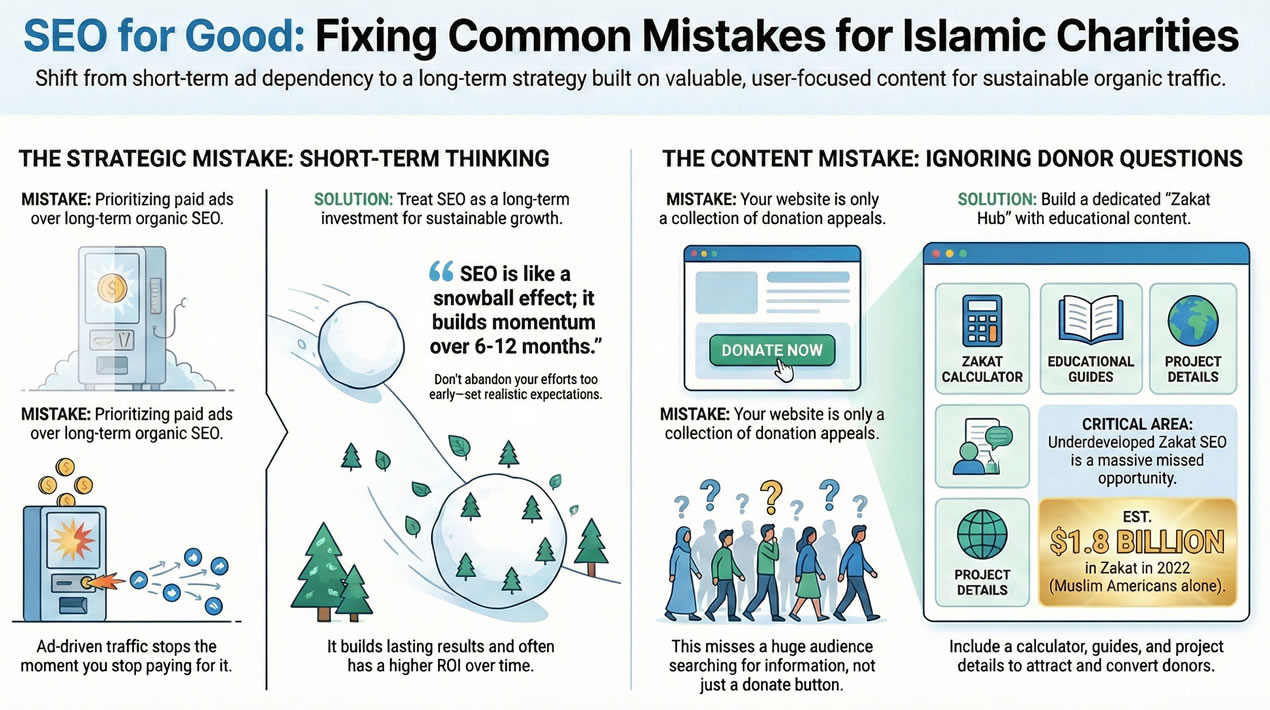
Common SEO Mistakes Islamic Charities Make
Even with the best intentions, charities often stumble in similar ways when it comes to SEO and digital strategy. Recognizing these common pitfalls can help your organisation avoid them. Here are some frequent mistakes Islamic charities make – and how to fix them:
1. Over-Reliance on Paid Ads (and Neglecting Organic)
Many charities pour effort into short-term campaigns and Google Ads (especially with the availability of Google Ad Grants) and assume SEO can wait. While ads can give quick wins, relying on them exclusively is risky and costly. The moment you stop paying, the traffic stops. SEO is the opposite – it’s a slow build but with lasting results. In fact, by embracing SEO, non-profits enjoy less dependence on paid ads and steady growth in organic traffic over time.
The mistake is not investing in content and SEO because paid seems easier. The remedy: allocate a portion of your marketing effort to SEO each month. For example, for every big campaign, have a parallel organic content piece. Over time, you’ll spend less on ads as your pages rank naturally. Remember, SEO often has a higher ROI in the long run (it’s like a snowball effect). If budget holders hesitate because SEO is “slow”, share data or case studies to show how, by Month 6 or 12, SEO can bring in donations at a fraction of the cost per acquisition of ads.
2. Ignoring Educational Content (Focusing only on Appeals)
As mentioned, content that educates and engages is critical. Yet a common mistake: some charity sites are just a collection of donation forms and “Donate now” pages with little informational content. This is understandable – limited resources, you focus on immediate fundraising. But ignoring educational content means you miss out on a huge audience and build no SEO equity. Imagine a user searching “How do I ensure my Zakat is used properly?” – if you don’t have content for that, they might end up on another site (perhaps even a competitor charity that does provide that info) and donate there.
Thin appeal pages (with just a few lines of text) also fail to rank or inspire, as we discussed. The fix: develop a content calendar that is not just campaign-driven but also knowledge-driven. Even one high-quality blog post a month can, over a year, create a robust library. Prioritize evergreen topics like Zakat, Sadaqah, charity in Islam, stories of beneficiaries, etc. One upside: education-first content often leads to donations (people find value, then feel inclined to give). If internal pushback is “we need to fundraise, not write articles,” note that educating donors is fundraising, just indirect and with a longer horizon.
3. Poor Zakat-Related SEO
Zakat is a pillar of Islam and a pillar of fundraising for Islamic charities – yet some charities don’t fully capitalize on Zakat-related search interest. Mistakes here include:
- Not having a dedicated Zakat section or landing page (so potential donors searching “give Zakat UK” don’t find you).
- Not optimising for obvious keywords like “Zakat calculator”, “calculate Zakat [year]”, “Zakat eligible charities”.
- Providing a calculator or guide but burying it in the menu or not updating it (if someone lands and sees outdated nisab values, they’ll bounce).
- Failing to explain how you handle Zakat (which is both a trust and SEO content opportunity). People search questions like “Is donating to charity X Zakat compliant?” – you want your own site to answer that, not a random forum.
To fix this: treat Zakat like a product. Do keyword research around it. Create a hub: “Zakat Hub” that includes what Zakat is, how to calculate, your projects that qualify for Zakat, testimonials (“I paid my Zakat with [Charity], here’s my experience”), and of course the call to donate. Use schema for FAQ on that page (“Can I give Zakat to build wells? [your answer]”).
This way, whether someone searches a general question or specifically about your org and Zakat, you’ve got it covered. Given that Muslim Americans gave an estimated $1.8 billion in Zakat in 2022 (much during Ramadan), and other regions similarly high, being absent in Zakat SEO is leaving money on the table (or rather, in someone else’s donation bucket).
4. Duplicate or Cannibalizing Pages (especially appeals)
We touched on this: charities sometimes make separate pages for each year or each small variation of a campaign, with largely similar content. For example, “Winter Appeal 2023” and “Winter Appeal 2024” might be nearly identical except maybe the date or target. This can cause keyword cannibalization where both pages compete for the same keyword (“winter charity appeal”) and both perform poorly. Or Google sees duplicate text and isn’t sure which to rank. It also divides your backlink equity if some sites link to one page and some to the other.
A better approach might be to have one evergreen Winter Appeal page that’s updated each year with new info (and perhaps an archive section for past achievements). If separate pages are necessary for record-keeping, then ensure each page has unique content (maybe one focuses on a different country or aspect) and link them (“See our 2023 Winter Appeal results here” etc.). Also, use canonical tags if one version is the main one. Another duplication issue: too many tags or categories creating thin pages (as the Tom Crowe audit found for nonprofits) – streamline your site taxonomy.
5. Weak Internal Linking and Site Navigation
Internal links are free SEO power, yet charities often neglect them. We see important pages not linked from the homepage or relevant content, orphan pages (only reachable via search, not through the site menu). For example, if you write a great blog “Top 10 Ways to Maximize Rewards in Dhul Hijjah” but don’t link it on your Dhul Hijjah campaign page or anywhere obvious, it’s stranded. Likewise, a donate page for a specific cause might not be linked in any content discussing that cause – so a user reading an article about education in Islam doesn’t get a prompt to donate to your education fund. This is both an SEO and UX mistake.
The fix is systematic: whenever you publish new content, always ask “What other pages on our site relate to this?” then add links in both directions if appropriate. Use descriptive anchor text (e.g., in your orphan sponsorship page, link a phrase “education for orphans” to your education program page if connected). Also, maintain a clear menu and sitemap. Many charity sites have a confusing menu with too many items or jargon. Streamline it so users (and Google) can easily find core sections. Remember, pages with more internal links tend to be seen as more important by Google, so decide your top priorities (e.g., main campaigns, calculator, about) and link to them frequently where relevant.
6. Not Optimising Basic On-Page Elements
This is a more tactical mistake but common. Examples: missing or duplicate page titles, no meta descriptions (or default ones). One audit found many nonprofits missing meta descriptions on pages. While meta descriptions don’t directly affect ranking, they affect click-through – a compelling one can increase clicks from search results. Another issue: not using header tags properly (H1, H2). Some charity sites might have the organisation name as H1 on every page (instead of a unique page topic H1) – this confuses search engines about page content. Or multiple H1s due to CMS quirks (e.g., a “Donate Now” widget injecting an H1).
The fix is easy: audit your pages (there are free tools) to ensure each page has a unique, descriptive title tag and H1 that matches the main keyword/subject, and meta description that “sells” the page to the searcher. These little optimizations can often improve your rankings quickly if they were previously off.
7. Short-Term Mindset – Stopping SEO Too Early
Some charities try SEO for a couple of months, don’t see big results, and then abandon or drastically slow efforts. SEO is a slow burn – you might only see modest gains in first 3 months, and serious traction after 6-12 months (as the Wolfpack timeline earlier illustrated, major growth often shows up in months 7-12). Quitting early is a mistake; it’s like stopping a marathon at mile 5 because you haven’t won yet.
The fix: set realistic expectations and get buy-in for a long-term approach. Show the team or board how SEO is compounding: maybe impressions or low-rank keywords are growing (a sign of future potential). If you stop, you plateau. So, avoid the trap of chasing only immediate ROI. Combine quick wins (like optimising existing pages) with long plays (content creation, authority building).By being aware of these mistakes, you can proactively address them. An outside perspective (like an SEO audit or even a peer review) can help spot some of these issues. The overarching theme is think long-term, think user-first, and cover the basics. Islamic charities that avoid these pitfalls will find their organic efforts much more fruitful, inshaAllah.
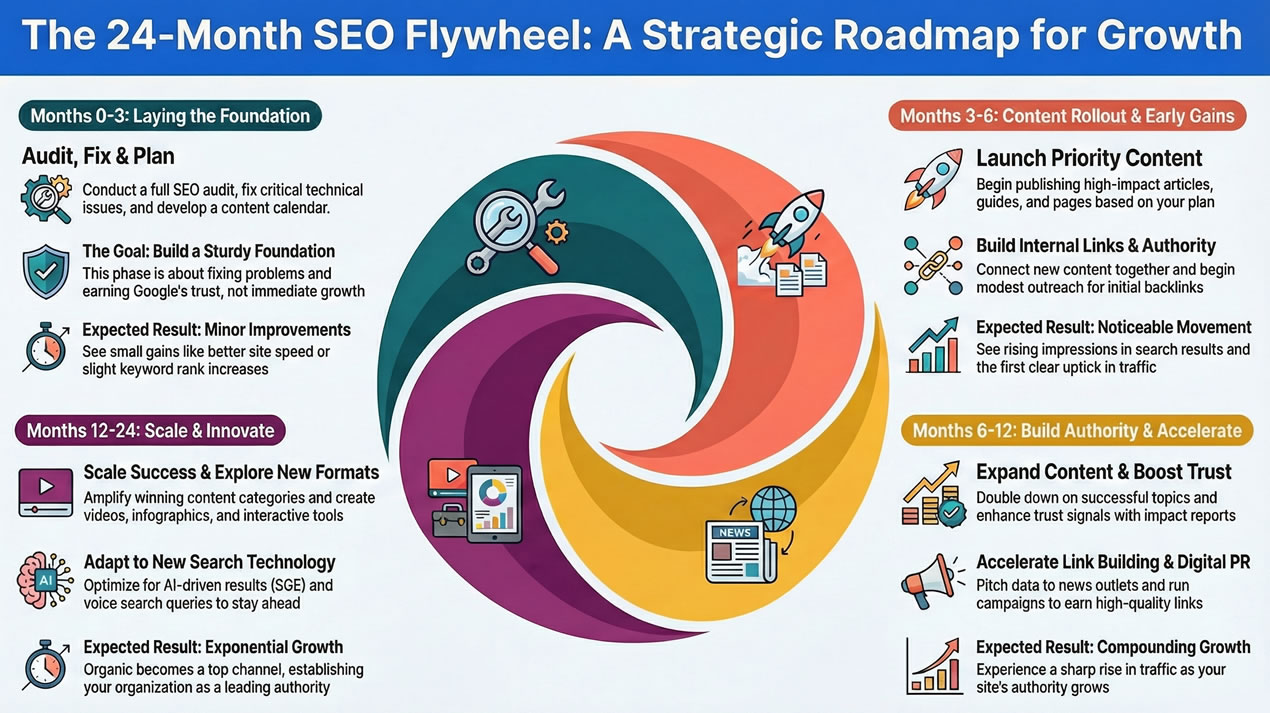
Strategic Roadmap for 0–24 Months
Finally, let’s lay out a high-level roadmap to implement the strategies we’ve discussed, broken into phases. This will help you prioritise and tackle SEO in manageable steps, building momentum over 24 months. Remember, SEO is cumulative – each phase builds on the previous.
Months 0–3: Laying the Foundation (Quick Wins & Fixes)
- Audit & Benchmark: Start with an SEO audit – examine your site’s current performance (technical issues, content gaps, backlink profile). Identify top quick fixes. Also set up analytics and Search Console if not already, and establish baseline metrics (current organic traffic, conversions, rankings for key terms).
- Technical Cleanup: In these early months, focus on technical health. Fix critical issues: broken links, missing meta tags, multiple H1s, slow page elements. Many of these are one-time fixes that can yield quick improvements. For example: compress large images, implement caching, ensure your site is HTTPS everywhere, and make sure the mobile experience is solid. Completing a technical SEO cleanup and improving site speed now will prevent you fighting uphill later.
- Structural Improvements: Update your site structure and navigation. Create those important pages that were missing (if any): e.g., a proper “About/Trust” page, key landing pages for major donation categories. Ensure the homepage or menu links to all high-priority sections.
- Research & Content Plan: Keyword research is a foundation task now. Identify the main topics and queries you want to rank for (Ramadan, Zakat, each major cause, etc.). Look at competitor charities – what content do they have that you don’t? Build a 12-month content calendar. Also plan which existing content can be revamped. Essentially, you’re creating the roadmap of content/SEO activities.
- Easy Content Updates: While new content might be in planning, you can update existing pages in these first months. For instance, beef up a thin campaign page with more info, add an FAQ section to your donation page, update old blog posts with fresh stats and re-promote them. These are quick content wins that can start moving the needle.
- Set up Tracking & KPIs: Ensure conversion goals are tracked (e.g., donation completions, newsletter sign-ups) and that you can segment by organic. This way, when improvements start happening, you’ll catch them.
Expectation: Don’t expect major traffic leaps yet. This phase is about building a sturdy foundation. It’s normal that by Month 3 you might not see huge changes in overall traffic. But you should see small improvements – perhaps a bump in site speed, a couple of keywords rising from page 5 to page 3, or Google indexing new content more frequently. You are essentially earning Google’s trust in this stage, and setting the stage for growth.
Months 3–6: Content Rollout and Early Gains
- Launch Priority Content: Begin creating and publishing the high-impact content identified in your plan. Focus on the content that targets keywords with decent search volume and aligns with upcoming events. For example, if Ramadan is 4 months away, by month 3-4 you should publish your revamped “Ramadan Appeal” page and supporting blog posts (so they have time to index and rank). If one of your goals is to capture Zakat traffic, ensure your Zakat guide/calculator is live and optimized in this window.
- Answer Common Questions (AEO prep): Publish FAQs and Q&A content (could be blog posts or a dedicated FAQ page) to capture Answer Engine opportunities. Mark them up with FAQ schema. For example, a blog like “10 Common Questions on Zakat Answered” might start getting featured in snippets. This also feeds Google’s SGE and Bing, as they love concise Q&A.
- Internal Link Building: Now that new content is coming out, aggressively link it together and to existing pages. Create those “content hubs” by interlinking blogs and core pages. For instance, your new Zakat articles should all link to the Zakat donation page with anchor text like “give your Zakat”. This phase, you might consider adding a related posts plugin or manual “See also” links on pages to surface relevant content.
- Begin Authority Efforts: Start modest outreach and backlink efforts. Perhaps in month 4 or 5, reach out to a partner mosque or blog to feature a guest article about your work (with a link back). List your site in Islamic charity directories if any. Basically, start getting your name out there online beyond your site. This might not show impact immediately but lays another foundation – off-page authority.
- Monitor and Tweak: Around month 4-6, you should see some early movement. Perhaps some keywords are now ranking in the top 50 or 30 that weren’t before, impressions in Search Console rising, maybe even a slight uptick in organic donations. Watch what’s working – if one content piece is gaining traction, consider expanding on that topic or promoting it more. Conversely, if something isn’t working (no one visiting that “Islamic finance glossary” you made), figure out why – maybe the keyword targeting was off.
- Technical Iteration: Any issues from the initial fixes still lingering? Address them. Also, implement any structured data or advanced technical enhancements now that basics are done. For example, add organisation schema, event schema for campaigns, etc. These can help click-throughs and representation in results.
Expectation: By the end of 6 months, you ideally have a solid base of new content and a healthier site. You might start seeing more noticeable traffic increases. Perhaps some pages are on page 1 or 2 of search results. You might get your first AI-generated mention (e.g., Bing’s chatbot citing your Zakat page in an answer – watch for these!). It’s still early, but momentum is building. This is often when the team or higher-ups start seeing “okay, something’s happening with SEO” because you can point to clear examples (like “our Ramadan page got 2,000 organic visits this month, up from 100 last year”).
Months 6–12: Build Authority & Accelerate (GEO readiness)
- Content Expansion: Continue creating content, but now guided by the performance data. Double down where you’re gaining traction. If your blog section on “Islamic living” is taking off, add more to it. Also, fill remaining gaps – by month 12 you want to have covered all major donor intents at least with some content. For instance, if you haven’t done so, create those pages for each major campaign/cause category (Orphans, Water, Education, etc.) optimized for search (“Islamic charity education projects” etc.). Also consider content for different stages of funnel – introductory explainer pieces and deeper impact reports.
- Refresh and Repurpose: Content you published in month 3-6, update it by month 12 (Google loves freshness). Add new insights or examples. Perhaps turn a successful blog post into a video or vice versa, to capture different search results (like video carousels).
- E-E-A-T Improvements: Around this phase, invest time in enhancing trust signals site-wide. Maybe publish that “Annual Impact Report 2025” and optimize its page. Get testimonials from beneficiaries or donors and feature them (people might search “reviews of [Charity]” – good to have those on your site). If any negative or false info exists out there, you might consider publishing a clarifying blog (reputation management via SEO).
- Link Building & Digital PR: Step up your outreach. Perhaps do a press release for a milestone (like “Charity distributes £X in Zakat – a new report”). If you have compelling data, pitch it to Muslim news outlets or community newsletters – these can generate buzz and backlinks. Maybe run a scholar webinar or podcast – which naturally earns links and social shares. The idea is by month 12, you’ve increased the quantity and quality of sites referencing you. Tools can help you track domain authority rising or number of referring domains.
- Generative AI Optimisation: As we near 2024-2025, consider specifically testing how your content appears in AI searches. For example, use Bing Chat or Google’s SGE (if available) to query things like “best Islamic charity for zakat” or “how to calculate zakat?”. See if you’re mentioned. If not, analyze who is – do they provide certain structured info you don’t? Perhaps add more concise fact snippets in your content (since AI might use a single sentence from you as an answer). Ensure all your content is factually consistent and your brand name is associated with key expertise (like have a line “According to Muslim Aid, one of the largest Islamic charities, …” in an article – this might lead an AI to mention your brand when summarizing).
- Multilingual/Global SEO (if applicable): If you plan to reach other language audiences (Arabic, French for North Africa, etc.), this phase could see the rollout of multilingual content or a localized microsite. Launch those with proper SEO consideration (hreflang tags, translated keywords, etc.). This can open new organic segments.
Expectation: By the 12-month mark, if all goes well, you should see compounding growth. Content starts reinforcing other content (as your site gains topical authority, anything new you publish might rank faster). Your organic traffic curve could be sharply up compared to month 1. You’ll likely have a portfolio of top-performing pages. Donations via organic should be noticeably higher than before – you might even be able to report something like “Year-on-year, organic online donations grew 50%” or similar, which is fantastic. Importantly, you’ve built an engine: a combination of content, SEO technique, and brand trust that’s self-sustaining. By now, you might also notice that other channels benefit – e.g., your SEO content gave you material for social media and email, improving those as well. Internally, this is the time to celebrate wins and solidify buy-in (“Look what a year of SEO achieved!”).
Months 12–24: Scale and Innovate (Continuous Growth)
- Scale What’s Working: Take your successes and amplify them. If a particular content category is dominating, consider creating a dedicated section or even a sub-brand around it (e.g., a “Zakat Knowledge Center” on your site). Use internal search data – what are people searching for on your site? If you added a search bar, you might discover new content ideas to publish in year 2.
- Explore New Content Formats: In the second year, get creative. Maybe launch a blog series interviewing imams about charity (text that can rank, video that can be shared). Or produce an infographic “The State of Muslim Giving 2025” that can earn backlinks. Perhaps start a Q&A advice column (with a scholar answering charity-related questions) – could be very shareable and SEO-friendly.
- Local and Voice SEO: If appropriate, invest in local SEO (Google My Business listings for your offices or events), and ensure your content is optimized for voice queries (which tend to be longer questions – but if you’ve done FAQs well, you’re on track). Maybe by 2025 more people use voice assistants to find charities; prepare by making sure your site is the answer one might hear (“According to XYZ Charity, you can calculate your Zakat by…”).
- Keep Improving Technical Aspects: Technical SEO is never “done”. Year 2 might bring new challenges (e.g., Google introduces a new Core Web Vital metric – like they did with INP). Stay updated and tweak accordingly. Also, as you add more content, periodically audit for broken links or slow pages. If site sections grow, ensure your hosting can handle it (downtime is an SEO killer, too).
- Monitoring & Adaptation: Continuously watch analytics and adjust strategy. Maybe in year 2, certain keywords plateau – consider a content refresh or a new angle. Also keep an eye on competitors: if you see another charity rising above you for a term, analyze why and counter it (more content, better on-page SEO, etc.). Use year 2 to also target more ambitious keywords now that your authority is higher.
- Integrate AI and New Search Features: As AI search evolves, year 2 might involve more directly providing content to those platforms. For instance, if Google allows site owners some interface to influence SGE, take advantage. Or if there are emerging platforms (like an “Islamic Q&A chatbot” powered by some organisation), ensure your content is available to it (maybe via partnerships or APIs). Basically, remain flexible to plug your content wherever users might be searching in the future.
- Set New Goals: By month 18 or so, you’ll have new baselines. Set refined goals: perhaps “Achieve top 3 ranking for 20 high-value keywords” or “Double organic donation revenue again by end of year 2”. Your roadmap is iterative – what was a goal in year 1 (e.g., create content X) becomes a baseline in year 2 (now optimize and get more out of content X).
Expectation: In the 12–24 month period, if year 1 was good, year 2 should be great. Often SEO growth is exponential when done right – so you might see even more dramatic increases in traffic and conversions. By the end of year 2, organic should be one of your top channels (if not the top) for bringing in engaged users. You should also have a robust brand presence online – people searching broadly charitable topics frequently encounter your site, and AI assistants often mention your organisation as an authority in Islamic charity (this is the GEO/AEO payoff). Essentially, you’re not just keeping up, but leading.
Conclusion of the Roadmap By following this phased approach, you build a sustainable organic growth engine. Each phase has clear focus areas but also feeds into the next. Importantly, this roadmap is not rigid – be agile. If a big opportunity or issue arises (e.g., a sudden news story drives interest in a topic), you might leap on that out of schedule. The beauty of organic strategy is that it compounds over time. As one SEO timeline guide noted, sites that continuously improve and publish see a “flywheel” effect by month 12, where momentum makes each new content piece perform better than the last. That’s where you want to be – in a virtuous cycle of content and SEO excellence that advances your charity’s mission.
Using SEO to Serve the Mission:
To wrap up, “winning organic traffic” isn’t just an end in itself. For Islamic charities, it means more people informed about the beauty of charity in Islam, more supporters finding your causes, and ultimately more help reaching those in need – all while being wise with your marketing budget. The age of AI search is upon us, but as we’ve seen, it actually reinforces the need for quality, trustworthy content. By understanding and implementing these latest SEO strategies, your charity can insha‘Allah thrive online, keeping faith and service at the forefront of digital innovation.
| Tool Name | Website | Category | Primary Purpose | Pricing | User Level | Region |
| Google Search Console | Visit Website | SEO/Analytics | Free Google tool for monitoring website performance in Google Search. Provides insights on queries, indexing, and SEO issues. | Free (Google-provided) | Beginner to Advanced | USA |
| Google Analytics 4 | Visit Website | Analytics | Free web analytics platform by Google to track site traffic and user behavior, essential for measuring SEO and marketing outcomes. | Free (standard GA4) | Intermediate | USA |
| Looker Studio (Data Studio) | Visit Website | Analytics/Reporting | Free data visualization and reporting tool by Google for dashboards and custom reports. Integrates with GA, GSC, etc. | Free (Pro version available for teams) | Intermediate | USA |
| Google Business Profile | Visit Website | Local SEO | Free Google tool to manage a charity’s presence on Google Search/Maps (address, hours, reviews) – critical for local visibility. | Free | Beginner | USA |
| Semrush | Visit Website | SEO (All-in-One) | Comprehensive SEO suite for keyword research, content optimization, competitor analysis, and site audits. Integrates some AI features for content and rank tracking. | Free trial; Paid plans from ~$139.95/month | Intermediate | USA |
| Ahrefs | Visit Website | SEO (All-in-One) | Advanced SEO platform known for its huge backlink index, competitor research, and keyword analysis. Excellent for link building and content gap analysis. | No free trial (free Ahrefs Webmaster Tools); plans from $99/month | Advanced | Singapore |
| Moz Pro | Visit Website | SEO (All-in-One) | Popular all-in-one SEO software suite designed to improve search visibility. Includes keyword tracking, on-page recommendations, and link analysis with a user-friendly interface. | Free 30-day trial; Paid plans from $99/month (Standard) | Beginner–Intermediate | USA |
| SE Ranking | Visit Website | SEO (All-in-One) | Robust SEO toolkit (with AI insights) combining rank tracking, site auditing, content optimization, and backlink monitoring. Offers local SEO features and white-label reporting for agencies. | 14-day free trial; Paid plans from ~$39/month (flexible pricing) | Intermediate | UK |
| Mangools (KWFinder) | Visit Website | SEO (All-in-One) | User-friendly SEO toolset (KWFinder, SERPChecker, etc.) ideal for keyword research, basic link tracking, and SERP analysis. Known for its easy-to-use interface – great for beginners. | Free limited plan; Paid plans from $29–$49/month | Beginner | EU (Slovakia) |
| Yoast SEO (WordPress) | Visit Website | SEO/Content (Plugin) | Widely-used free WordPress plugin that makes on-page SEO simple. Provides real-time content analysis (readability, meta tags, schema) and technical SEO features (sitemaps, etc.) for site owners. | Free (Plugin); Premium version £99/year with extra features | Beginner | Netherlands |
| Screaming Frog SEO Spider | Visit Website | Technical SEO | Desktop website crawler for auditing on-page SEO and technical issues (broken links, missing tags, etc.). Allows detailed analysis of up to 500 URLs free – useful for site health checks. | Free for up to 500 URLs; Paid license ~£199/year | Intermediate–Advanced | UK |
| Google PageSpeed Insights | Visit Website | Technical Testing | Free performance analysis tool that evaluates page speed and Core Web Vitals on mobile and desktop. Provides suggestions to improve loading times and user experience. | Free | Beginner | USA |
| GTmetrix | Visit Website | Technical Testing | Freemium website speed testing tool (uses Lighthouse engine) ideal for granular performance data. Offers waterfall charts, multiple test locations, and advanced options for debugging slow pages. | Free plan available; Paid plans from ~$10–$15/month | Beginner–Intermediate | Canada |
| WebPageTest | Visit Website | Technical Testing | Free advanced web performance tool favored by developers for in-depth analysis. Supports ~30 global test locations, various browsers, and up to 300 free tests/month for detailed site speed diagnostics. | Free (open-source); Private instances and API plans available | Advanced | USA |
| Google Rich Results Test | Visit Website | AEO (Structured Data) | Google’s official structured data testing tool to validate schema markup and preview rich results. Helps ensure your FAQs, reviews, events, etc. are eligible for rich snippets in SERPs. | Free | Beginner | USA |
| Merkle Schema Markup Generator | Visit Website | AEO (Structured Data) | Free web-based tool from Merkle (Dentsu) for generating JSON-LD schema markup for content like articles, FAQs, events, etc.. No coding required – copy and paste generated code to add structured data to your site. | Free | Beginner–Intermediate | USA |
| AnswerThePublic | Visit Website | Content/AEO (Research) | Keyword listening tool that visualizes questions and topics people search (e.g. “how to donate…”) – great for content brainstorming and optimising for featured snippets and FAQs. | Freemium (limited free searches; Pro from ~$11/month) | Beginner | UK/USA |
| Surfer SEO | Visit Website | Content Optimisation | On-page optimization platform with AI-driven suggestions for content structure and keywords. Analyzes top SERPs to help improve content relevancy and offers an AI writing assistant for creating SEO-friendly copy. | Paid plans from $89–$119/month (includes limited AI credits) | Intermediate | Poland |
| BuzzSumo | Visit Website | Content Research | Content research and ideation tool that identifies trending topics, popular articles, and influencers. Helps charities find engaging content ideas and analyze social share metrics to inform content strategy. | Free trial available; Paid plans from $99/month (Pro) | Intermediate | UK |
| Writesonic | Visit Website | AI Content/AEO | Generative AI platform for content creation that also offers AI search visibility features. Can generate blog posts, social content, and analyze your site for missing schema or FAQs to improve Answer Engine Optimisation. | Freemium (limited free credits); Paid plans from $19/month (depends on quality/word count) | Beginner–Intermediate | USA |
| OpenAI ChatGPT | Visit Website | AI/Automation | AI conversational tool (GPT-4) useful for brainstorming content ideas, drafting copy, and automating routine tasks. Marketers use it to generate meta descriptions, FAQs, or simple code for SEO (e.g. JSON-LD schema) via prompts. | Free (GPT-3.5); Plus subscription $20/month for GPT-4 access | Beginner | USA |
| Jasper AI | Visit Website | AI Content/Marketing | AI writing assistant tailored for marketing teams – helps generate blog posts, social media updates, and SEO-friendly content with brand tone control. Integrates with Surfer SEO for on-page optimization suggestions. | Paid (Pro plans from ~$59/month) | Beginner–Intermediate | USA |
| Matomo | Visit Website | Analytics | Privacy-friendly web analytics platform (open-source). Gives full ownership of data and similar insights to Google Analytics. Supports goals, content tracking, and even heatmaps. Useful for charities concerned about data privacy. | Free on-premise (self-hosted); Cloud hosting from ~€22/month for 50k hits | Intermediate | EU (Open Source) |
| BrightLocal | Visit Website | Local SEO | Local SEO platform focused on improving local search presence. Offers tools for tracking local rankings, managing business listings/citations, monitoring online reviews, and auditing Google Business Profile performance. Ideal for charities with local offices or stores. | 14-day free trial; Paid plans from $29/month (Single Business) | Intermediate | UK |
| Goodie AI | Visit Website | AEO/GEO (AI Search) | Enterprise Answer Engine Optimisation platform built “AI-first”. Monitors how your charity’s content appears in AI-driven search answers (Google SGE, ChatGPT, etc.) and provides recommendations to improve AI citations and visibility. | Paid (enterprise pricing); plans start at ~$495/month | Advanced | USA |
Conclusion
The evolving nature of SEO in the age of AI offers as many opportunities as challenges for Islamic charities. With AI-driven answers and chatbots becoming mainstream, the old playbook of simply aiming for a #1 Google ranking won’t suffice. Today’s search landscape is fragmented – visibility matters more than pure rankings, as users get information from featured snippets, voice assistants, and AI-generated overviews.
To succeed, charities must broaden their approach: focus on total search visibility rather than just blue links on a results page. By embracing a strategy that blends trustworthy, audience-focused content with technical excellence, your organisation can secure a strong presence wherever supporters are searching, being “trusted, technically sound, and easy for machines to understand” in this new paradigm. In short, adapting to AI-driven search is not about abandoning SEO fundamentals, but about applying them in a more holistic, future-facing way.
Crucially, the core pillars of trust, content, and technical performance remain at the heart of winning organic traffic. In fact, as search becomes more AI-powered, trust and credibility stand out as durable advantages for sustaining visibility. By prioritising authentic, mission-driven content that demonstrates your charity’s expertise and authority, you signal to both algorithms and audiences that your site is a reliable source of information. Google’s E-E-A-T framework (Experience, Expertise, Authoritativeness, Trustworthiness) provides a useful guide here – content optimised for E-E-A-T is more likely to be seen as credible and rank among trusted sources, which in turn boosts your charity’s credibility and encourages donors.
Equally, attending to technical excellence is non-negotiable: technical issues like slow-loading pages or poor mobile layouts can severely undermine your visibility and user engagement. A fast, mobile-friendly website with solid technical SEO not only improves your search rankings but also ensures that once people find you, nothing stands in the way of them exploring your cause. In summary, helpful content, strong trust signals, and smooth performance work together to earn lasting organic growth, even as algorithms evolve.
Armed with the roadmap provided in this post, your team should feel empowered to begin refining your organic strategy with confidence. Start with an honest SEO audit of your website to assess where you stand – this will highlight what’s working and what needs improvement in your content and technical setup. From there, take iterative steps to implement the best practices discussed: enrich your site with high-quality, relevant content, strengthen your E-E-A-T signals (through things like transparent storytelling, quality backlinks, and up-to-date info), and fix any technical bottlenecks holding back your page experience.
Remember that SEO is a long-term investment in your mission’s visibility; with each tweak and update, you’re building greater trust with both search engines and your supporters. Most importantly, stay adaptable and proactive – the search landscape will continue to change, but with a focus on the fundamentals and a willingness to learn, your Islamic charity can confidently navigate the age of AI search and win the organic traffic it deserves. And if you ever feel you need an extra hand or expert guidance to accelerate your progress, know that we at AMCM.agency are here to support your mission-driven growth every step of the way.
Raise 20% More Through Affiliate Fundraising with AMCM.Agency
Affiliate fundraising isn’t about setting up links and hoping for results – it’s about strategy, relationships, and performance. At AMCM.Agency, we specialise in building and managing affiliate fundraising programmes for charities, with a track record rooted in over 20 years of affiliate marketing expertise.
We offer your organisation instant access to a network of over 10,000 pre-vetted publishers – from cashback platforms and coupon sites to bloggers and influencers – all experienced in cause-driven campaigns. Our team handles campaign setup, outreach, and long-term optimisation to ensure sustainable growth, not just short-term gains.
Whether you’re launching your first affiliate programme or scaling an existing one, we’ll help you increase donations by at least 20% – with the right partners, platforms, and performance model.
👉 Ready to grow your fundraising through affiliate marketing? Download AMCM Agency’s media kit or get in touch with AMCM.Agency to explore how we can support your mission.


